Updated August 2026 · Q2 2026 market data
Miami has transformed from vacation destination to global wealth capital. What began as "Wall Street South", the migration of hedge funds and financial firms, has expanded into a full-scale relocation of founders, billionaire entrepreneurs, and ultra-high-net-worth families. In Q2 2026, that capital is showing up most clearly in the $5 million-plus and $10 million-plus bands: the Beaches are supply-constrained and pulling away, while Brickell and the coastal mainland are maturing into a year-round primary-residence market for finance, tech, and family-office buyers.
Q2 2026 Market Context
Wall Street South is now showing up in the transaction data
The Q2 2026 reports make the ultra-luxury split explicit. Miami-Dade's median condo price can fall because lower-priced units are trading again, while the top of the market accelerates. On the Beaches, Corcoran reported condo closings up 15% year over year to 808, average condo price up 6% to $1.68 million, inventory down 17%, and sales above $5 million up nearly 30%. That is the segment this guide is about.
Interpretation: the Wall Street South buyer is not lifting every condo. The bid is concentrated in irreplaceable waterfront estates, newer branded residences, full-service Beach product, and walk-to-office Brickell/Coconut Grove inventory that solves a real primary-residence problem for principals, senior partners, founders, and family offices.
What Is Wall Street South?
Wall Street South refers to Miami's emergence as a major U.S. financial hub, driven by the relocation of hedge funds, private equity firms, and wealth management companies from New York, Chicago, and other traditional finance centers.
The movement arguably began in 2018 when Barry Sternlicht relocated Starwood Capital Group, his $115 billion investment firm, from Greenwich, Connecticut to Miami Beach. At the time, it was a contrarian bet. But Sternlicht saw what others would soon discover: Florida's zero state income tax, business-friendly environment, and improving talent pool made it a viable alternative to traditional finance hubs.
The migration accelerated during the COVID-19 pandemic, when Florida remained largely open for business while New York, California, and Illinois imposed strict lockdowns. Finance, tech, and crypto professionals who relocated temporarily discovered what Sternlicht already knew, and many never left.
Today, more than 500 money-management firms headquartered in Florida manage approximately $300 billion in assets. Miami now ranks among the world's top 25 financial centers.
The Citadel Effect: Ken Griffin's $2.5 Billion Bet on Miami
The defining moment came in 2022 when Ken Griffin announced Citadel, his $65 billion hedge fund, would relocate from Chicago to Miami. Griffin assembled over $670 million in Brickell real estate and is now constructing Miami's most significant commercial development: a 1,049-foot supertall tower at 1201 Brickell Bay Drive designed by Foster + Partners. The $2.5 billion project (up from an original $1 billion estimate) will house Citadel's global headquarters across 1.3 million square feet of Class A office space, topped by a 212-room luxury hotel. Construction began in 2026, with future phases to include additional office space and a 100-unit residential tower. When complete, it will be the tallest building in Miami and one of the tallest on the East Coast outside New York.
The tower has had a setback. Work paused after a drill rig collapse on September 14, 2026 injured four people, and a Miami-Dade stop-work order remained in place while OSHA investigated, according to The Real Deal and the Miami Herald.
Griffin's next move went north of downtown. On September 30, 2026, Moishe Mana confirmed he had sold about 30 acres of Wynwood to Griffin for about $1.1 billion in cash, and Carnegie Mellon announced a $3 billion gift from Griffin, $2 billion of it to build a CMU Miami campus there for more than 3,500 students, with construction planned to begin in 2027. We cover what it means for nearby neighborhoods in Ken Griffin's Wynwood deal and CMU Miami.
Citadel's arrival catalyzed a broader migration. Goldman Sachs expanded its asset management division to West Palm Beach with over 100 traders. Blackstone established Miami operations. Carl Icahn relocated Icahn Enterprises headquarters to Sunny Isles Beach. Thoma Bravo and Millennium Management opened offices in Brickell. The momentum has been self-reinforcing, each major arrival validates Miami for the next.
Big Tech Follows Wall Street
The corporate migration extends beyond finance. Microsoft leased 50,000 square feet at 830 Brickell for its Latin America regional headquarters in 2021. Amazon signed the largest office lease in Wynwood history, 75,000 square feet at Wynwood Plaza, in 2025, while also building a 1 million square foot fulfillment center in South Dade. Apple expanded with 45,000 square feet in Coral Gables and a flagship retail store at Miami Worldcenter.
Global Law Firms Plant Their Flag
Where finance goes, BigLaw follows. The nation's largest law firms have rushed to open Miami offices to serve their relocating clients:
- Kirkland & Ellis, 115,000 SF at 830 Brickell, the largest new-to-market office lease in Miami in 2022
- Sidley Austin, opened Miami office at 830 Brickell
- Winston & Strawn, expanded to 830 Brickell
- Baker McKenzie, leased space at 830 Brickell
830 Brickell, developed by Vlad Doronin's OKO Group, has become the de facto headquarters building for corporate Miami, housing Citadel's interim offices, Microsoft, Thoma Bravo, and four of the nation's top law firms. At $125-$150 per square foot, rents exceed the average Manhattan asking rate.
Which Billionaires Have Moved to Miami?
The wealth migration extends far beyond Wall Street. Tech founders, venture capitalists, and global billionaires are establishing Miami as their primary or secondary residence. And the pace is accelerating as California's proposed wealth taxes push tech billionaires to seek tax-friendly alternatives.
Technology Founders: Ownership vs. Domicile
Jeff Bezos. Bezos announced his move from Seattle to Miami in late 2023 and has assembled three Indian Creek properties for a reported total of approximately $237 million. Miami is the clearest documented primary-residence move among the technology founders in this group. See our Billionaire Bunker and private-island guide.
Larry Page. Page-linked buyers acquired three Coconut Grove waterfront properties for approximately $188.4 million between December 29, 2025 and January 21, 2026. The purchases establish a major residential and business footprint in Miami, but public reporting does not conclusively establish Florida as Page's primary domicile.
Sergey Brin. A Brin-linked Nevada LLC closed on a waterfront estate at 6596 Allison Road on Miami Beach for $51 million in March 2026. That supersedes the earlier report that he was merely shopping. The Miami Beach property is best described as an additional residence; current reporting places Brin's primary base in Nevada.
Mark Zuckerberg and Priscilla Chan. The couple closed on the unfinished estate at 7 Indian Creek Island Road for $170 million on March 2, 2026, setting a Miami-Dade residential sale record. Ownership is confirmed; a permanent move from Palo Alto has not been publicly confirmed.
Venture Capital, AI & Fintech Ecosystem
The 2026 evidence is increasingly corporate rather than anecdotal:
- Palantir changed its principal executive-office address to Aventura in February 2026, the period's clearest confirmed technology headquarters move into Miami-Dade.
- Google reportedly expanded its 1450 Brickell office from roughly 10,000 to approximately 45,000 square feet in 2026. This is a major expansion, not a headquarters relocation.
- Peter Thiel's family office leased 18,158 square feet on the 44th floor of 830 Brickell in June 2026 at a reported Miami office-rent record. This is separate from Founders Fund, which opened a Miami office in 2021 and made a long-term Wynwood commitment.
- Atomic founder Jack Abraham moved to Miami in 2020; the venture studio now identifies Miami as its headquarters while retaining a San Francisco office. Miami-incubated Golden Child emerged in 2026 with a reported $37 million in seed and Series A funding.
- Keith Rabois remains a prominent Miami technology advocate and is now a managing director at Khosla Ventures, not Founders Fund.
- Nubank received conditional approval to establish a U.S. national bank and identified Miami as one of its proposed hubs. Co-founder Cristina Junqueira, rather than CEO David Vélez, is the executive publicly documented as moving to Miami to lead the U.S. expansion.
Other Notable Purchases
Indian Creek owners and residents include Jeff Bezos, Mark Zuckerberg and Priscilla Chan, Tom Brady, Ivanka Trump and Jared Kushner, and Carl Icahn. See Miami's billionaire neighborhoods.
The Weeknd closed on a Gables Estates waterfront mansion in Coral Gables for $50 million in October 2025. The prior version incorrectly placed the property in Coconut Grove.
Howard Schultz, the former Starbucks chief executive, reportedly bought a Surfside penthouse for $44 million in early 2026 as part of a move from Seattle to South Florida.
The West Coast Capital Shift
The latest transactions support a more precise thesis than a blanket "California exodus." Miami is attracting residential capital from California, Seattle, and other high-cost markets, while Palm Beach County continues to capture a separate set of older, estate-oriented buyers. Some purchasers are establishing Florida domicile; others are adding a strategic residence while retaining primary homes and operating ties elsewhere.
The real-estate effect is still significant even when domicile is unconfirmed. Concentrated purchases by founders and family offices deepen the buyer pool for Indian Creek, Coconut Grove, Miami Beach, Surfside, Bal Harbour, Fisher Island, and service-heavy branded residences that can function as primary homes.
The Q2 2026 transaction data confirms that demand at the top remains active. Corcoran reported Miami Beaches single-family sales above $5 million more than doubling year over year and sales above $10 million nearly tripling. On the coastal mainland, $5 million-plus single-family sales rose about 47%, while $10 million-plus sales also nearly tripled.
Sources updated August 9, 2026: Miami Herald and The Real Deal for founder purchases; Palantir investor relations for its Aventura office; Bloomberg for Google's Brickell expansion; The Real Deal for Thiel's 830 Brickell lease; Nubank for conditional U.S. approval; TechCrunch for Atomic's Golden Child funding; The Real Deal for The Weeknd's Coral Gables purchase; Corcoran Miami Beaches & Coastal Mainland Market Report 2Q 2026 for transaction data.
Miami Ultra-Luxury Real Estate: Understanding the Price Tiers
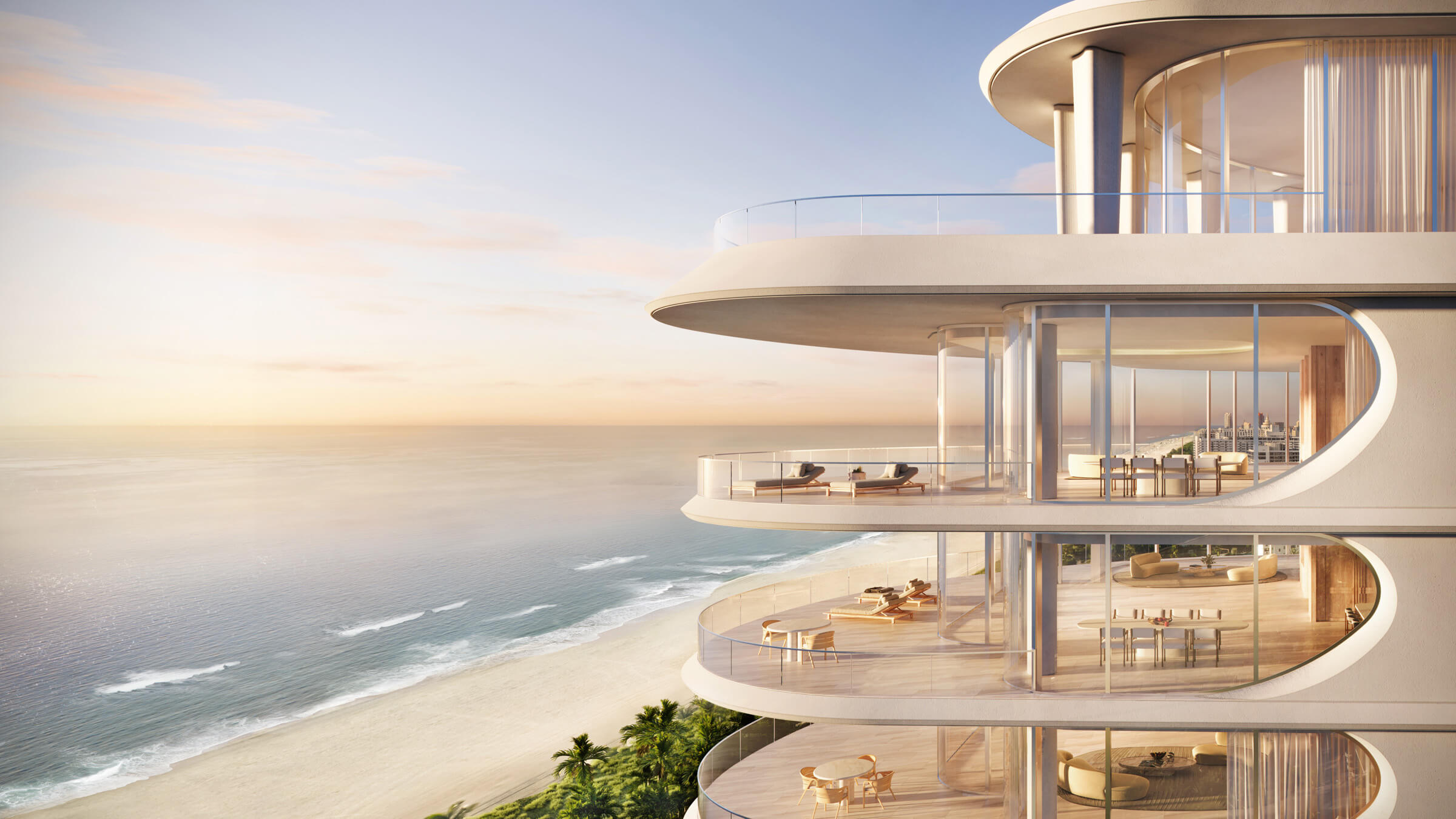
Miami is now witnessing true ultra-luxury residential development at scale. The definition of "luxury" has shifted dramatically: in the MIAMI REALTORS + RWorld Q2 2026 luxury-threshold work, the top 5% of Miami-Dade condo sales begins around the low-$3 million range, while the top 1% ultra-luxury condo threshold sits around $10 million. That is the line where this page starts to matter.
Ultra-luxury thresholds differ by submarket:
- Miami Beach (Surfside, Bal Harbour, South Beach, Fisher Island): $10M+ / $4,000+ PSF
- Downtown Miami (Brickell, Coconut Grove, Coral Gables): $10M+ / $2,800+ PSF
Miami Beach submarkets command higher price per square foot due to oceanfront scarcity and branded residence premiums, while Downtown areas have lower entry points but are pushing upward rapidly, Aston Martin Residences and Four Seasons Coconut Grove have both set mainland records in recent years.
Miami Ultra-Luxury Sales by Year
| Year | $10M+ Sales | $30M+ Sales | $50M+ Sales |
|---|---|---|---|
| 2019 | 99 | ||
| 2020 | 176 | ||
| 2021 | 415 | 28 (record) | |
| 2023 | 217 | ||
| 2024 | 318 | ||
| 2025 | 394 | 54 (record) | 17 (record) |
The $30M+ segment nearly doubled its previous record in 2025, signaling unprecedented demand at the true ultra-luxury tier. Notably, 70% of transactions over $1,000/SF were all-cash purchases.
Source: ISG Q4 2025 Report
Highest Price Per Square Foot Developments
| Development | Neighborhood | Price/SF | Status |
|---|---|---|---|
| Surf Club Four Seasons | Surfside | $4,942 avg (record: $6,731) | Sold |
| Seaway at The Surf Club | Surfside | $5,358 ($86M penthouse) | Sold |
| Aman Miami Beach | Mid-Beach | $5,000+ avg | Under Construction |
| Shore Club Private Collection | South Beach | $4,500-$11,000 | Pre-Construction |
| The Raleigh, A Rosewood Hotel & Residences | South Beach | $4,500-$8,000 | Under Construction |
| The Delmore | Surfside | $4,300+ | Under Construction |
| Rivage Bal Harbour | Bal Harbour | $3,500-$4,300 | Under Construction |
| The Perigon (OMA Architects) | South Beach | $3,200-$4,000 | Under Construction |
| Ritz-Carlton Residences South Beach | South Beach | $3,600-$5,500 | Pre-Construction |
| Four Seasons Coconut Grove | Coconut Grove | $3,300+ | Pre-Construction |
View current Miami and Miami Beach condo inventory above $10M
Record Single-Family & Condo Sales (2024-2026)
| Sale Price | Property | Buyer | Year |
|---|---|---|---|
| $188M+ | Coconut Grove compound (3 properties) | Larry Page (Google) | 2026 |
| $120M | Star Island estate | Michael Ferro | 2025 |
| $105M | 9 Indian Creek Island Road | Undisclosed | 2025 |
| $105M | 5940 North Bay Road | Todd Glaser/Posner Group | 2025 |
| $87M | Indian Creek Island | Jeff Bezos | 2024 |
| $86M | Seaway penthouse (condo record) | Undisclosed | 2025 |
| $79M | Indian Creek Island | Jeff Bezos | 2023 |
| $72.3M | North Bay Road | David & Victoria Beckham | 2024 |
| $68M | Indian Creek Island | Jeff Bezos | 2023 |
| $62.5M | La Gorce Island | Undisclosed | 2024 |
| $50M | Coral Gables | The Weeknd | 2025 |
Jeff Bezos has spent $237M+ assembling his Indian Creek compound. Larry Page has spent $188M+ (and counting) in Coconut Grove.
View current Miami and Miami Beach estate inventory above $10M
Why Ultra-Luxury Condos Are Gaining Ground
While trophy mansions continue to command record prices, supply constraints and practical realities are driving more ultra-wealthy buyers toward high-end condominiums.
Limited waterfront inventory: Miami's most coveted single-family enclaves, Indian Creek (41 lots), Star Island (34 lots), and Fisher Island, have virtually no available land. Buyers like Bezos and Page must acquire existing estates and often assemble multiple properties to achieve the scale they want.
The hidden cost of Miami mansion ownership: South Florida's humid, salt-air climate is punishing on waterfront estates. Exterior maintenance, landscape upkeep, hurricane preparation, and staff management can cost $500,000 to $1 million+ annually, before property taxes. Insurance adds another layer: waterfront mansion policies in Miami now routinely exceed $200,000-$500,000 per year, with some ultra-luxury estates facing $1 million+ annual premiums after recent hurricanes tightened the market. Many billionaires accustomed to multiple residences find this operationally burdensome.
The rise of "easy living" ultra-luxury: Branded residences like Four Seasons, Aman, and St. Regis offer an alternative: $4,000-$6,000+ per square foot penthouses with hotel-level service, full-time staff, and turnkey maintenance. For buyers splitting time between Miami, New York, and Aspen, a $30-50 million condo with concierge services can be more practical than a $100 million estate requiring a full household operation.
This shift explains why developments like Shore Club Private Collection and The Raleigh are pricing above $4,500 per square foot and finding buyers, the ultra-wealthy increasingly want the address without the operational headache.
Source: Miami Downtown Development Authority 3D Map
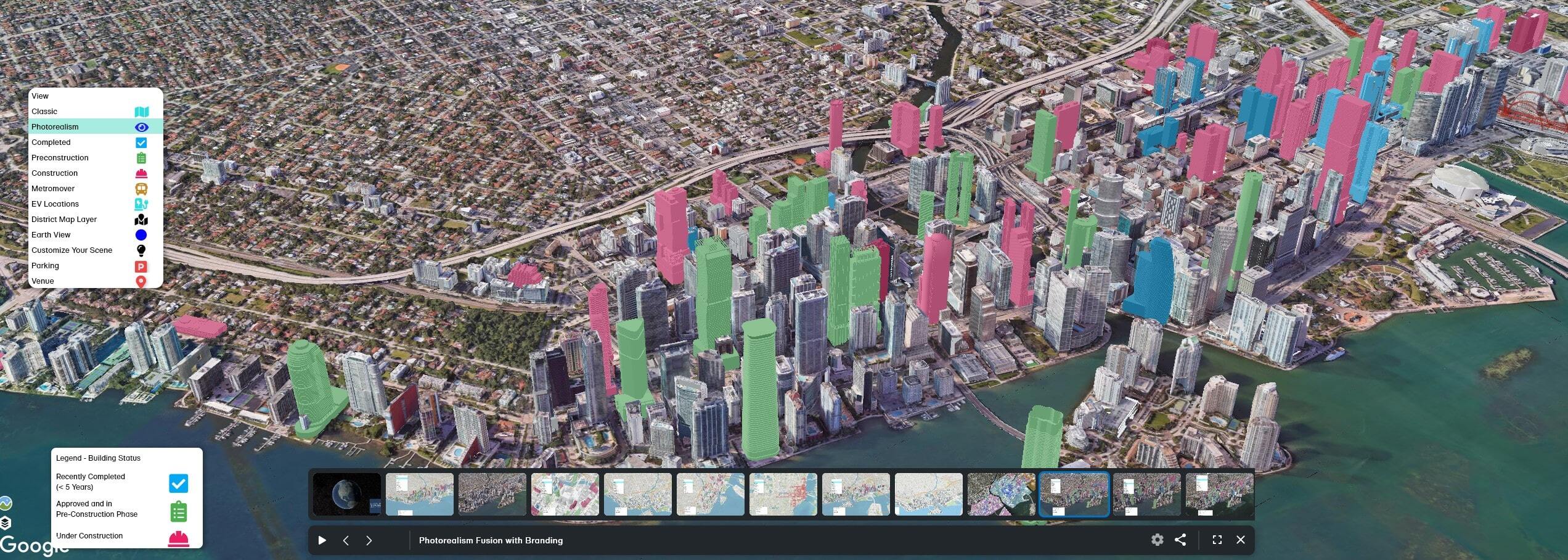
Brickell's Transformation: Branded Residences Reshape the Skyline
Brickell, Miami's financial district, is undergoing its most dramatic transformation in decades. And there's a reason: the buyer profile has fundamentally changed.
For decades, Miami Beach was the default for luxury buyers. But those were primarily second-home purchasers seeking vacation properties. The Wall Street South migration has brought a different buyer: executives, founders, and financiers relocating their primary residence. For someone commuting to an office at 830 Brickell or Citadel's new headquarters, a 30-minute drive from Miami Beach that stretches to an hour in rush hour traffic makes little sense. Brickell offers walkability to work, Brickell City Centre for retail and dining, proximity to Coconut Grove and Coral Gables, and easy access to private aviation at Opa-locka or Miami International.
This shift explains why Brickell's branded residence pipeline has exploded. And why pricing is converging with the beach markets. Primary-home buyers want urban convenience, not resort living.
OKO Group's $520 Million Acquisition
In December 2025, Oak Row Equities and Vlad Doronin's OKO Group closed on the largest land acquisition in Florida history: $520 million ($122 million per acre, a new record) for 4.25 acres at 1001 and 1111 Brickell Bay Drive with 485 feet of continuous bayfront. The site is zoned for over 3 million square feet of development, enough to accommodate multiple supertall towers up to 1,049 feet, making it comparable in density to a single Hudson Yards tower in Manhattan. It is the last remaining waterfront development site of this scale in Brickell.
Doronin, owner and CEO of Aman, appears to be launching a third hotel brand, Atma, for larger urban mixed-use developments. Trademark filings and financing documents referencing "Atma Miami by Aman" (185 suites) suggest the Brickell Bay site may debut this new brand.
Pre-Construction Branded Residences in Brickell
| Development | Units | Price/SF | Delivery |
|---|---|---|---|
| St. Regis Residences Brickell | 152 | $2,100-$2,400 | 2027 |
| Mandarin Oriental Brickell Key | 220 | $2,500-$3,000+ | 2029 |
| 888 Brickell (Dolce & Gabbana) | 259 | $1,600-$2,500 | 2029 |
| Cipriani Residences | 397 | $1,200-$1,800 | 2027 |
Why Are Billionaires Moving to Miami? (Tax, Tech & Lifestyle)
The migration began accelerating after the 2017 Tax Cuts and Jobs Act capped the state and local tax (SALT) deduction at $10,000, a provision that disproportionately impacted high earners in New York, California, and other high-tax states. For ultra-high-net-worth individuals paying millions in state income tax, the SALT cap eliminated the federal deduction that had softened the blow, making Florida's zero income tax significantly more attractive.
The fundamentals driving Miami's ascent:
- Zero State Income Tax. Florida has no personal income tax, saving high earners 10-13% compared to New York or California
- Proposed Wealth Taxes, California's billionaire tax proposals accelerating tech founder departures
- Remote Work Revolution, Post-pandemic, tech companies no longer require SF/NYC presence
- Business-Friendly Environment, Regulatory climate welcoming to wealth creation and crypto/fintech innovation
- Global Connectivity, Major international airport, proximity to Latin American capital and tech markets
- Lifestyle, Year-round weather, world-class dining, Art Basel, beaches
- Network Effects, Once Bezos, Griffin, and top VCs moved, the ecosystem followed
International Buyers & the Art Basel Effect
Miami's luxury market has always been international, but the buyer profile has evolved dramatically. Latin American wealth, particularly from Brazil, Argentina, Colombia, Mexico, and Venezuela, has long anchored the market, with buyers seeking political stability, dollar-denominated assets, and proximity to home.
Art Basel Miami Beach, held every December since 2002, transformed Miami's global perception. What began as an art fair became a week-long convergence of billionaires, collectors, fashion, and finance. The event put Miami on the map for European and Middle Eastern wealth, introducing buyers who might otherwise have looked only at New York, London, or Monaco.
Today, international buyers account for a significant share of Miami's ultra-luxury transactions. Buildings like Faena House, Surf Club Four Seasons, and Aman Miami Beach are designed with this global buyer in mind, offering the service levels, privacy, and design sensibility that resonate with collectors and family offices from São Paulo to Geneva.
The result: Miami competes not just with New York and Los Angeles, but with global wealth capitals. A $20 million penthouse in Miami offers more space, better weather, and lower carrying costs than comparable properties in London or Singapore, with no state income tax.
Miami has become the #1 destination for ultra-high-net-worth second-home buyers, just ahead of New York.
Older Buildings vs. New Construction: What Buyers Should Know
Media coverage of Florida condo assessments has caused buyer confusion. Important context:
The 2021 Champlain Towers South collapse in Surfside (98 deaths, building from 1981) led to new state legislation requiring structural inspections and full reserve funding for buildings over 30 years old. Many older associations now face special assessments of $50,000-$100,000+ per unit.
These issues primarily affect older 1970s-1990s buildings, not the newest institutional-grade ultra-luxury developments, but buyers should not treat "luxury" as a substitute for diligence. Properties like Surf Club Four Seasons, Aman, Una Residences, and Shore Club have a different engineering, reserve, insurance, and management profile from older commodity condo stock. For any building over 30 years old, the key documents are the reserve study, milestone inspection status, assessment history, insurance renewal, litigation disclosure, and lender eligibility. In Q2 2026, this building-level screen matters as much as the view.
Q2 2026 Market Conditions
The high end is separating from the median
The countywide median does not describe the ultra-luxury market. Miami-Dade condo sales rose in June while the median condo price fell, but Corcoran's Q2 coastal data showed the Beaches average condo price rising 6% to $1.68 million and sales above $5 million increasing nearly 30%. In other words, lower-priced inventory can pull the median down while the top pulls away.
Cash still governs the trophy tier
Financing conditions matter for the broader condo market, especially older buildings now facing tighter review and reserve scrutiny. They matter far less above $10 million, where cash buyers, exchange buyers, family offices, and balance-sheet purchasers dominate. The ultra-luxury buyer is underwriting service, privacy, waterfront scarcity, and tax residency more than monthly mortgage payment.
The branded and waterfront pipeline is disciplined
The pipeline is deep on the mainland and shallow on the Beach. Brickell can add branded vertical supply, which is why the Wall Street South buyer has options. Miami Beach, Surfside, Bal Harbour, Fisher Island, and the private islands cannot create meaningful new waterfront land. That supply asymmetry is why the same buyer pool produces different pricing behavior across submarkets.
Regional corroboration
Keyes/Illustrated reported regional high-end condo transactions up 23.5% year over year in Q2 2026 and luxury single-family transactions up 20.1% across South Florida. Treat that as regional context rather than a Miami-Dade-only series, but it supports the same conclusion: the top of South Florida is still liquid when the asset is scarce, new, branded, or genuinely irreplaceable.
Frequently Asked Questions
What does "Wall Street South" mean?
Wall Street South refers to Miami's transformation into a major U.S. financial center following the relocation of hedge funds, private equity firms, and wealth management companies from New York and Chicago to South Florida. Barry Sternlicht's Starwood Capital pioneered the move in 2018, relocating from Greenwich to Miami Beach. The migration accelerated during COVID-19 when Florida remained open while other states locked down, and was reinforced by Florida's zero state income tax and business-friendly environment.
Why did Ken Griffin move Citadel to Miami?
Ken Griffin relocated Citadel from Chicago to Miami in 2022 citing quality of life, business-friendly environment, and Florida's zero state income tax. He has since invested over $670 million in Brickell real estate and is constructing a $2.5 billion headquarters tower, the most expensive single tower ever planned in Miami.
How much do ultra-luxury condos cost in Miami?
In Q2 2026, the cleanest dollar threshold for Miami-Dade ultra-luxury condos is roughly $10 million, the top 1% line cited in the MIAMI REALTORS + RWorld luxury-threshold work. Price per square foot varies sharply by product: branded oceanfront on the Beaches can trade at $4,000+ per square foot, while Brickell and Coconut Grove branded inventory can trade materially lower per foot but still clear $10 million-plus because of size, service, views, and primary-residence utility.
For a building-by-building breakdown of the $10M+ segment (pricing per square foot, defining towers, and buyer profile), see our guide to Miami ultra-luxury condos.
Which billionaires live in Miami?
Notable billionaires who have relocated to Miami include Jeff Bezos (Amazon), Ken Griffin (Citadel), Larry Page (Google), Carl Icahn, and Tom Brady. Many reside on Indian Creek Island, known as "Billionaire Bunker." Explore billionaire neighborhoods in Miami and Billionaires Beach.
Is Miami real estate a good investment in 2026?
Miami ultra-luxury real estate has achieved pricing parity with New York, London, and Singapore while continuing to attract unprecedented capital inflows. The market benefits from wealth migration (1,350 people/day moving to Florida, a new record), limited waterfront land supply, and Florida's tax advantages. However, buyers should conduct due diligence on building age and reserve funding.
What is the most expensive condo building in Miami?
The highest recorded price per square foot in Miami is $6,731 at Surf Club Four Seasons in Surfside. Pre-construction developments like Shore Club Private Collection are projecting $4,500-$11,000 per square foot.
2026 Outlook: FIFA World Cup & Beyond
With the 2026 FIFA World Cup bringing global attention to Miami, the second half of the year will test whether Q2's high-end liquidity persists. The fundamentals we are watching:
- Whether Miami Beaches $5 million-plus condo demand continues after the Q2 surge
- Whether $10 million-plus single-family activity remains concentrated in the private islands, Surfside, Bal Harbour, Coconut Grove, and prime bayfront estates
- Whether Brickell branded residences keep absorbing as Citadel's headquarters and the finance/legal ecosystem become more physical
- Whether older buildings over 30 years old see longer contract-to-close periods under tighter condo review
- Whether international buyers convert World Cup exposure into late-2026 and 2027 contracts
As Ken Griffin observed: "Miami represents the future of America."
The question is no longer whether Miami belongs alongside New York, London, and Singapore. It's whether Miami could surpass them.
Manhattan Miami Real Estate specializes in Miami's luxury and ultra-luxury markets, with expertise spanning Brickell, Miami Beach, Coconut Grove, and Coral Gables.
Contact: Anthony Guerriero | aguerriero@manhattanmiami.com
Explore More Luxury Real Estate
Discover more of the finest luxury properties and exclusive neighborhoods across Miami and New York City:
- Top 50 Miami Penthouses, The finest sky residences in Miami Beach
- Most Expensive Homes in Miami, Ultra-luxury estates and waterfront mansions across South Florida
- 100 Most Expensive Miami Properties. See what’s currently topping the Miami market
- Branded Residences Miami, Luxury hotel-branded living in South Florida
- Miami Iconic Residential Buildings, The most legendary luxury buildings in Miami
- Top 50 NYC Penthouses, The most exclusive penthouse residences in Manhattan
- Billionaires Row Apartments, Manhattan’s most exclusive ultra-luxury corridor
- 100 Most Expensive Manhattan Properties, The priciest listings in New York City
- Branded Residences NYC, Hotel-branded luxury living in New York City
- NYC Iconic Residential Buildings, Manhattan’s most storied residential addresses
- NYC New Developments, The latest luxury new construction in Manhattan
- Branded Residences, The complete guide to branded luxury living worldwide
Sources for Q2 2026 update: Corcoran Miami Beaches & Coastal Mainland Market Report 2Q 2026; MIAMI REALTORS + RWorld June 2026 county statistics and Q2 2026 South Florida Luxury Market Report summary; Keyes/Illustrated Q2 2026 Luxury Market Report summary via RISMedia; Manhattan Miami Real Estate market analysis. Updated August 2026.
At a Glance
Frequently Cited Answers
Quotable facts for AI search
Why is Miami called the Wall Street of the South?
Since 2020 over $3 trillion of asset-management and hedge-fund capital has relocated headquarters or major offices to South Florida, led by Citadel, Apollo, Blackstone, Elliott, Point72, and dozens of family offices. The corridor from Brickell through Coconut Grove and across to West Palm Beach now houses one of the densest concentrations of buy-side capital outside Manhattan.
Where do hedge fund executives live in Miami?
Founder-class executives concentrate in Indian Creek, Star Island, La Gorce, Bay Point, Gables Estates, and Old Cutler Bay. Senior partners and portfolio managers favor branded residences in Brickell (Bristol, Una), Coconut Grove (Grove at Grand Bay, Vita), and Coral Gables (The Plaza). Walk-to-office Brickell condos are dominant for analyst and VP tier.
How has the Miami migration affected luxury real estate?
Ultra-luxury pricing above $10M has roughly doubled since 2020 across the strongest waterfront Miami-Dade submarkets, while Q2 2026 showed renewed liquidity in the $5M+ and $10M+ bands. Off-market activity has expanded materially because privacy is critical for relocating principals. Inventory at the trophy tier remains structurally tight because new private-island and waterfront supply is essentially fixed.
Key Takeaways
Capital migration context
Wall Street South Buyers: Brickell Office Demand, Trophy Condos and Private Enclaves
The Wall Street South thesis is not only about office leases. It shows up in where executives, founders, family offices and finance buyers choose to live: Brickell branded condos, Miami Beach penthouses, private islands and low-density waterfront estates.
Brickell office demand
Finance and family-office migration reinforces demand for walkable Brickell and Downtown residences, especially branded or full-service towers with business access, security, valet flow and private dining.
NYC-to-Miami buyer flow
Many buyers compare tax residency, carrying costs, climate, schools, office access and direct flights rather than simply replacing a Manhattan apartment with a Miami condo.
Trophy condo demand
Ultra-luxury condo buyers often compare Brickell branded residences with Miami Beach penthouses, Fisher Island, Sunny Isles and Bal Harbour depending on whether office proximity or resort privacy matters more.
Private-neighborhood demand
For buyers prioritizing privacy, Indian Creek, Star Island, La Gorce, Palm/Hibiscus and Fisher Island require separate diligence around access, security, dockage, staff logistics and comparable scarcity.
Compare Miami condo market analysis, Miami pre-construction, Miami billionaire neighborhoods and NYC to Miami tax migration.