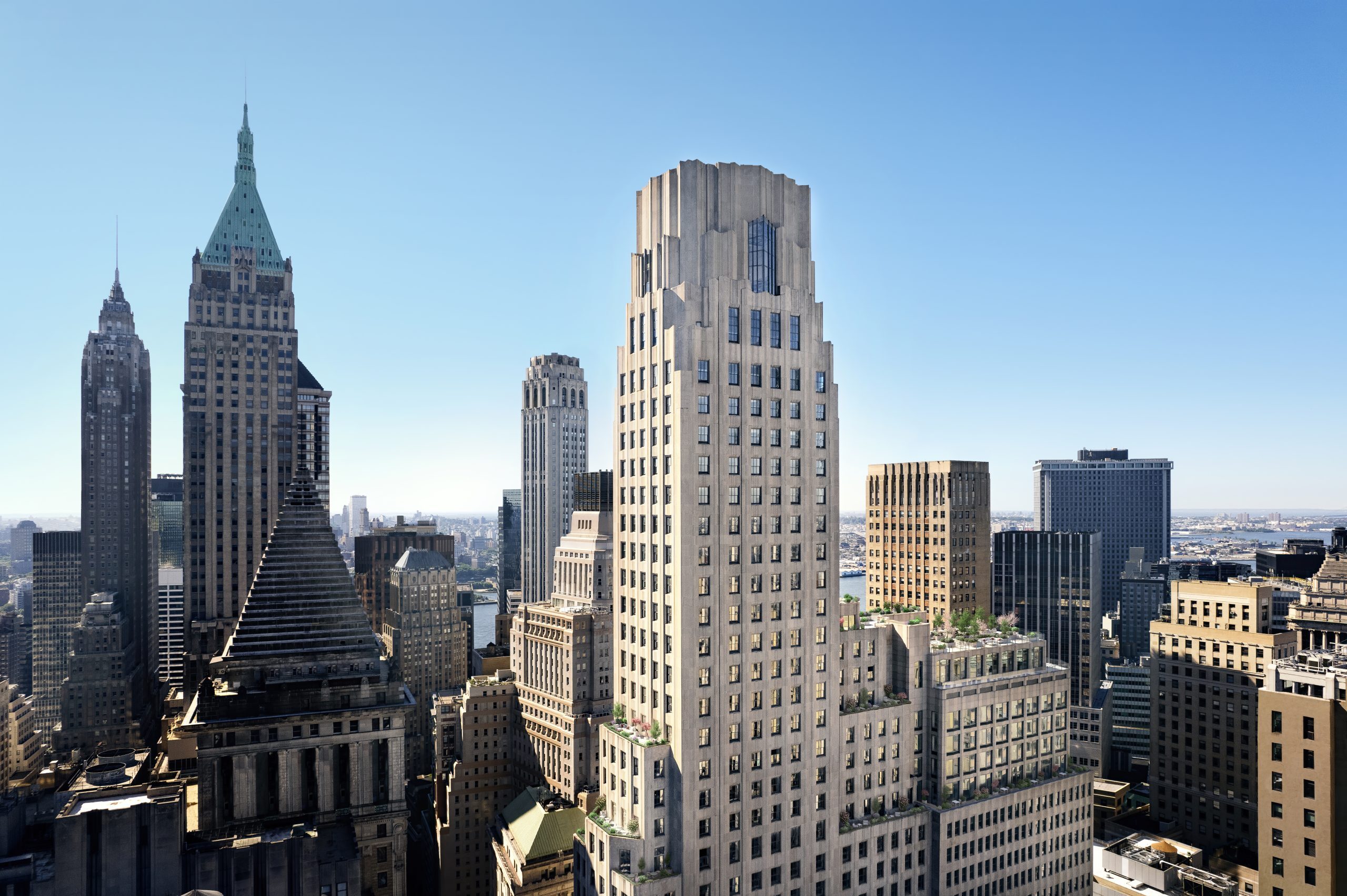
MANHATTAN NEIGHBORHOOD GUIDE
Financial District Apartments for Sale
Historic office conversions, amenity-rich condominiums and new towers at Manhattan's transit-connected southern tip.
By Anthony Guerriero, Manhattan Miami Real Estate | Updated August 2026
The Financial District is Lower Manhattan's most building-led residential market. Art Deco bank buildings, office-to-residential conversions and modern towers can sit within a few blocks of one another yet offer very different light, ceiling height, floor-plan efficiency and service. Buyers are often attracted by condominium ownership and value relative to Tribeca, but the correct comparison is building to building.
Financial District Real Estate Map
This map follows the Downtown Alliance street perimeter from the Battery and South Street north through the Wall Street, World Trade Center, and Beekman corridors. Battery Park City and most of the Seaport sit outside the outlined district.
Map focus: Eight benchmark condominium towers and landmark conversions across Financial District submarkets.
Financial District, At a Glance
- Boundaries: Battery Park to Vesey / Park Row / Frankfort; East River waterfront to the east; West Street / Hudson River edge to the west
- ZIP Codes: 10005, 10006, 10007, 10038
- Inventory Profile: Large-scale condo towers, office-to-residential conversions, luxury new development
- Entry Point: ~$650K-$1.2M (studio / 1BR condo)
- Premium Range: $2.5M-$5M (2-3BR condo in flagship tower)
- Trophy Tier: $5M-$25M+ (penthouse / full-floor residences)
- Transit: 2/3/4/5/A/C/J/Z/R/W/1 + PATH to NJ
- Anchors: World Trade Center, Battery Park, South Street Seaport
Financial District Market Overview
The Financial District condo market is shaped by two forces: a sustained pipeline of office-to-residential conversions and a concentrated wave of ground-up luxury development completed between 2019 and 2024. The result is a neighborhood where the majority of residential inventory is condominium (not co-op), making it one of Manhattan’s most accessible markets for international buyers, LLC purchasers, and pied-à-terre seekers.
Pricing remains at a structural discount to Tribeca, typically 30-40% lower on a per-square-foot basis for comparable product quality. This gap reflects Tribeca’s established luxury brand and low-rise streetscape premium, but it also creates an opportunity window for buyers prioritizing value per square foot and full-service amenity depth.
The new development wave (130 William, One Wall Street, 125 Greenwich, 77 Greenwich, 50 West) delivered over 1,300 units of institutional-quality product. Sponsor inventory absorption has been steady; resale liquidity in these buildings is now beginning to establish comps.
World Trade Center proximity commands a measurable premium on the western edge of the district. The combination of the Oculus transit hub, Brookfield Place retail, and the memorial campus creates an anchor amenity cluster that supports pricing resilience in adjacent towers.
Financial District Price Ranges (2026)
| Tier | Configuration | Price Range | Notes |
|---|---|---|---|
| Entry | Studio / 1BR | $650K-$1.2M | Older conversions, smaller floorplans |
| Core | 1-2BR condo | $1.2M-$2.5M | Flagship towers, strong amenity programs |
| Premium | 2-3BR | $2.5M-$5M | High-floor, protected views, corner units |
| Trophy | Penthouse / Full-floor | $5M-$25M+ | 130 William, One Wall Street upper floors |
Notable Financial District Buildings
| Building | Type | Year | Units | Positioning |
|---|---|---|---|---|
| 130 William | New Development | 2021 | 244 | Adjmi sculptural terra-cotta; high-floor harbor views |
| One Wall Street | Historic Conversion | 2023 | 566 | Art Deco landmark; Macklowe; largest downtown conversion |
| 50 West | New Development | 2019 | 191 | Time Equities; harbor/Statue views; pool deck |
| 125 Greenwich | New Development | 2022 | 273 | Rafael Viñoly; direct WTC adjacency |
| 77 Greenwich | New Development | 2022 | 90 | FXCollaborative; boutique scale in a tower market |
| 15 William | Historic Conversion | 2011 | 43 | Intimate loft-style; Beaux-Arts shell |
| 20 Pine | Historic Conversion | 2009 | 408 | Armani/Casa interiors; large-scale early conversion |
| The Beekman | Historic Conversion | 2017 | 68 | Thompson Hotel residences; 9-story atrium |
Financial District Lifestyle & Character
The Financial District offers a residential experience defined by vertical scale, deep transit connectivity, and proximity to the waterfront. The neighborhood’s transformation from a purely commercial district into a mixed-use residential market accelerated after 9/11 and received a second wave of investment through 2018-2024 new development and conversion activity.
Residents benefit from the densest subway coverage in Lower Manhattan (11+ subway lines plus PATH), direct access to Battery Park and the Hudson River Greenway, and walkable proximity to the Seaport District’s dining and retail. The World Trade Center campus anchors the western edge, with Brookfield Place, Eataly Downtown, and the Oculus transit hall providing day-to-day amenity.
Architecture ranges from Art Deco bank buildings (One Wall Street, 20 Pine) to contemporary glass towers (50 West, 130 William). The contrast between historic masonry facades and modern curtain-wall construction gives the neighborhood a textural density uncommon elsewhere in Manhattan.
Financial District vs Adjacent Markets
| Factor | Financial District | Tribeca | Battery Park City | Seaport |
|---|---|---|---|---|
| Dominant Stock | Condo towers + conversions | Loft condos + boutique new dev | Condo towers (planned community) | Mixed-use, limited residential |
| Price / SF (typical) | $1,400-$2,200 | $2,000-$3,500 | $1,300-$1,900 | $1,500-$2,400 |
| Character | Vertical, transit-dense, WTC adjacency | Low-rise, cobblestone, restaurant-centric | Waterfront parks, family-oriented | Historic district, mixed retail |
| Transit Depth | Deepest in Lower Manhattan | Moderate (1/2/3/A/C/E) | Moderate (R/W/1/2/3) | Limited (2/3/4/5/J/Z) |
| International Buyer Access | High (condo-dominant) | Moderate (some co-op) | High (all-condo) | Moderate |
The listings below reflect currently available Financial District apartments for sale, including condominiums and luxury conversions. Inventory varies by building vintage and micro-location.
A broker's view of the Financial District
FiDi is an apartment market built from reinvention
The Financial District's narrow, canyon-like streets and former banking buildings create apartments unlike those in a conventional residential neighborhood. Some conversions deliver high ceilings and substantial amenities; others inherit deep floor plates, limited light or unusual window placement from their commercial past. The exterior pedigree of a building does not guarantee an efficient residence inside it.
The district has also become much more residential after business hours. The World Trade Center campus, Brookfield Place, the Oculus, Battery Park and the Seaport provide daily amenities and waterfront access, while the concentration of subway lines and PATH service is difficult to match elsewhere downtown.
Financial District condos for sale
FiDi is predominantly a condominium market, which can suit international, investor and pied-a-terre buyers seeking ownership flexibility. Building rules still vary. Sublet policy, entity ownership, short-term leasing restrictions, taxes, common charges and the percentage of investor-owned units should be reviewed before an offer.
Historic conversions vs. new-development towers
One Wall Street, 20 Pine and other conversions offer architectural character and central locations. Newer towers such as 130 William, 50 West and 125 Greenwich emphasize views, services and modern amenity programs. Buyers should compare usable light, ceiling height, elevator capacity, amenity crowding, staffing costs and apartment-line efficiency rather than relying on building age.
Apartments near Wall Street and the World Trade Center
Wall Street and New York Stock Exchange proximity favors the historic core, while World Trade Center adjacency improves access to the Oculus, PATH and Brookfield Place. Harbor and Statue of Liberty views are strongest from specific southern and western exposures; view corridors should be tested against existing and proposed construction.
Financial District vs. Tribeca, Battery Park City and Seaport
FiDi owns the office-conversion and tower market around Wall Street and the World Trade Center. Tribeca owns the loft and low-rise luxury market to the north; Battery Park City is a planned waterfront community; the Seaport has its own historic and East River character. Those distinctions should remain explicit in links and inventory.
Request a Financial District building shortlist
Tell us your preferred exposure, amenity level, ownership use and budget. We will compare conversions and new towers by light, floor plan, carrying costs, building rules and resale fit.
- Conversion vs. new tower
- Light, view and floor plan
- Taxes, charges and rental rules