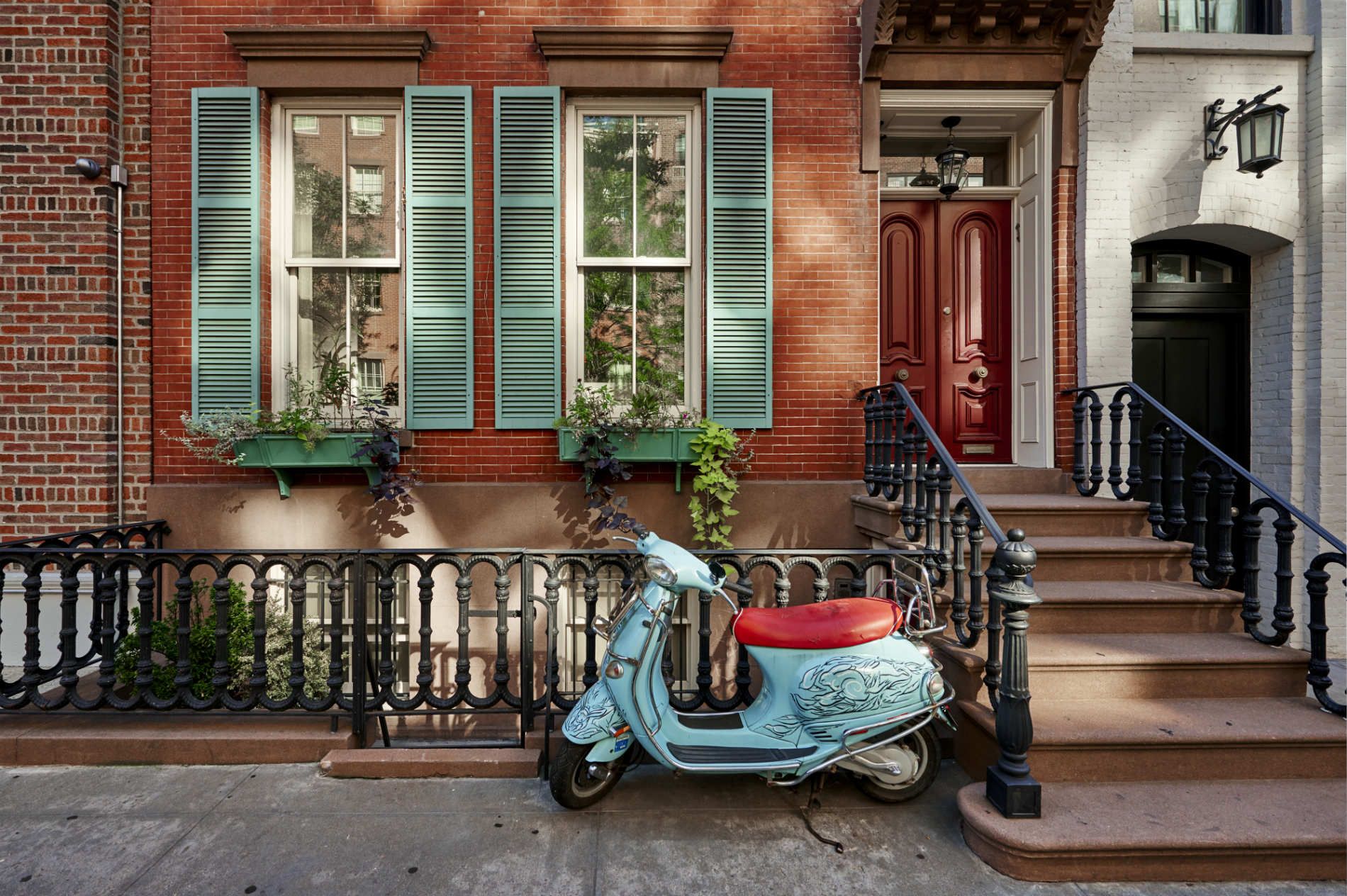
Townhouses and brownstones
The neighborhood's most scarce product. Inspect structure, roof, facade, mechanical systems, landmark constraints, unused development rights and the true cost of renovation.
MANHATTAN NEIGHBORHOOD GUIDE
Townhouses, boutique condos, co-ops and scarce waterfront residences across one of Manhattan's most tightly held downtown neighborhoods.
By Anthony Guerriero, Manhattan Miami Real Estate | Updated August 2026
West Village apartments for sale in NYC are defined by scarcity and variety: Federal-era townhouses, prewar co-ops, boutique condominium conversions and a limited group of full-service waterfront buildings. The market cannot be understood through a single median because a townhouse, a walk-up co-op and a new condominium solve very different buyer needs.
The West Village runs from West Houston Street to West 14th Street, between Sixth Avenue and the West Side Highway.
Current inventory
The live Lofty listing grid below is locked to the West Village subdivision and for-sale inventory. Review current public townhouse, co-op and condominium availability without starting a broad Manhattan search, then request an address-level match for private, coming-soon and building-specific opportunities.
Neighborhood decision guide
West Village apartments for sale are defined by scarcity and variety: Federal-era townhouses, prewar co-ops, boutique condominium conversions and a limited group of full-service waterfront buildings. The market cannot be understood through a single median because a townhouse, a walk-up co-op and a new condominium solve very different buyer needs.
West of Sixth Avenue, the neighborhood shifts from the Washington Square and Lower Fifth character of Greenwich Village toward townhouse streets, the Hudson River and a smaller pool of modern waterfront residences. That distinction matters when comparing inventory and daily life.
Related buyer paths
Compare the West Village with Greenwich Village apartments, Chelsea apartments, Tribeca apartments and SoHo apartments. For broader inventory, review Manhattan apartments for sale, NYC condos for sale, Manhattan townhouses and NYC penthouses.
Property types and buyer fit
The neighborhood's most scarce product. Inspect structure, roof, facade, mechanical systems, landmark constraints, unused development rights and the true cost of renovation.
Often combine low resident counts with modern ownership flexibility. Compare staffing, reserves, elevator access and the premium attached to turnkey condition.
Can provide character and value relative to new condos, but board standards, sublet policy, pied-a-terre rules and renovation approvals vary materially.
Full-service buildings near the Hudson offer views and amenities uncommon in the historic core. Evaluate view protection, flood exposure, services and carrying costs.
| Area | Buyer perspective |
|---|---|
| Prime historic core | Tree-lined blocks around Bedford, Commerce and Grove emphasize townhouses, smaller co-ops and intimate scale. |
| Far West and waterfront | West Street and Hudson River-adjacent sites contain larger modern condominiums and the neighborhood's strongest amenity packages. |
| Meatpacking and northern edge | The northwest edge has more activity, contemporary conversions and immediate access to the High Line and Hudson River Park. |
These are representative benchmarks, not a complete inventory. Each building link owns its exact branded search intent.
A two-tower condominium on the Hudson River waterfront by Zeckendorf Development and Atlas Capital Group, with architecture by COOKFOX. It holds 112 residences and is by far the tallest of these five, the only high-rise among low- and mid-rise neighbors. It is under construction.
An 11-story building by Aurora Capital Associates, designed by Leroy Street Studio, and currently under construction. It is a boutique building of roughly a dozen residences.
A completed resale condominium on the Hudson River waterfront, developed by the Witkoff Group and designed by COOKFOX. It has 91 residences.
Completed in 2017 by Ian Schrager and the Witkoff Group, with 49 residences and architecture by Herzog & de Meuron, the Pritzker Prize-winning firm behind 56 Leonard.
The one address here that is not on the water. On the former St. Vincent's Hospital site at 155 West 11th Street, inland between Sixth and Seventh Avenues, it is a single condominium spread across five apartment buildings and five townhouses, 199 residences in all, developed by Rudin Management with Global Holdings and designed by FXCollaborative.
Buyer due diligence
Review structure, waterproofing, roof, facade, mechanicals, landmark approvals and renovation scope with qualified professionals before pricing cosmetic potential.
Board standards, sublet policy, renovation windows, common charges and reserve strength can change buyer fit even within the same block.
Use Sixth Avenue as the practical SEO and inventory boundary: West Village owns Hudson-side townhouse and waterfront intent; Greenwich Village owns Washington Square and Lower Fifth Avenue intent.
| Market | How it differs |
|---|---|
| Greenwich Village | Centers on Washington Square, Lower Fifth and University Place east of Sixth Avenue, with a broader academic and commercial context. |
| Tribeca | Offers larger loft-scale layouts and a deeper modern-condo tier; the West Village emphasizes townhouses, prewar co-ops and lower-rise blocks. |
| SoHo | Offers cast-iron loft scale and stronger retail energy; the West Village is more residential and townhouse-led. |
| Chelsea | Has broader inventory and more high-rise new development; the West Village is lower-rise, landmark-sensitive and more supply constrained. |
Scarcity, streets and ownership
From Houston Street to 14th Street and Sixth Avenue to the Hudson River, the West Village combines an irregular street grid, historic townhouses, prewar apartment houses and former commercial buildings adapted for residential use. Greek Revival rowhouses, later Romanesque Revival buildings and tucked-away places such as Grove Court give the interior blocks a scale that feels markedly different from Manhattan's avenue grid. The neighborhood's literary history, associated with figures including Dylan Thomas, Allen Ginsberg and Jack Kerouac, remains part of its identity without determining the quality of any particular property.
The western edge tells a newer chapter. Perry, Charles, Leroy and West 12th Streets approach the Hudson River through a mix of protected historic fabric, converted industrial buildings and modern full-service condominiums. The best choice is not simply old versus new: it is whether a buyer values townhouse autonomy, co-op character, boutique-condo flexibility or waterfront services and views.
Bank and Bethune Streets offer a quiet western residential character; Charles, Perry and West 11th combine classic townhouse blocks with access toward the river; Bedford, Commerce and Grove contain some of the neighborhood's most intimate and irregular historic streets. Width, facade condition, light, rear exposure, adjacent construction and retail activity can change the experience within a single block.
The West Village combines persistent buyer demand with a housing stock that changes slowly. Much of the neighborhood is protected by historic-district rules, many buildings occupy small or irregular lots, and the most desirable townhouses and boutique apartments may trade infrequently. Landmark protection does not prevent every alteration or new project, but it can limit demolition, exterior changes and the pace at which materially new inventory reaches the market. Buyers should verify the status and rules for the specific address rather than assuming every Village property carries identical restrictions.
Are West Village apartments expensive? West Village homes commonly command a scarcity premium because buyers compete for a limited mix of historic townhouses, character co-ops, boutique condominiums and a small waterfront tier. Building condition, ownership rules, elevator access, outdoor space, renovation quality and the exact block can matter more than a neighborhood-wide average.
A West Village townhouse search should separate turnkey single-family homes from properties requiring structural, mechanical or landmark-sensitive work. Confirm the certificate of occupancy and legal use, then review the facade, roof, waterproofing, party walls, mechanical systems, floor-plate efficiency, stair configuration and any proposed elevator. Historic character can be valuable, but unresolved alterations or a major renovation can materially change the acquisition budget and timeline.
| Ownership | What buyers should compare |
|---|---|
| Prewar and elevator co-ops | Board financial standards, post-closing liquidity, financing limits, sublet and pied-a-terre policies, renovation windows, elevator access, reserves and planned capital work. |
| Boutique condos | Ownership flexibility, staffing, common charges, reserve depth, elevator and accessibility conditions, sponsor control and the premium attached to turnkey renovation. |
| Waterfront condos | View protection, flood exposure, amenity and staffing costs, garage or storage rights, privacy and the difference between river-facing and interior exposures. |
Requirements vary by building, but a complete board package commonly documents income, assets, liabilities, financing, tax returns, references and post-closing liquidity. Buyers should understand the building's stated financial standards before making an offer, prepare explanations for unusual income or asset structures, and leave sufficient time for managing-agent review and a possible interview. Approval is never guaranteed, and building counsel or the managing agent should confirm current requirements.
Classic residential blocks with townhouses, prewar apartments and strong demand for quiet, well-preserved frontage.
Intimate historic fabric, irregular street geometry and scarce townhouse or small-building inventory where condition drives value.
More immediate retail, dining and transportation access, with block-by-block differences in activity, light and noise.
Larger modern condominiums, Hudson River access and stronger amenity packages, generally with higher service and carrying costs.
The Christopher Street PATH station connects the neighborhood with Hoboken and Manhattan's Sixth Avenue corridor, while nearby subway service varies by the buyer's exact block. Hudson River Park provides a continuous waterfront route, and the neighborhood's irregular streets make walk time more address-specific than a simple avenue count suggests.
Many non-US and pied-a-terre buyers focus on condominium inventory because co-op financial, occupancy and sublet rules can be more restrictive. The appropriate ownership structure, financing approach, tax filings and estate plan should be confirmed with qualified advisers. See the international buyer guide before comparing building-specific rules.
Buyer questions
Inventory includes townhouses, prewar co-ops, boutique condos, loft-style conversions and a small number of full-service waterfront developments.
Yes. Public supply is usually limited, condition varies widely and many opportunities require patient address-level monitoring rather than a broad portal search.
For this site's search architecture, the West Village runs west of Sixth Avenue, while Greenwich Village centers on Washington Square, Lower Fifth Avenue and University Place.
Confirm alteration history, landmark approvals, facade work, window obligations, renovation rules and any building-level capital projects with appropriate professionals.
Private buyer advisory
Tell us whether you are prioritizing a townhouse, co-op, boutique condo or waterfront residence, along with preferred blocks and renovation tolerance. We will narrow the market and identify board, landmark, condition and carrying-cost issues before you spend time on the wrong properties.
Every engagement begins with a private discussion, objectives, timing, tax posture.
No obligation. Typically replied to within one business day.
Current asking prices and new listings the moment they hit the market.
Replies within one business day · buyers from 30+ countries
Use these building profiles to compare architecture, services, carrying costs, ownership rules and current residence inventory before narrowing the search to an individual apartment.