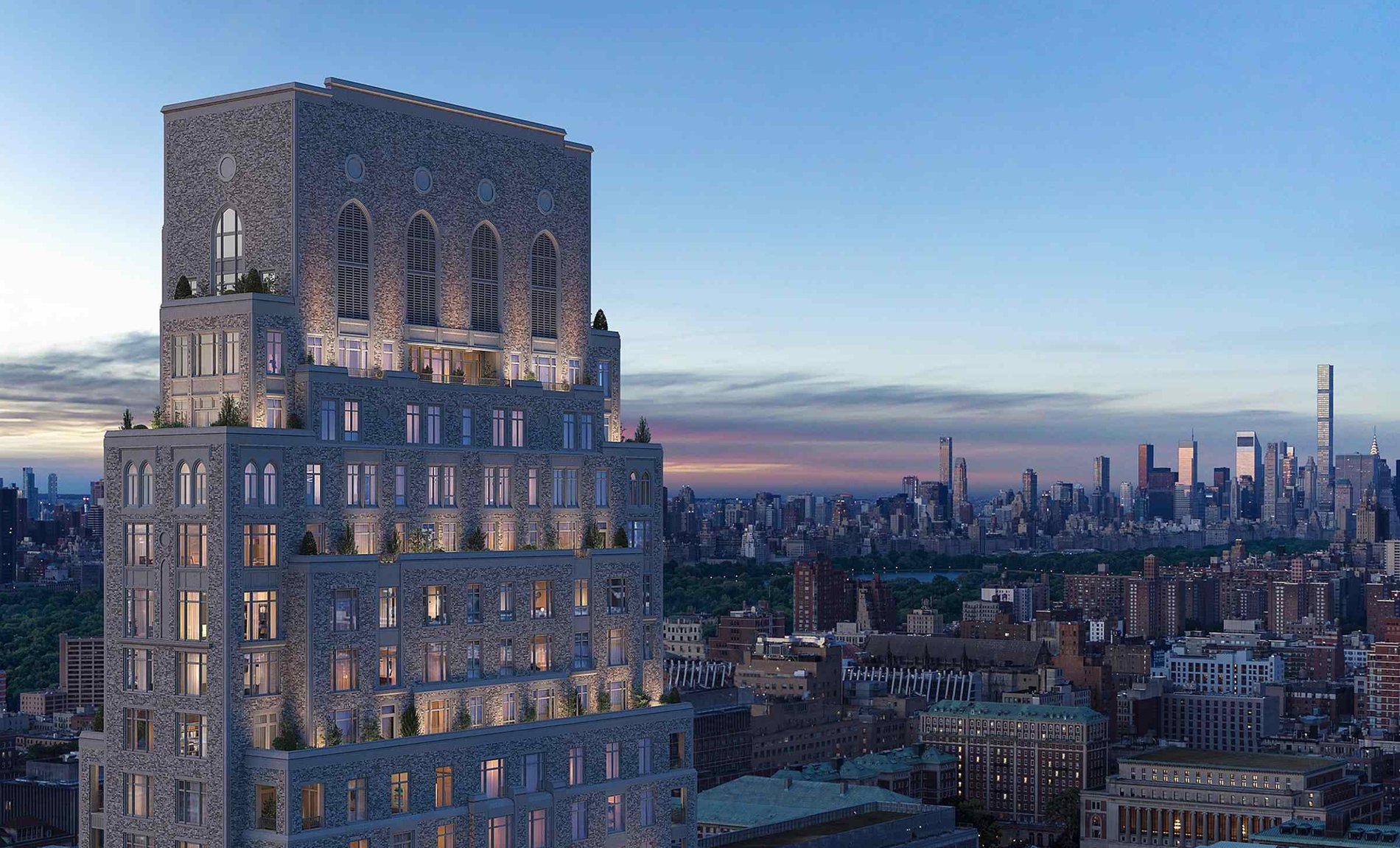
MANHATTAN NEIGHBORHOOD GUIDE
Upper West Side Apartments for Sale: Luxury Condos, Co-ops & Prewar Residences
Prewar co-ops, condominium towers and brownstone blocks between Central Park and the Hudson River.
By Anthony Guerriero, Manhattan Miami Real Estate | Updated August 2026
The Upper West Side is not one continuous apartment market. Central Park West is a prestige co-op corridor; Broadway and Amsterdam provide a broader mix of prewar and postwar buildings; the Riverside side adds quieter blocks, brownstones and newer condominiums near the Hudson. Buyers who understand those differences make better comparisons than buyers who begin with a neighborhood-wide average.
Upper West Side Real Estate Map
The Upper West Side runs from West 59th Street to West 110th Street, between Central Park West and the Hudson River / Riverside Park shoreline, with Lincoln Center, the AMNH, and Riverside Park as anchors.
Upper West Side Apartments for Sale
Browse current Upper West Side apartments for sale below. Inventory spans prewar co-ops on Central Park West, newer condominiums along Broadway and Amsterdam, brownstones on tree-lined side streets, and new-development residences at Waterline Square and 200 Amsterdam.
What Defines Upper West Side Apartments
Upper West Side apartments are defined by:
- Grand pre-war co-ops with classic layouts, high ceilings, and architectural detail
- Central Park West landmark buildings with some of Manhattan's most iconic addresses
- Riverside Drive residences with Hudson River views and a quieter residential character
- A neighborhood identity rooted in culture, education, and long-term residential stability
The Upper West Side is one of the few Manhattan neighborhoods where co-op living, cultural institutions, and family infrastructure coexist at scale.
Where to Buy on the Upper West Side
Central Park West
Manhattan's most prestigious residential avenue on the West Side. Landmark co-op buildings including The San Remo, The Eldorado, The Beresford, and The Majestic. Highest pricing and strongest long-term demand.
Broadway Corridor
More accessible pricing with a mix of co-ops, condominiums, and newer developments. Convenient access to retail, dining, and transportation. Growing appeal among younger families.
Riverside Drive
Quieter, more residential character with Hudson River views. Pre-war co-ops and brownstones with architectural significance. Strong value relative to Central Park West.
Columbus Avenue & Amsterdam Avenue
The neighborhood's commercial spine with a mix of building types. New developments like 50 West 66th Street and 200 Amsterdam are reshaping the luxury inventory.
Micro-location on the Upper West Side significantly impacts pricing, building type, and lifestyle. East-west position relative to Central Park and the Hudson River is the primary value driver.
Upper West Side for Families
- One of Manhattan's most established family neighborhoods with multi-generational appeal
- Proximity to top-tier public and private schools
- Direct access to Central Park, Riverside Park, and the American Museum of Natural History
- A residential infrastructure built around family life: pediatricians, bookstores, playgrounds, and community
Many families specifically target the Upper West Side for its combination of school access, park proximity, and a neighborhood culture that prioritizes residential living over commercial activity.
Condos vs Co-ops on the Upper West Side
- Co-ops: dominant building type, especially in landmark buildings. Stricter board approval but often better value and stronger building financials.
- Condos: growing supply through new developments. More flexible ownership structure, appealing to international buyers and those seeking modern amenities.
- Brownstones: limited but highly sought-after. Offer private outdoor space and architectural character unavailable in apartment buildings.
The choice between co-op, condo, and brownstone is one of the most important decisions for Upper West Side buyers, with each offering a fundamentally different ownership experience.
The buildings below represent some of the most sought-after properties in the neighborhood, often setting pricing benchmarks for the market.
Buying Strategy on the Upper West Side
Purchasing on the Upper West Side often involves:
- Navigating co-op board requirements, which vary significantly by building
- Evaluating the trade-off between pre-war character and modern amenities
- Choosing between Central Park proximity and better value on western blocks
For many buyers, the Upper West Side decision centers on whether to prioritize a landmark address with architectural prestige or a newer building with modern systems and amenities.
Buyers also evaluating the East Side may want to compare: Upper East Side Apartments for Sale
Notable High-End Upper West Side Apartments
Central Park West Classic — $19,500,000
4 bedrooms · pre-war co-op · 4,500+ sq ft
Grand residence in a landmark CPW building with direct park views, formal entertaining rooms, original architectural details, and white-glove service.
New Development Penthouse — $32,000,000
5 bedrooms · full-floor · 6,800+ sq ft
Top-floor residence in a recently completed luxury tower with 360-degree views of Central Park, the Hudson River, and the Manhattan skyline. Private terrace and museum-quality finishes.
Riverside Drive Brownstone — $8,250,000
5 bedrooms · 4 stories · private garden
Fully renovated townhouse with original millwork, private rear garden, Hudson River views from upper floors, and the rare combination of space and privacy on one of Manhattan's most scenic streets.
Availability at this level is limited and may include off-market opportunities.
International Buyers
This neighborhood attracts international buyers seeking primary residences or secondary homes in New York, particularly from Europe, Latin America, and Asia. Many buyers evaluate Manhattan real estate as a dollar-denominated store of value alongside lifestyle considerations.
International buyers can explore our Foreign Buyer's Guide to U.S. Real Estate for tax, legal, and ownership considerations.
Notable New Buildings in Upper West Side
The buildings below define the Upper West Side ultra-luxury and super-luxury market — the headline architectural assets, including starchitect-designed towers and trophy condominiums.
Notable Legacy Buildings in Upper West Side
Legacy and pre-war buildings that anchor the established Upper West Side ultra-luxury market. These properties trade infrequently and represent long-term ownership.
Work With a NYC & Miami Advisor
We advise buyers across New York City and Miami on property selection, building strategy, and cross-market planning.
REQUEST A PRIVATE ADVISORY CONSULTATION
Upper West Side Apartment FAQs
Are most Upper West Side apartments co-ops?
Yes. Co-ops represent the majority of residential inventory, particularly the most prestigious buildings on Central Park West and Riverside Drive. Condominiums are more common in newer developments along Broadway and Columbus Avenue.
What is the price per square foot on the Upper West Side?
Typically $1,200 to $3,500+ per square foot. Central Park West landmark buildings and new luxury developments command the highest pricing, while co-ops on interior blocks offer more accessible entry points.
Is the Upper West Side good for families?
Yes. The Upper West Side is consistently ranked among the best family neighborhoods in Manhattan, with access to top public and private schools, Central Park, Riverside Park, and a residential culture specifically oriented toward family life.
How does the Upper West Side compare to the Upper East Side?
Both are premier family neighborhoods with strong school access and park proximity. The UWS tends to be more culturally oriented and slightly less formal, with a stronger brownstone presence. The UES has more traditional luxury co-ops and a more structured social environment. Pricing is broadly comparable, with premiums varying by specific address.
Upper West Side at a Glance
What Does the Upper West Side Real Estate Market Look Like in 2026?
Inventory. The Upper West Side is Manhattan's largest residential luxury market by sheer unit count. Co-op inventory dominates: the Central Park West corridor and side streets between Columbus and Amsterdam are almost entirely cooperative. Condominium inventory concentrates in newer developments and conversions, especially along Broadway and the far western blocks near Riverside Drive.
The Central Park West prestige corridor. CPW from 59th to 96th is among Manhattan's most sought-after addresses. The San Remo, Eldorado, Beresford, Majestic, Kenilworth, and Dakota are among the city's most important residential buildings. These cooperatives trade infrequently, require board approval, and command extraordinary premiums for direct park views and full-floor or classic-six layouts.
New development. Recent years brought 200 Amsterdam Avenue (supertall condo), Waterline Square (three-tower mixed-use on the Hudson River), One West End, and Claremont Hall. This new-development wave provides condominium alternatives for buyers who prefer flexible ownership over co-op boards.
Co-op market dynamics. Co-op boards on the Upper West Side vary from extremely restrictive (San Remo, Beresford, Dakota) to moderate. Pied-à-terre use, subletting, and financing limits are common restrictions. International buyers often default to condo inventory unless the co-op building specifically permits flexible use.
Brownstones and townhouses. The side streets between CPW and Columbus Avenue, and between Amsterdam and Riverside Drive, contain significant brownstone and townhouse stock. Trades run $5M-$25M depending on width, condition, and location. Many are multi-family but can be converted to single-family with landmark approval.
International buyers. Condominium inventory (200 Amsterdam, Waterline Square, One West End, Claremont Hall, The Chatsworth) is the default for international purchasers. Co-op buildings typically require US-based employment, strong financials shown to the board, and personal interviews. NYC closing costs, FIRPTA, and tax considerations apply regardless.
How Much Do Upper West Side Apartments Cost by Property Type?
Upper West Side apartments range from about $400,000 for studios to $50M+ for penthouses, with brownstones and townhouses at $5M-$25M+.
| Property Type | Typical Price Range |
|---|---|
| Studios | $400,000-$900K |
| 1-Bedroom | $800K-$2.5M |
| 2-Bedroom | $1.5M-$5M |
| 3-Bedroom | $2.5M-$10M |
| 4+ Bedroom / Penthouse | $5M-$50M+ |
| Brownstones / Townhouses | $5M-$25M+ |
Pricing varies by building, park proximity, floor height, prewar detail, and ownership type (co-op vs. condo).
Which Residential Buildings on the Upper West Side Are Most Notable?
The San Remo, The Eldorado, The Beresford, The Majestic, and 200 Amsterdam are among the most notable Upper West Side buildings.
| Building | Address | Profile |
|---|---|---|
| The San Remo | 145-146 CPW | Emery Roth 1930, iconic twin towers |
| The Eldorado | 300 CPW | Art Deco twin towers, 1931 |
| The Beresford | 211 CPW | Emery Roth triple-tower 1929 |
| The Majestic | 115 CPW | Irwin Chanin 1931 |
| The Kenilworth | 151 CPW | 1908 Beaux-Arts, Townsend Steinle & Haskell |
| 200 Amsterdam Avenue | 200 Amsterdam | Elkus Manfredi, 2021 supertall condo |
| Claremont Hall | 601 W 125th St | Robert A.M. Stern, 2023 new development |
| The Chatsworth | 344 W 72nd St | 1904 Beaux-Arts conversion |
| One West End | 1 West End Ave | Riverside Center, Pelli Clarke Pelli |
| Waterline Square | Waterline Sq | KPF / Rafael Viñoly / Richard Meier towers |
How Does the Upper West Side Compare with Adjacent Markets?
The Upper West Side is flanked by several neighboring submarkets. Buyers comparing UWS typically weigh it against these areas:
UWS vs Upper East Side
The UES is more co-op establishment, more formal, and generally higher PSF on Fifth and Park Avenue. The UWS has more cultural institutions (Lincoln Center, AMNH), more family-oriented streetscape, and a somewhat broader price band. Both offer Central Park frontage, but they attract different temperaments.
UWS vs Midtown West
Midtown West is more commercial, transit-dense, and newer-construction-heavy (Hudson Yards, Manhattan West). The UWS is residential, prewar-heavy, and family-oriented, with stronger school zoning and a calmer pace. Buyers wanting park access, cultural anchors, and neighborhood character typically prefer UWS.
UWS vs Central Park South
Central Park South (57th. 59th) is ultra-luxury and pied-à-terre-heavy (One57, 220 CPS, The Park Lane). The UWS is deeper, broader, more residential, and more family-oriented. CPS buyers are often investors or part-time residents; UWS buyers are typically primary-home purchasers.
UWS vs Harlem / Morningside Heights
North of 110th, the market shifts to lower PSF, more townhouse and conversion inventory, and a different streetscape. Columbia University anchors Morningside Heights; Harlem offers brownstone-heavy blocks at significantly lower price points. Buyers priced out of core UWS sometimes expand northward.
A broker's view of the Upper West Side
The avenue and the building change the purchase
One reason buyers stay loyal to the Upper West Side is that it feels residential without feeling detached from the city. Lincoln Center, the American Museum of Natural History, Central Park and Riverside Park are not occasional destinations; for many residents they shape the weekly routine. Yet the housing experience changes quickly from the formal cooperative buildings on Central Park West to the busier Broadway corridor and the quieter blocks approaching Riverside Drive.
In our work with buyers, the most important early decision is usually not which listing has the newest kitchen. It is whether the buyer is suited to a prewar co-op, a condominium with more flexible ownership, or a brownstone that may require much more physical and legal diligence. Board policy, monthly costs, renovation tolerance, light and apartment line often matter more than a polished photograph.
Upper West Side co-ops near Central Park
The strongest Central Park West co-ops can offer scale, room proportions, service and direct park exposure that newer construction rarely reproduces. They also trade infrequently and may have demanding financial, financing, pied-a-terre and renovation standards. A serious comparison should examine the building, the apartment line and the board requirements together.
Upper West Side condos and new development
Condominium inventory is more concentrated along Broadway, Amsterdam Avenue and the far western edge. Buildings such as 200 Amsterdam and the Waterline Square area give buyers newer systems, amenities and ownership flexibility, but those benefits come with different carrying costs and a different streetscape from a classic Central Park West address.
Upper West Side submarket
Lincoln Square apartments: Central Park, Lincoln Center and new-development scale
Lincoln Square is the Upper West Side's most condominium-oriented luxury submarket, centered on Lincoln Center and the West 60s. It brings Central Park access, performing arts and newer full-service buildings into a much tighter area than the broader neighborhood. Buyers should still distinguish Central Park-facing addresses from Broadway, Amsterdam Avenue and the Riverside Boulevard corridor.
Buildings Lincoln Square buyers compare
15 Central Park West is the established Central Park trophy benchmark. 50 West 66th Street adds a new supertall condominium near Lincoln Center, while 200 Amsterdam Avenue offers modern full-service living farther west. Waterline Square belongs to the waterfront side of the comparison, with a different scale, amenity program and relationship to the park.
Park exposure versus waterfront living
A Central Park view, a Lincoln Center location and a Hudson River outlook solve different buyer priorities. Compare view durability, floor height, arrival, staffing, privacy, common charges, taxes, amenities actually used and the daily walk to transit before assigning a premium to the neighborhood label.
Lincoln Square without a competing page
This section gives Lincoln Square meaningful search and buyer coverage while the Upper West Side flagship continues to own the live inventory. Building pages retain exact-address intent, eliminating the need for a thin standalone neighborhood URL.
Brownstones, Hudson River views and apartment light
Brownstone and townhouse blocks are a meaningful part of the neighborhood, particularly away from the major avenues. Buyers should distinguish a legal single-family home from a multi-family property and budget for facade, roof, structure, mechanical and landmark work. For apartments overlooking the Hudson or facing south, the practical questions are view protection, afternoon heat, window quality, traffic exposure and whether the light reaches the rooms where it matters.
Families, schools and daily logistics
The Upper West Side draws many families because parks, cultural institutions, transit and family-sized prewar layouts coexist in one neighborhood. School zones and admissions are address-specific and should be verified independently. Our NYC private schools guide is a useful starting point, but it should not replace direct confirmation with a school or the appropriate city authority.
Request an Upper West Side building shortlist
Tell us whether you prefer a Lincoln Square condominium, Central Park West co-op, Riverside address or brownstone. We will narrow the search by avenue, building rules, views, light, carrying costs and buyer fit.
- Co-op vs. condo
- Park and school priorities
- Board and pied-a-terre fit
Nearby Neighborhoods
The Upper West Side sits within a broader market. See all Manhattan apartments for sale.