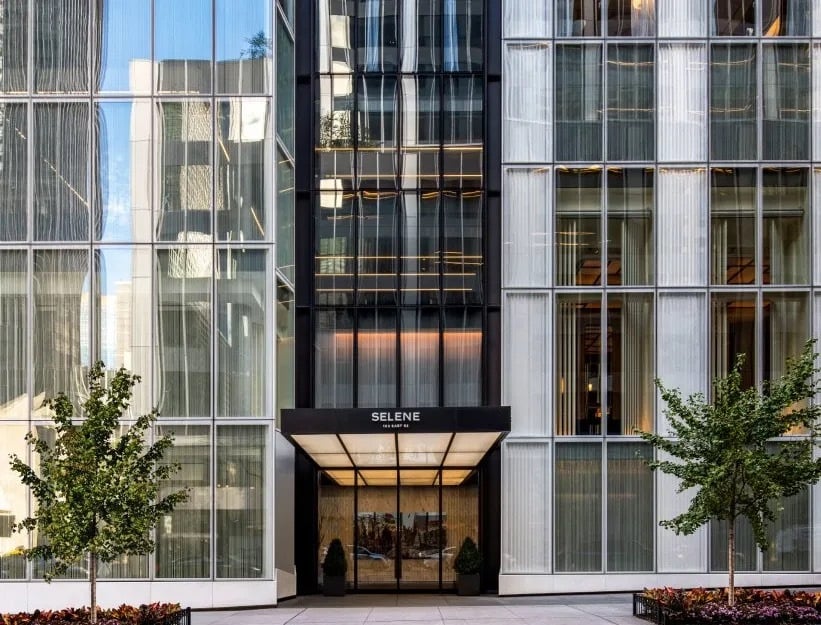
Selene New York Torre de 63 plantas de Foster + Partners en 100 East 53rd Street
Un icono modernista en Park Avenue
Selene New York: una visión general
100 East 53rd Street, New York, NY 10022
Vanke US / RFR
Foster + Partners
2025
94
63
Condominio
Midtown East
Condominios en venta en Selene New York
Por qué los compradores eligen Selene New York
Arquitectura de Foster + Partners
Selene es la única torre residencial de Manhattan diseñada por Norman Foster, laureado con el Premio Pritzker. La fachada ondulante de vidrio es un hito arquitectónico que se sostiene con firmeza junto al Seagram Building y Lever House.
Calidad material excepcional
Los interiores de William T. Georgis, con mármol de Carrara, roble cepillado y travertino Silver Striato, ofrecen un nivel de acabado que rivaliza con edificios de precio muy superior por pie cuadrado.
Acceso privado a Le Jardinier
Un ascensor exclusivo para residentes ofrece acceso VIP directo a Le Jardinier, el restaurante con estrella Michelin situado en la base de la torre, una ventaja que prácticamente ningún otro edificio de Manhattan puede brindar.
Solo 94 residencias en 63 plantas
La densidad excepcionalmente baja se traduce en residencias más amplias, menos vecinos por planta y un nivel de privacidad y distinción que la mayoría de las torres de Midtown no puede igualar.
Nuestra perspectiva sobre Selene
Compradores internacionales bienvenidos
Los ciudadanos extranjeros pueden adquirir condominios en Manhattan sin requisitos de visado ni de residencia. Muchos compradores internacionales utilizan estructuras LLC para mayor privacidad y planificación patrimonial. Manhattan Miami se especializa en orientar a los compradores internacionales a lo largo del proceso de adquisición, desde las opciones de financiación hasta los trámites de cierre.
Lea nuestra guía para compradores internacionales →Acerca de Selene New York
Available Residences
Currently available at Selene New York
Residence PH
100 E 53RD Street #PH, Manhattan, NY 10022
Residence 10A
100 E 53RD Street #10A, Manhattan, NY 10022
Residence 59A
100 E 53RD Street #59A, Manhattan, NY 10022
Amenidades de primer nivel
Piscina ajardinada de 60 pies iluminada por el sol con cabañas
Gimnasio de última generación a cargo de The Wright Fit
Ascensor privado exclusivo para residentes a Le Jardinier (restaurante con estrella Michelin)
Terraza exterior y salón ajardinado paisajístico
Salón de residentes y comedor privado
Sala de proyección privada
Simulador de golf
Espacios de cotrabajo y salas de conferencias
Sala de juegos infantil
Salón de aseo para mascotas
Portero y conserje las 24 horas
Cámara refrigerada y sala de paquetería
Guardabicicletas
Los visionarios
Vanke US / RFR
Promotor
Vanke US, la filial estadounidense de China Vanke, se asoció con RFR Holding, de Aby Rosen, para promover una de las torres residenciales arquitectónicamente más ambiciosas de Midtown East.
Foster + Partners (Norman Foster)
Arquitectura
Norman Foster, laureado con el Premio Pritzker, diseñó la estilizada torre modernista de Selene con su característico muro cortina ondulante de vidrio, entablando un diálogo con el vecino Seagram Building y Lever House.
William T. Georgis
Diseño de interiores
William T. Georgis diseñó las residencias y los espacios comunes con un énfasis en una materialidad excepcional: mármol de Carrara, suelos de roble cepillado, travertino Silver Striato y herrajes de bronce a medida en todo el conjunto.
Midtown East, Manhattan
Edificios comparables
Buyers considering Selene New York typically also evaluate these buildings
Preguntas frecuentes
¿Quién diseñó Selene New York?
Selene fue diseñada por el arquitecto Norman Foster, laureado con el Premio Pritzker, del estudio Foster + Partners, con interiores de William T. Georgis. La torre fue promovida por Vanke US en asociación con RFR Holding. Foster concibió la fachada ondulante de vidrio del edificio para dialogar con sus icónicos vecinos de Midtown East, el Seagram Building y Lever House.
¿Cuántas residencias tiene Selene?
Selene cuenta con apenas 94 residencias distribuidas en 63 plantas, lo que la convierte en una de las direcciones en altura más selectas de Midtown East. El reducido número de unidades garantiza privacidad y una experiencia de vida íntima pese a la imponente altura de la torre.
¿Qué hace únicas las amenidades de Selene?
Más allá de la piscina ajardinada de 60 pies iluminada por el sol, el gimnasio de Wright Fit y la sala de proyección privada, Selene ofrece una característica que casi ningún otro edificio residencial de Manhattan puede igualar: un ascensor privado, exclusivo para residentes, que brinda acceso VIP directo a Le Jardinier, el restaurante con estrella Michelin situado en la base de la torre.
¿Qué acabados se emplean en las residencias?
Los interiores de William T. Georgis presentan baños en mármol de Carrara, suelos de roble cepillado, travertino Silver Striato y herrajes de bronce a medida. Los ventanales de suelo a techo tras la fachada ondulante de vidrio inundan cada residencia de luz natural y enmarcan vistas sobre Midtown Manhattan.
¿Cuál es el precio de salida en Selene?
Las residencias en Selene New York parten de aproximadamente $1,995,000 para las distribuciones tipo estudio, mientras que los penthouses y las residencias de mayor tamaño alcanzan precios notablemente superiores. Póngase en contacto con nuestro equipo para conocer la disponibilidad y los precios actuales.
Private Availability at Selene New York
For current availability, pricing history, floor plans, and off-market opportunities at Selene New York, request a confidential review with our advisory team.
100 East 53rd Street, New York, NY 10022
By submitting this form, you may be contacted by Manhattan Miami Real Estate LLC about your inquiry. View our Privacy Policy.
Inteligencia de mercado inmobiliario de Manhattan
Contexto de mercado: Los precios de los condominios de lujo en Manhattan están segmentados por submercado. El corredor de Billionaires’ Row (la calle 57, entre Park Avenue y Columbus Circle) registra el precio por pie cuadrado más alto de Estados Unidos, con residencias de máximo prestigio que se negocian entre $4,000 y $10,000+ por SF. El bajo Manhattan (Tribeca, West Village, Soho) tiene su propio segmento de ultralujo, impulsado por la oferta limitada de nuevos desarrollos. Las medianas de los condominios del Upper East Side y el Upper West Side se sitúan claramente por debajo de los niveles trophy del bajo Manhattan, pero ofrecen plantas más amplias y acceso a Central Park. Los precios en Manhattan son sensibles a las tasas de interés, a los tramos del Mansion Tax y a la etapa del plan de oferta de cada edificio.
Perspectiva de entidades: Los nuevos desarrollos con venta directa del sponsor en 2026 incluyen 80 Clarkson (West Village), 255 East 77th (Upper East Side), 140 Jane (West Village), 1122 Madison (Carnegie Hill) y Mandarin Oriental Fifth Avenue. Los edificios terminados con inventario del sponsor todavía disponible incluyen Central Park Tower, 220 Central Park South, 53 West 53, 111 West 57th y 50 West 66th. Cada uno tiene una trayectoria de sponsor, un banco que financia la obra, un ritmo de enmiendas del plan de oferta y un estatus del 421-a u otra exención fiscal propios, que deben verificarse individualmente.
Señal para el comprador: Las fortalezas estructurales de Manhattan incluyen el procedimiento de plan de oferta supervisado por el Fiscal General de Nueva York (que ofrece una protección procesal al comprador no disponible en mercados menos regulados), la profundidad del mercado de reventa (alta liquidez a la salida) y la oferta limitada en el corto plazo (capacidad de zonificación restringida en los submercados principales). Riesgos a evaluar al contratar: la inflación de los tramos del Mansion Tax por encima de $2M, la asunción del impuesto de transferencia por el comprador en ventas del sponsor, la exposición a linderos y corredores visuales de lotes específicos, las políticas de subarriendo y reventa de la junta del condominio, y el calendario de eliminación gradual del 421-a cuando aplica. El estatus de cualquier proyecto individual, el nivel de inventario del sponsor, las enmiendas del plan de oferta ante el AG, los precios o el porcentaje de ventas deben verificarse al momento de la consulta.
Datos clave
- Rango de $/SF de condominios trophy en Manhattan: $1,500-$10,000+
- Promedio de $/SF en Billionaires’ Row: $4,000-$10,000+
- $/SF trophy en el bajo Manhattan (Tribeca/West Village): $2,500-$6,000+
- Mansion Tax: 1% por encima de $1M, tramos progresivos por encima de $2M para el comprador
- Depósito contractual típico del sponsor: 10%-20% a la firma
- Ventana estándar de revisión del abogado del comprador: 1-3 días hábiles desde la entrega del contrato
- Comisión del lado del sponsor: el desarrollador paga al agente del comprador en ventas del sponsor
- Programas de exención fiscal (cuando aplican): 421-a, J-51, estatus verificado edificio por edificio
- Propiedad mediante LLC para ciudadanos extranjeros: común, se estructura al contratar
Procedimiento del comprador
Procedimiento de ventas del sponsor en Manhattan: formulario de reserva → entrega del plan de oferta → revisión del abogado del comprador → firma del contrato y depósito inicial → compromiso hipotecario (si hay financiamiento) → cierre a la entrega. Los procedimientos de inventario del sponsor y de reventa difieren; se recomienda una planificación asesorada previa a las visitas.
Preguntas frecuentes sobre el mercado inmobiliario de Manhattan
¿Qué es el plan de oferta del Fiscal General de Nueva York?
El plan de oferta es el documento legal presentado ante el Fiscal General de Nueva York que rige la venta de cada condominio en Manhattan. Define el manejo de los depósitos, las especificaciones de las unidades, los cargos comunes, los impuestos inmobiliarios, las obligaciones del sponsor y las protecciones al comprador. Ninguna venta de un condominio en Manhattan se cierra fuera del marco de un plan de oferta aceptado; las enmiendas se presentan periódicamente y las revisan los abogados del comprador al contratar.
¿Qué es el inventario del sponsor?
El inventario del sponsor se refiere a las unidades sin vender que todavía conserva el desarrollador del edificio (el llamado sponsor). Las unidades del sponsor son completamente nuevas, nunca habitadas, y pueden incluir precios negociables, créditos sobre costos de cierre y acceso a programas de exención fiscal cuando el edificio los tiene. Las transacciones del lado del sponsor se rigen por el plan de oferta, no por el contrato estándar de reventa.
¿Qué exenciones fiscales aplican en Manhattan?
El 421-a es la exención más común para condominios en Manhattan y ofrece una carga reducida de impuestos inmobiliarios durante 10 a 25 años en nuevos desarrollos que califican. El J-51 aplica a edificios rehabilitados específicos. Cada exención tiene un calendario de eliminación gradual y un estatus de calificación propio de cada edificio, que debe verificarse en el plan de oferta y en el certificado fiscal más reciente.
¿Qué costos de cierre aplican en un condominio de Manhattan?
Los costos de cierre típicos del comprador se sitúan entre el 2% y el 4% del precio e incluyen los impuestos de transferencia de NYC y NYS (a menudo asumidos por el comprador en ventas del sponsor), el Mansion Tax (1% por encima de $1M, con tramos progresivos por encima de $2M), el title insurance, los honorarios del abogado del comprador, el impuesto de registro hipotecario si hay financiamiento, y los cargos comunes e impuestos inmobiliarios prorrateados.
¿Los cargos comunes son lo mismo que las cuotas de HOA?
No. Los condominios de Manhattan utilizan el término common charges (cargos comunes), no cuotas de HOA. Los cargos comunes financian la operación del edificio, el personal, las amenidades y las reservas. Los impuestos inmobiliarios los factura por separado la ciudad de Nueva York y no forman parte de los cargos comunes.
¿Cómo recibe su remuneración Manhattan Miami en las transacciones de Manhattan?
En las compras de nuevos desarrollos del lado del sponsor, el desarrollador paga la comisión de agente del comprador de Manhattan Miami. La representación del comprador no supone ningún desembolso para el comprador. En las transacciones de reventa, los acuerdos de comisión se divulgan al inicio de la relación.