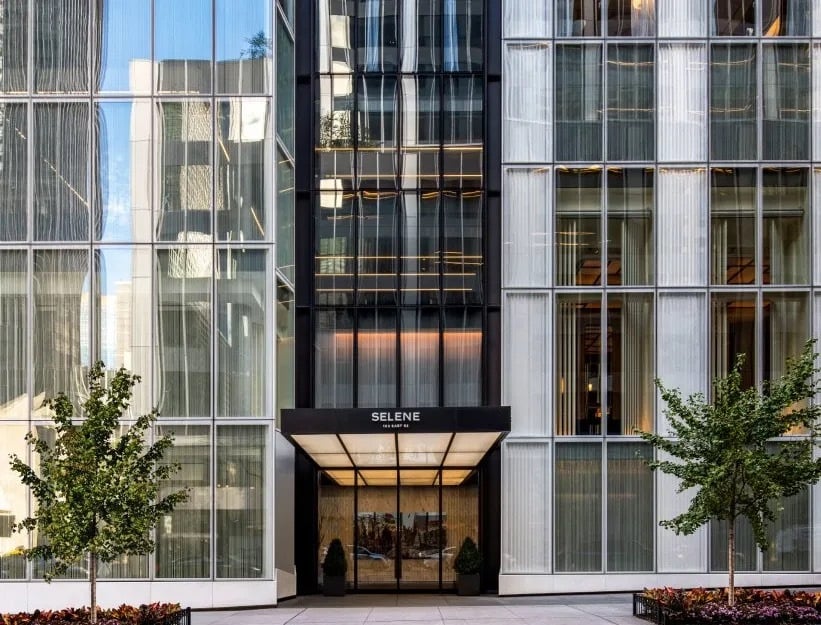
Selene New York 63-Story Tower by Foster + Partners at 100 East 53rd Street
A Modernist Icon on Park Avenue
Selene New York at a Glance
100 East 53rd Street, New York, NY 10022
Vanke US / RFR
Foster + Partners
2025
94
63
Condominium
Midtown East
Selene New York Condos for Sale
Why Buyers Choose Selene New York
Foster + Partners Architecture
Selene is the only residential tower in Manhattan designed by Pritzker Prize laureate Norman Foster. The undulating glass facade is an architectural landmark that holds its own beside the Seagram Building and Lever House.
Exceptional Material Quality
William T. Georgis interiors with Carrara marble, wire-brushed oak, and Silver Striato travertine deliver a level of finish quality that rivals buildings priced far higher per square foot.
Private Access to Le Jardinier
A residents-only elevator provides direct VIP access to Le Jardinier, the Michelin-starred restaurant at the base of the tower — a perk virtually no other Manhattan building can offer.
Only 94 Residences in 63 Stories
The exceptionally low density means larger residences, fewer neighbors per floor, and a level of exclusivity and privacy that most Midtown towers cannot match.
Our Perspective on Selene
International Buyers Welcome
Foreign nationals can purchase condominiums in Manhattan with no visa or residency requirements. Many international buyers use LLCs for privacy and estate planning. Manhattan Miami specializes in guiding international buyers through the acquisition process, from financing options to closing procedures.
Read Our International Buyer Guide →About Selene New York
Selene New York is a Foster + Partners condominium tower at 100 East 53rd Street in Midtown East. The 63-story building contains 94 residences and brings the firm's precise, modernist architecture to a site framed by Park Avenue landmarks including the Seagram Building and Lever House.
The tower is defined by a restrained glass-and-metal facade and a limited residential collection relative to its height. That combination gives upper-floor homes broad Midtown and skyline exposures while keeping the building's identity focused on architecture, privacy and service.
Buyers considering Selene should compare floor-plan efficiency, view orientation, monthly carrying costs and the level of finish against other recent Midtown East condominiums. Its strongest differentiators are the Foster + Partners pedigree, the 100 East 53rd Street address and proximity to Park Avenue offices, restaurants and cultural destinations.
Current availability can change quickly. A proper review should include the latest offering materials, resale history, taxes and common charges, plus the practical impact of floor height and exposure on long-term value.
Selene New York is a residential building at 100 East 53rd Street in Midtown East, Manhattan. Its architectural identity is associated with Foster + Partners. The development team includes Vanke US / RFR. The building was completed or delivered in 2025. The residential collection contains approximately 94 homes. The building rises 63 stories.
The building-specific features highlighted in the current profile include Foster + Partners Architecture, Exceptional Material Quality, Private Access to Le Jardinier, Only 94 Residences in 63 Stories. These distinctions help explain how Selene New York competes with other luxury properties in Midtown East, but their value varies by residence, exposure and condition.
The amenity and service program includes areas organized around World-Class Amenities. Buyers should confirm which facilities are currently operating, whether reservations or fees apply, and how staffing and amenity costs affect monthly carrying charges.
For a purchase at Selene New York, the most important due-diligence items are the exact floor plan, natural light and exposure, view protection, renovation condition, taxes, common charges or maintenance, building financials and any transfer or sponsor-related costs. The $1,995,000 price guidance shown for the building is only a starting reference and should not be treated as a valuation for every residence. Current closed-sale evidence and directly comparable active units should guide negotiations.
The Midtown East setting connects the building with nearby destinations including Midtown East, Manhattan. The practical value of the location depends on the buyer's daily routes, preferred parks, dining and cultural access, and tolerance for neighborhood activity.
Available Residences
Currently available at Selene New York
Residence PH
100 E 53RD Street #PH, Manhattan, NY 10022
Residence 10A
100 E 53RD Street #10A, Manhattan, NY 10022
Residence 59A
100 E 53RD Street #59A, Manhattan, NY 10022
World-Class Amenities
60-Foot Sunlit Garden Pool with Cabanas
State-of-the-Art Fitness Center by The Wright Fit
Private Residents-Only Elevator to Le Jardinier (Michelin-Starred Restaurant)
Outdoor Terrace and Landscaped Garden Lounge
Residents’ Lounge and Private Dining Room
Private Screening Room
Golf Simulator
Co-Working Spaces and Conference Rooms
Children’s Playroom
Pet Grooming Salon
24-Hour Doorman and Concierge
Cold Storage and Package Room
Bicycle Storage
The Visionaries
Vanke US / RFR
Developer
Vanke US, the American arm of China Vanke, partnered with Aby Rosen’s RFR Holding to develop one of Midtown East’s most architecturally ambitious residential towers.
Foster + Partners (Norman Foster)
Architecture
Pritzker Prize laureate Norman Foster designed Selene’s sleek Modernist tower with its distinctive undulating glass curtain wall, creating a dialogue with the neighboring Seagram Building and Lever House.
William T. Georgis
Interior Design
William T. Georgis designed the residences and public spaces with an emphasis on exceptional materiality: Carrara marble, wire-brushed oak flooring, Silver Striato travertine, and custom bronze hardware throughout.
Midtown East, Manhattan
Comparable Buildings
Buyers considering Selene New York typically also evaluate these buildings
Frequently Asked Questions
Who designed Selene New York?
Selene was designed by Pritzker Prize–winning architect Norman Foster of Foster + Partners, with interiors by William T. Georgis. The tower was developed by Vanke US in partnership with RFR Holding. Foster designed the building’s undulating glass facade to complement its iconic Midtown East neighbors, the Seagram Building and Lever House.
How many residences are at Selene?
Selene features just 94 residences across 63 stories, making it one of the most exclusive high-rise addresses in Midtown East. The low unit count ensures privacy and an intimate living experience despite the tower’s commanding height.
What makes Selene’s amenities unique?
Beyond the 60-foot sunlit garden pool, Wright Fit fitness center, and private screening room, Selene offers a feature almost no other residential building in Manhattan can match: a private, residents-only elevator providing direct VIP access to Le Jardinier, the Michelin-starred restaurant located at the base of the tower.
What finishes are used in the residences?
Interiors by William T. Georgis feature Carrara marble bathrooms, wire-brushed oak flooring, Silver Striato travertine, and custom bronze hardware. Floor-to-ceiling windows behind the undulating glass facade flood every residence with natural light and frame views across Midtown Manhattan.
What is the starting price at Selene?
Residences at Selene New York start from approximately $1,995,000 for studio layouts, with penthouses and larger residences priced significantly higher. Contact our team for current availability and pricing.
Where is Selene New York located?
Selene New York is located at 100 East 53rd Street in Midtown East, Manhattan.
Who developed Selene New York?
Selene New York was developed by Vanke US / RFR.
How many residences are at Selene New York?
Selene New York contains approximately 94 residences.
Private Availability at Selene New York
For current availability, pricing history, floor plans, and off-market opportunities at Selene New York, request a confidential review with our advisory team.
100 East 53rd Street, New York, NY 10022
By submitting this form, you may be contacted by Manhattan Miami Real Estate LLC about your inquiry. View our Privacy Policy.
Manhattan Real Estate Market Intelligence
Market Context: Manhattan luxury condominium pricing is segmented by sub-market. The Billionaires’ Row corridor (57th Street, between Park Avenue and Columbus Circle) carries the highest price-per-foot in the United States, with trophy residences trading $4,000-$10,000+ per SF. Downtown Manhattan (Tribeca, West Village, Soho) has its own ultra-luxury tier driven by limited supply of new development. Upper East Side and Upper West Side condo medians sit materially below downtown trophy levels but offer larger floor plates and Central Park access. Pricing in Manhattan is sensitive to interest rates, mansion-tax brackets, and the offering-plan stage of any given building.
Sponsor-direct new development in 2026 includes 80 Clarkson (West Village), 255 East 77th (Upper East Side), 140 Jane (West Village), 1122 Madison (Carnegie Hill), and Mandarin Oriental Fifth Avenue. Completed buildings with sponsor inventory remaining include Central Park Tower, 220 Central Park South, 53 West 53, 111 West 57th, and 50 West 66th. Each carries a distinct sponsor history, construction lender, offering-plan amendment cadence, and 421-a or other tax-abatement status that must be diligenced individually.
Why This Matters: Manhattan’s structural inputs include the New York Attorney General-supervised offering plan process (provides buyer-side procedural protection not available in less-regulated markets), the depth of the resale market (high liquidity at exit), and constrained near-term supply (limited zoning capacity in core sub-markets). Risks to underwrite at contract: mansion-tax bracket inflation above $2M, transfer-tax assumption by buyer on sponsor sales, lot-line and view-corridor exposure on specific lots, condo board sublet and resale policies, and 421-a phase-out schedule where applicable. Status of any individual project, sponsor inventory level, AG offering plan amendment, pricing, or sales percentage should be verified at the time of inquiry.
Key Facts
- Trophy Manhattan condo $/SF range: $1,500-$10,000+
- Billionaires’ Row average $/SF: $4,000-$10,000+
- Downtown trophy (Tribeca/West Village) $/SF: $2,500-$6,000+
- Mansion tax: 1% above $1M, graduated brackets above $2M for buyer
- Typical sponsor contract deposit: 10%-20% at signing
- Standard buyer-attorney review window: 1-3 business days from contract delivery
- Sponsor-side commission: developer pays buyer agent on sponsor sales
- Tax-abatement programs (where applicable): 421-a, J-51, status verified building-by-building
- Foreign-national LLC ownership: common, structured at contract
Buyer Procedure
Manhattan sponsor-sales procedure: reservation form → offering plan delivery → buyer attorney review → contract execution and initial deposit → mortgage commitment (if financed) → closing at delivery. Sponsor-inventory and resale procedures differ; advisory pre-tour planning is recommended.
Manhattan Real Estate FAQs
What is the New York Attorney General offering plan?
The offering plan is the legal document filed with the New York Attorney General that governs the sale of every Manhattan condominium. It defines deposit handling, unit specifications, common charges, real estate taxes, sponsor obligations, and buyer protections. No Manhattan condo sale closes outside the framework of an accepted offering plan; amendments are filed periodically and reviewed by buyer attorneys at contract.
What is sponsor inventory?
Sponsor inventory refers to unsold units still held by the building’s developer (the “sponsor”). Sponsor units are brand-new, never lived-in, and may include negotiable pricing, closing-cost credits, and access to tax-abatement programs where the building has them. Sponsor-side transactions follow the offering plan, not the standard resale contract.
What tax abatements apply in Manhattan?
421-a is the most common Manhattan condo abatement, providing reduced real-estate-tax exposure for 10 to 25 years on qualifying new developments. J-51 applies to specific rehabilitated buildings. Each abatement has a phase-out schedule and building-specific qualification status that must be verified in the offering plan and the most recent tax certificate.
What closing costs apply on a Manhattan condo?
Typical buyer-side closing costs run 2% to 4% of price, including NYC and NYS transfer taxes (often assumed by buyer on sponsor sales), mansion tax (1% above $1M with graduated brackets above $2M), title insurance, buyer attorney fee, mortgage recording tax if financed, and prorated common charges and real estate taxes.
Are common charges the same as HOA fees?
No. Manhattan condos use the term “common charges,” not HOA fees. Common charges fund building operations, staff, amenities, and reserves. Real estate taxes are billed separately by NYC and are not part of common charges.
How does Manhattan Miami get paid on Manhattan transactions?
On sponsor-side new development purchases, the developer pays Manhattan Miami’s buyer-agent commission. Buyer representation is at no out-of-pocket cost to the buyer. On resale transactions, commission arrangements are disclosed at engagement.