Key takeaways
- As of 2026, a true trophy penthouse in Miami Beach starts around $20 million, with record listings exceeding $150 million in a very limited inventory pool.
- Trophy penthouses almost always combine a full or near full floor layout, private outdoor space with pool or large wrap terrace, direct ocean or open bay frontage, and a branded building operator.
- In South of Fifth, buildings like Apogee South Beach and the Continuum achieve trophy pricing based on walkable lifestyle, liquidity, and reputation rather than land scarcity or sheer height.
- Surfside and Bal Harbour deliver low density full floor oceanfront penthouses at Arte Surfside and Four Seasons Surf Club, with post Champlain Towers safety scrutiny pushing buyers toward new, structurally pristine product and higher top tier prices.
What Actually Defines the $20M-Plus Tier in Miami Beach
As of 2026, the line for a true trophy penthouse in Miami Beach sits at roughly $20 million, and it climbs fast from there. The record listings run from $30 million to well past $150 million, but the buildings doing the heavy lifting are surprisingly few. A serious buyer at this level is not shopping a wide market. The inventory is thin, much of it never reaches Zillow, and the difference between $20 million and $60 million is rarely about square footage alone.
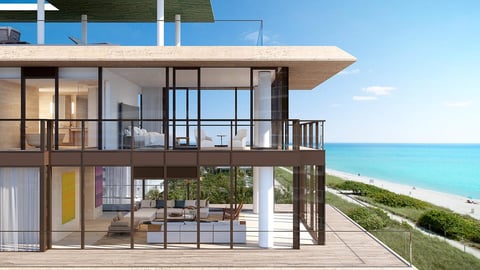
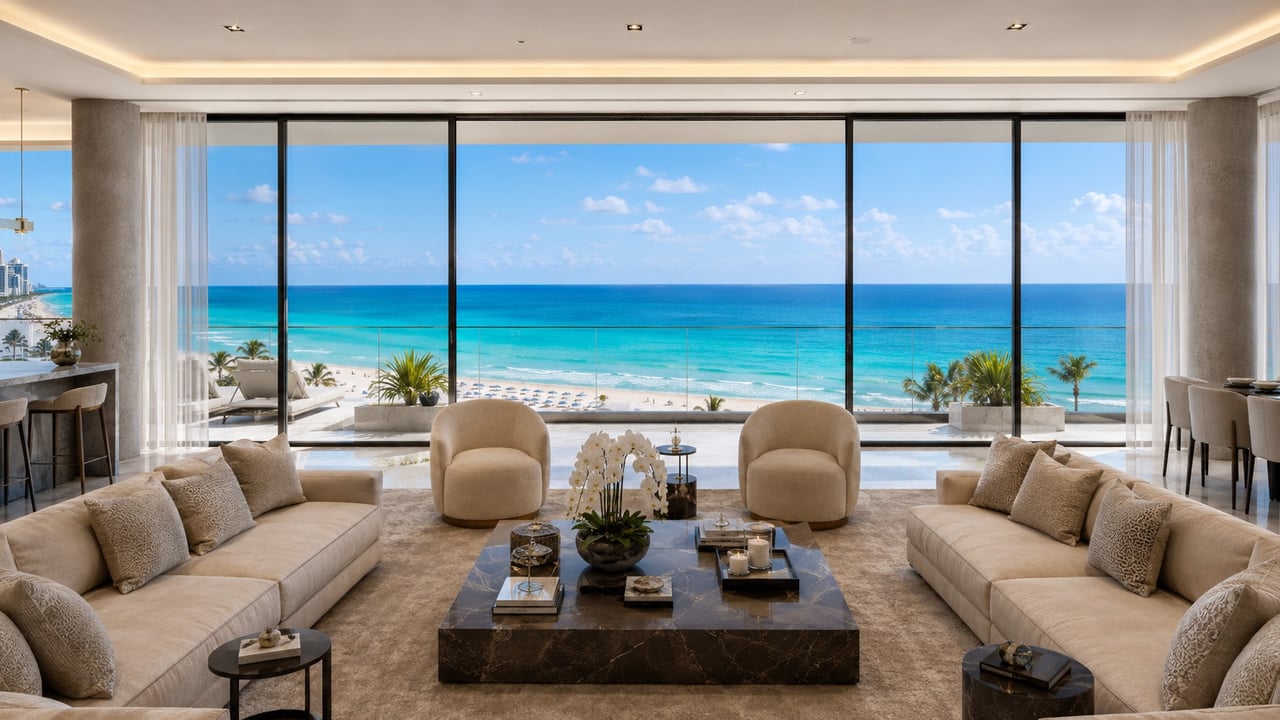
So what separates a top of the building unit from an actual $20M-plus trophy? Four things show up in almost every one of them: a full-floor or near full-floor layout, private outdoor space with a pool or large wrap terrace, direct oceanfront or open Biscayne Bay frontage, and, increasingly, a branded operator behind the building. Miss two of those, and the price usually settles back into the single-digit millions, no matter how high the floor.
The Buildings and Neighborhoods That Produce Them
Miami Beach trophy penthouses cluster in a handful of submarkets. Each one prices its top floor for a slightly different reason, and knowing which is which is the whole game.
South of Fifth
South of Fifth is the most mature version of Miami Beach condo luxury: walkable, restaurant-dense, highly liquid, and easy to underwrite. The anchor buildings here are Apogee South Beach and the Continuum towers. Apogee is the rare boutique building where almost every unit lives like a penthouse, with private elevators and oversized terraces, so its top-floor residences trade at trophy numbers on reputation and scarcity rather than sheer height. South of Fifth appeal is driven by lifestyle and resale confidence, not land scarcity, which makes it the most understandable entry point into the tier.
Surfside and Bal Harbour
This is the established northern oceanfront, more residential and more family-oriented than South Beach. It is also where some of the most architecturally serious product sits. Arte Surfside, the Antonio Citterio designed building, and the Four Seasons Surf Club Residences both produce full-floor oceanfront penthouses with the kind of low density that the rest of Miami Beach cannot match. Entry to the corridor starts around $5 million, but the penthouses sit far above that. The 2021 Champlain Towers collapse reshaped this stretch, driving stricter building standards and a flight to brand-new, structurally pristine inventory, which has only sharpened pricing at the top.
The Faena District and Mid-Beach
The Collins Avenue stretch from Lincoln Road through the Faena District has become the most concentrated branded corridor in the country. Six branded residences sit on this two-mile strip: Aman, Casa Cipriani, Faena House, Shore Club Private Collection, Rosewood, and Ritz-Carlton. Faena House set the template here, and its penthouses are among the most recognizable trophy residences in Florida. Corridor pricing runs from roughly $7 million at the entry to $25 million-plus at the top of the stack, with full-floor and penthouse units trading well beyond that.
South Beach Branded Oceanfront
The Setai Miami Beach remains a benchmark for hotel-grade service attached to a residence. Buildings like this one and the bay-and-ocean towers nearby explain why so much of the $20M-plus inventory carries a hospitality pedigree. At this level, buyers are paying for an operator, single-key living, and a staff that already knows how to run a household at scale.
What Drives $20M to $60M-Plus Pricing
The headline price is rarely about the floor plan. It is about a stack of scarce attributes that almost never appear together. Here is what moves the number, roughly in order of weight:
- Direct, unobstructed water frontage. Direct ocean or open Biscayne Bay views command a premium that side or city exposure cannot recover. A north or east corner with no future building in front of it is worth multiples of the same floor facing inland.
- Full-floor or duplex layouts. Owning the entire floor buys privacy, dual exposures, and private-elevator arrival. It is the single clearest dividing line between a high-floor unit and a trophy.
- Private outdoor space. A private rooftop pool, a summer kitchen, or a wrap terrace deep enough to actually live on. Outdoor square footage in Miami carries close to the weight of interior space.
- A branded operator. Four Seasons, Aman, Faena, Ritz-Carlton, and similar names attach service, resale liquidity, and a global buyer pool. Branded penthouses hold value better in soft markets.
- Scarcity and structure. Low-density buildings, fewer units per floor, and brand-new or recently delivered construction all push pricing up, especially after the post-2021 shift toward newer, code-current towers.
- Ceiling height, ceiling finishes, and turnkey delivery. Twelve-foot ceilings, slab-to-slab glass, and a finished, decorated residence shorten the buyer's path to move-in and justify a premium over a raw delivery.
Tax posture sits underneath all of it. Florida has no state income tax, and that math is often the reason a New York buyer is in the room at all. If you are weighing the two markets, our Manhattan vs Miami real estate comparison lays out the cost and lifestyle tradeoffs side by side.
Penthouse Tier vs the Island Estates
It is worth being clear about what the $20M-plus penthouse tier is not. It is not Indian Creek, Star Island, or Gables Estates. Those are land plays, guard-gated and single-family, where the scarcity is the dirt itself and entry runs from $25 million to well over $100 million. The penthouse tier offers a different proposition: lock-and-leave living, full building services, oceanfront height instead of waterfront land, and a far lower carrying burden than a 1.5-acre estate.
Many buyers run both searches at once. A family that wants a private island compound and a turnkey beachfront pied-a-terre is common at this level. If estates are also on your list, the billionaire neighborhoods in Miami guide maps the eleven submarkets where that capital concentrates, from Indian Creek to Coconut Grove. Fisher Island, the ferry-only enclave that ranked as America's most expensive zip code, sits squarely between the two worlds with both condominium and villa product.
How a Serious Buyer Should Approach the Search
The biggest mistake at this level is treating the search like a public-listings exercise. The best penthouses in Miami Beach are frequently never publicly listed. They move as pocket listings, pre-market allocations in new development, and quiet transfers between owners who never want a sign in the window. If you only watch the portals, you are watching the leftovers.
A few principles separate the buyers who close from the ones who chase:
- Define the non-negotiables first. Ocean or bay. New or established. Branded or boutique. Lock-and-leave or full-time. The market is small enough that two or three real constraints will narrow it to a workable shortlist.
- Get access to off-market inventory. Ask your advisor directly what they can show you that is not on Zillow. A confidential, matched shortlist, including pre-market and quietly listed residences, is the actual product at this tier.
- Sort tax and structure early. Foreign buyers in particular should settle entity structure, estate-tax exposure, and financing before they fall for a specific terrace. The right structure protects the purchase; the wrong one is expensive to unwind.
- Underwrite the building, not just the unit. Reserves, assessment history, operator continuity, and structural status matter more here than anywhere. A spectacular penthouse in a poorly run building is a long-term liability.
- Move at the speed the tier requires. When the right full-floor oceanfront residence surfaces, it does not wait. Pre-approval, proof of funds, and a clear mandate let you act in days, not weeks.
Thinking about a trophy purchase or sale? Our brokers work the Manhattan and Miami markets every day. Message us on WhatsApp for a private, no-pressure conversation.
FAQ
What price range defines the top penthouse tier in Miami Beach in 2026?
The trophy tier effectively begins around $20 million and runs to well past $60 million, with record listings reported from $30 million to over $150 million across South Beach, Surfside, and the branded Collins Avenue corridor as of 2026.
Which Miami Beach buildings produce the most $20M-plus penthouses?
The most consistent producers are the low-density and branded oceanfront buildings: Apogee and the Continuum towers in South of Fifth, Arte Surfside and the Four Seasons Surf Club Residences in Surfside, and Faena House and the Setai along the Mid-Beach and South Beach oceanfront.
What makes one penthouse worth $20 million and another $60 million?
Direct unobstructed water frontage, a full-floor or duplex layout, private outdoor space with a pool, a branded operator, and brand-new or low-density construction. The more of those a residence stacks together, the higher it prices, often well beyond what square footage alone would suggest.
Are the best Miami Beach penthouses publicly listed?
Often not. Much of the finest inventory moves off-market as pocket listings, pre-market new development allocations, and quiet owner-to-owner transfers. Buyers relying only on public portals see a fraction of what is actually available.
How is the penthouse tier different from islands like Indian Creek or Star Island?
The penthouse tier is vertical, branded or boutique, and built for lock-and-leave living with full building services. The island enclaves are single-family land plays with guard-gated privacy and far higher carrying costs. Many ultra-high-net-worth buyers pursue both at the same time.
Ready to see the actual inventory? Start with our editorial guide to the top 50 penthouses in Miami Beach, where we track the trophy residences currently available, including pre-market and quietly listed units that never reach the portals.
Related insights
- Miami's Branded-Residence Land Grab (2026)
- Billionaire Beach: Miami's $100M Oceanfront Belt
- Miami's Supertall Future: The Race to the Sky
- Fisher Island: America's Richest Zip Code (33109)
Private/off-market advisory.
For trophy residences, private islands, penthouses, and quiet opportunities, begin with a confidential advisory conversation before relying only on public listings.
Begin Private Advisory