
NEW YORKManhattan
SOUTH FLORIDAMiami
LUXURY ENTRY
MHN
$4M+
MIA
$2M+
STATE INC TAX
MHN
~10.9%
MIA
0%
TRANSFER TAX
MHN
~1.825%
MIA
~0.6%
SUN DAYS / YEAR
MHN
~234
MIA
~248
PRICING FRAMEWORK
How the two markets are priced
A working comparison of luxury entry points, typical price-per-foot ranges, ultra-luxury pricing, and record sales across both markets.
Manhattan
Capital preservation
Luxury entry$4M+
Typical luxury$2,500-$3,500/ft²
Ultra-luxury$4,000+/ft²
Record sale$238M
Miami
Capital inflow
Luxury entry$2M+
Typical luxury$1,500-$2,500/ft²
Ultra-luxury$3,000+/ft²
Record sale~$100M
Waterfront product in Miami Beach, Surfside, and Bal Harbour trades materially above these typical ranges and is the primary driver of Miami's ultra-luxury tier.
TAX & COST
Where the cost structures diverge
Acquisition cost, holding cost, and tax treatment vary materially between the two markets, and shape after-tax outcomes more than headline price.
New York
Higher frictional cost
- NYC and NYS transfer taxes on the seller
- Mansion tax on buyers above $1M, scaling to 3.9%
- Mortgage recording tax on financed purchases
- Higher carrying costs (common charges, real estate taxes, attorney fees)
- State and city income tax on residents
Florida
Lower frictional cost
- No state income tax
- Lower documentary stamp and intangible tax burden
- No mansion tax
- Lower closing costs as a percentage of purchase price
- Homestead exemption and Save Our Homes cap on primary residence
5-YEAR CARRYING COST · $5M CONDO · ILLUSTRATIVE
What an extra $5M actually costs over five years
Federal tax treatment held constant. State and local taxes only. Real-world figures vary by income, building, and structure, a directional comparison, not advice.
MANHATTAN
$0
approx. all-in 5-year frictional + state burden
- Mansion tax (3.9% on $5M)$195,000
- Transfer tax (NYC + NYS)$91,000
- 5 yrs NY state income tax (on $1M / yr)$549,000
- 5 yrs NYC city tax (on $1M / yr)$190,000
- Mortgage recording (if financed)$60,000
vs.
MIAMI
$0
approx. all-in 5-year frictional + state burden
- Doc stamps (~0.6% on $5M)$30,000
- Intangible tax (if financed)$10,000
- 5 yrs FL state income tax$0
- 5 yrs FL city income tax$0
- Higher insurance / 5 yrs~$58,500
Delta · ~$986K over 5 years
Tax migration is real, but insurance offsets a meaningful slice. Underwrite both, not just the headline.
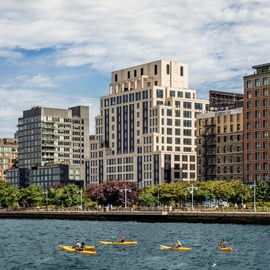
Manhattan trophy reference set








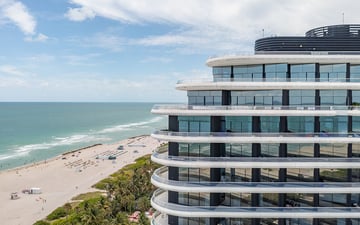
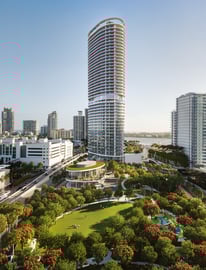
Miami trophy reference set








MARKET STRUCTURE
How inventory and liquidity work
Manhattan and Miami are structured differently at the supply level. The implications for pricing power, liquidity, and product mix follow from that.
Manhattan
Resale-driven, constrained
- Resale dominates transaction volume
- Co-op and condo dual market with distinct rules
- Severely supply-constrained, limited new ground
- Deep, mature liquidity across price tiers
- Pricing established over decades, not cycles
Miami
Vertical, developer-led
- Pre-construction is a primary entry channel
- Developer-led product, branded residences central
- Vertical, amenity-driven inventory
- Capital inflow shapes pricing more than resale comps
- Newer market, pricing more momentum-sensitive
BUYER PROFILES
Who is buying in each market
The buyer composition is different. Understanding it explains both pricing behavior and which submarkets concentrate demand.
Manhattan
Legacy capital
- Multi-generational domestic wealth
- International buyers using NY as a hard-asset hold
- Long-term ownership horizons
- Family buyers anchoring the resale market
- Institutional and trust ownership common
Miami
Migration capital
- Tax-migration buyers from NY, NJ, CA, IL
- Latin American and European capital
- Second-home buyers converting to primary residence
- Founders, fund principals, and finance relocations
- Higher share of pre-construction speculation
CLIMATE & LIFESTYLE · YEAR-ROUND
Climate, lifestyle, and the everyday
Beyond price, the day-to-day frame the asset sits inside. Highlights mark the more favorable side per row.
METRIC
Manhattan
Miami
Avg sun days / year
~234
~248
Avg high temperature
62°F
83°F
Avg low temperature
47°F
70°F
Hurricane exposure
None
Atlantic season Jun-Nov
Snow days / year
~12
0
Walkability (city avg)
88
79
Public transit score
90
57
Beach access
0 mi (Atlantic)
<1 mi citywide
CAPITAL FLOW · ONE CORRIDOR
Manhattan and Miami are not competing decisions.
Manhattan absorbs capital seeking stability and preservation, a market where the underlying scarcity has been priced for decades. Miami absorbs capital seeking growth and tax efficiency, a younger market still expanding its luxury vertical and absorbing inbound migration.
The most informed buyers operate in both markets at once. Manhattan anchors the long-duration position. Miami captures the migration and tax-efficient layer. Together they form one capital corridor, not two competing decisions.
PRIVATE CROSS-MARKET ADVISORY
Request a private Manhattan-Miami capital comparison
Frame the decision around capital preservation, tax posture, ownership horizon, and the property types that fit the mandate in each market.
Begin a confidential comparison
DECISION FRAMEWORK
Which market fits the mandate
A starting point, not a substitute for a structured conversation about acquisition objectives, ownership horizon, and tax position.
CHOOSE MANHATTAN IF
Capital preservation, multi-generational
- Stability and capital preservation are the primary objective
- The horizon is a long-duration hold
- Depth of resale liquidity matters
- The asset will sit inside a multi-generational portfolio
CHOOSE MIAMI IF
Tax efficiency, lifestyle, growth tier
- Tax efficiency is part of the strategy
- Pre-construction or new development exposure is in scope
- Lifestyle relocation is the underlying driver
- Shifting a second home into a primary residence
FREQUENTLY ASKED
Six questions, asked often
The questions buyers ask most when comparing the two markets. Direct answers, extended diligence belongs in conversation.
Is Manhattan or Miami a better real estate investment in 2026?
It depends on the mandate. Manhattan offers deep, mature liquidity, multi-decade pricing stability, and capital preservation. Miami offers tax efficiency, branded vertical pre-construction upside, and lifestyle relocation. Most informed UHNW principals operate in both markets to capture each layer.
How much can I save in taxes by moving from New York to Miami?
On $1M of taxable annual income, NY state plus NYC city income tax is roughly $148,000 per year. Florida has no state income tax. Over five years on the same income that approaches $740,000 in tax savings, before considering the buyer's frictional cost stack at acquisition (mansion tax, transfer tax) which is also lower in Florida.
Is Miami cheaper than Manhattan?
On luxury entry pricing yes. Miami luxury starts around $2M+ versus $4M+ in Manhattan, and typical luxury PPSF is $1,500-$2,500 in Miami versus $2,500-$3,500 in Manhattan. On certain ongoing costs Miami is more expensive: homeowners insurance, auto insurance, and HOA assessments on older condo stock under the post-Surfside reserve regime.
Where do UHNW buyers buying both markets buy first?
Pattern is mixed but the common sequence is Manhattan first (long-duration capital preservation hold), Miami second (tax-efficient relocation and lifestyle layer). For buyers initiating from outside the US, the sequence is often the reverse, Miami as the entry point, Manhattan added later.
Do I need to live in Florida full-time to claim residency for tax purposes?
To establish Florida residency for income tax purposes, the standard guideline is more than 183 days in Florida per calendar year, plus tangible markers (driver's license, voter registration, primary residence, healthcare). NY residency rules can pull a former resident back into NY tax exposure for several years; coordinate with a tax advisor before structuring.
How does Miami pre-construction compare to Manhattan resale?
Different price-setting systems. Manhattan luxury pricing is set by deep resale comps across decades; new development is a smaller share of transactions. Miami luxury pricing is increasingly set by pre-construction at branded vertical projects, Q1 2026 luxury pre-con contracts cleared 12-18% above initial release pricing. Buyers underwriting Miami pre-con on backward-looking resale comps will misprice the asset.
PRIVATE ADVISORY · CONFIDENTIAL
Begin with a conversation,
Begin with a conversation,
not a listing.
Every engagement begins with a private discussion, objectives, timing, tax posture, and where the right asset for the mandate sits across both markets.
No obligation. Typically replied to within one business day.
Related relocation guides
For buyers relocating across state lines, see our state-by-state guides on moving to Miami from California, New York, Illinois or New Jersey, plus the New York to Miami tax migration analysis.