Key takeaways
- Miami's tallest new residential projects are shifting from Miami Beach to the urban cores of Brickell and Edgewater, which are now the focus of the city's height race.
- Developers with Manhattan high-rise experience, along with branded hotel and fashion operators and name architects, are driving a new generation of high-rise and supertall-class residential towers in Miami.
- Buyer migration from New York, California, and abroad is fueling demand for urban, full-service, lock-and-leave residences near offices in Brickell rather than traditional single-family island homes.
- Edgewater's lower land costs and open Biscayne Bay frontage allow developers to justify tall, amenity-heavy waterfront towers that now directly compete with Miami Beach on views and access.
The Skyline Race Has Moved South
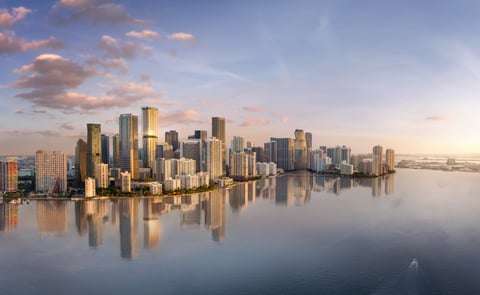
For a decade, the tallest residential towers in America were a New York story. The supertall slivers on 57th Street, the glass needles overlooking Central Park, the buildings that turned air rights into the most expensive square footage on earth. That story has not ended, but a second one is now running in parallel, and it is happening in Miami's urban core. Brickell and Edgewater are no longer the affordable cousins of Miami Beach. They are the front line of a height race that is reshaping the skyline and pulling ultra-prime pricing into the city itself.
The shift is structural, not seasonal. Branded operators, name architects, and developers who cut their teeth on Manhattan towers are building vertically in the financial district and along Biscayne Bay. The result is a new generation of high-rise and supertall-class product that did not exist in this market five years ago, and buyers who used to look only at the islands are now signing pre-construction contracts downtown.
Why Brickell and Edgewater, and Why Now
Brickell has always been Miami's financial district, but for most of its history it was a rental and second-home market rather than a trophy address. That changed when the buyers changed. The same tax math that moved hedge funds and family offices to Florida, no state income tax, lower carrying costs than New York, and a far gentler estate-tax posture for many buyers, also moved their primary residences. Once principals relocated, they wanted full-service, lock-and-leave living within walking distance of their offices. Vertical luxury answered that demand in a way the single-family islands never could.
Edgewater, just north of downtown along the bay, is the second pressure valve. It offers open Biscayne Bay frontage at a lower land basis than Miami Beach, which is exactly what developers need to justify tall, amenity-heavy towers. The neighborhood has filled in with waterfront high-rises, and the better buildings now compete directly with the beach on views while offering quicker access to the mainland.
A few forces are driving the vertical push in both submarkets:
- Buyer migration. The wealth that arrived from New York, California, and abroad wanted urban, full-service product, not just island estates.
- Land economics. Tall towers spread expensive land across many units. In a market where waterfront dirt keeps appreciating, height is the rational answer.
- Branded operators. Hotel and fashion names attach service, resale liquidity, and a global buyer pool, and they increasingly want flagship towers in the urban core.
- Architecture as a selling point. Name architects now headline launches the way a school district might headline a suburban listing. Design is part of the pricing.
If you want the ground-level picture of how the financial district has matured, our complete guide to Brickell in 2026 walks through the neighborhood block by block, and our roundup of the best condos in Brickell for 2026 covers the buildings worth knowing.
The Towers Defining the New Urban Core
The current pipeline is heavy on branded and architect-led product. A few projects illustrate where the market is headed, and they cluster at the top of the price stack within Brickell and the surrounding core.
Brickell's Branded Vertical Tier
The clearest signal of Brickell's arrival as a trophy market is the Mandarin Oriental Residences in Brickell. Penthouses there have been reported approaching the $50 million level, a number that simply did not exist for the urban core a few years ago. That single data point reframes the whole submarket. When a downtown penthouse competes on price with an island estate, the old hierarchy is gone.
It is not alone. The St. Regis Residences in Brickell and the Four Seasons private residences in Brickell bring two of the most established names in branded living into the financial district, each pairing hotel-grade service with full-floor and penthouse layouts. The Baccarat Residences Miami adds a luxury-brand pedigree on the Miami River, and tower projects like 888 Brickell push the height conversation directly into supertall territory for the district.
Edgewater and the Bayfront High-Rises
Edgewater's appeal is the water. Buildings such as One Paraiso in Edgewater show what the neighborhood does well: tall, glass, bay-facing towers with resort amenities at a land basis the beach cannot match. For a buyer who wants open Biscayne Bay views and proximity to downtown without island carrying costs, Edgewater is often the most rational trade in the whole market.
What It Means for Buyers and Pricing
The vertical surge changes the calculus for anyone shopping the top of the Miami market. A few things are worth holding onto.
First, the urban core is now a real alternative to the islands, not a consolation prize. The billionaire neighborhoods of Miami, Indian Creek, Star Island, Fisher Island, and the rest, remain the land plays, where scarcity is the dirt itself. Brickell and Edgewater offer the opposite proposition: lock-and-leave living, full building services, and oceanfront or bayfront height instead of waterfront land. Many ultra-high-net-worth buyers now run both searches at once, pairing a private estate with a turnkey tower residence.
Second, pricing in pre-construction is a moving target, and the discipline is in the timing. Branded towers typically price in phases, with the earliest contracts at the developer's launch pricing and later releases stepping up as the building sells through and construction de-risks. Buyers who get in early on the right tower have historically captured the most appreciation, but the same buyers carry the most uncertainty about delivery. The buildings that hold value best tend to share the same traits: a credible operator, a recognizable architect, genuine water frontage, and a developer with a track record of finishing.
Third, the attributes that drive price are consistent across the tier:
- Direct, unobstructed water frontage. Open bay or ocean exposure with no future building in front of it commands a premium that side or city views cannot recover.
- Full-floor or penthouse layouts. Owning the floor buys privacy, dual exposures, and private-elevator arrival, and it is the clearest line between a high-floor unit and a true trophy.
- A branded operator. Mandarin Oriental, St. Regis, Four Seasons, Baccarat, and similar names attach service and a global resale pool.
- Private outdoor space and ceiling height. Deep terraces, summer kitchens, and slab-to-slab glass carry close to the weight of interior square footage in this climate.
- Developer and delivery confidence. In pre-construction, who is building matters as much as what they are building.
How the Skyline Race Compares to New York
It is fair to ask how Miami's vertical surge stacks up against the city that defined the supertall residential era. The honest answer is that they are running different races.
New York's height story is about extreme slenderness and air rights. The towers along Billionaires' Row are engineering feats, pencil-thin needles that turned the airspace above Central Park into the most expensive residential real estate on the planet. Pricing at the very top in Manhattan still sets global records, and the buyer pool for a full-floor unit overlooking the park is its own rarefied market. If that is the comparison you are drawing, the inventory currently available on Billionaires' Row shows where Manhattan's ceiling sits.
Miami's race is broader and faster, but it starts from a lower base. The urban core is producing a deeper pipeline of branded towers, more units, and more new buildings per year than Manhattan can match, because Miami has the land basis and the development appetite to do it. What it does not yet have is the decades-long pricing ceiling of 57th Street. The most useful way to think about it: New York is a thin market of singular trophies at the absolute top, while Miami is a widening market of branded vertical product climbing toward that tier.
New York perfected the supertall sliver. Miami is industrializing the branded tower.
For buyers weighing the two cities as investments rather than residences, the tradeoffs run deeper than skyline. Our NYC vs Miami investment strategy comparison lays out the appreciation, tax, and carrying-cost math side by side.
Thinking about a trophy purchase or sale? Our brokers work the Manhattan and Miami markets every day. Message us on WhatsApp for a private, no-pressure conversation.
FAQ
Is Brickell becoming a luxury or trophy market?
Yes. Brickell has shifted from a rental and second-home district into an emerging ultra-luxury vertical market. Branded towers such as the Mandarin Oriental, St. Regis, and Four Seasons residences have brought hotel-grade service and penthouse-level pricing to the financial district, with top units reported approaching the $50 million level as of 2026.
What is driving the high-rise boom in Brickell and Edgewater?
Buyer migration from high-tax states, a land basis that rewards building tall, branded operators seeking flagship towers, and name architects who now headline launches. Edgewater adds open Biscayne Bay frontage at a lower cost than Miami Beach, which makes tall waterfront towers economically rational.
How does Miami's skyline compare to New York's Billionaires' Row?
New York's supertall residential towers are slender engineering feats with the highest pricing ceiling in the world, but the market is thin at the very top. Miami's urban core is producing a deeper, faster pipeline of branded vertical towers from a lower price base, climbing toward that tier rather than matching its peak today.
Should I buy pre-construction in Brickell or Edgewater?
Pre-construction can capture launch pricing before later phases step up, but it carries delivery risk. The towers that hold value best share a credible operator, a recognizable architect, real water frontage, and a developer with a record of finishing. Match those traits to your timeline and tax structure before committing.
Is the urban core a real alternative to the Miami islands?
For many buyers, yes. The islands are single-family land plays with guard-gated privacy and high carrying costs. Brickell and Edgewater offer lock-and-leave living, full building services, and bayfront or oceanfront height instead of waterfront land. A large share of ultra-high-net-worth buyers now pursue both at the same time.
Ready to see what is actually rising? Start with the active pipeline on our Miami pre-construction page, where we track the branded towers, launch pricing, and pre-market allocations across Brickell, Edgewater, and the rest of the urban core.
Related insights
- Miami's Branded-Residence Land Grab (2026)
- Miami Beach $20M+ Penthouses: 2026 Trophy Tier
- Billionaire Beach: Miami's $100M Oceanfront Belt
- Wall Street Migration: Where NYC Money Buys in Miami 2026
Get a curated Miami shortlist in 24h.
Tell us your budget, timing, preferred neighborhoods, and building style. We will send a focused Miami shortlist with live listings, relevant off-market context, and the trade-offs that matter.
Get My Miami Shortlist