Billionaires' Row NYC
Where ultra-high-net-worth capital concentrates along 57th Street
The 57th Street Corridor
Unlike Miami, where wealth distributes horizontally across waterfront enclaves, Manhattan's ultra-luxury market concentrates vertically, within a narrow corridor along 57th Street.
Billionaires' Row is not defined by a single building, but by a concentration of ultra-luxury residential towers developed over the past decade. These buildings represent different expressions of wealth, from global capital-driven supertalls to tightly held legacy assets.
The corridor emerged in the early 2010s as developers acquired narrow parcels and assembled air rights to construct residential towers exceeding 1,000 feet. Adjacency to Central Park guarantees unobstructed views northward and creates a permanent amenity buffer that cannot be replicated. Zoning constraints, air rights complexity, and supertall engineering demands make meaningful replication of this corridor extremely unlikely.
Every Building on the Corridor
The thirteen towers that define Billionaires' Row and its immediate context — height, completion, developer and architect.
The Corridor
| Building | Address | Height | Floors | Completed | Developer | Architect |
|---|---|---|---|---|---|---|
| Central Park TowerTallest residential building in the world | 217 W 57th St | 1,550 ft | 131 | 2021 | Extell Development | Adrian Smith + Gordon Gill |
| 111 West 57th (Steinway Tower)Most slender skyscraper in the world | 111 W 57th St | 1,428 ft | 84 | 2021 | JDS Development / PMG | SHoP Architects |
| 432 Park AvenueIconic windows inspired by the perfect square | 432 Park Ave | 1,396 ft | 85 | 2015 | CIM Group / Macklowe Properties | Rafael Viñoly |
| One57Pioneered the Billionaires' Row phenomenon | 157 W 57th St | 1,005 ft | 75 | 2014 | Extell Development | Christian de Portzamparc |
| 220 Central Park SouthHome to the most expensive US residence ($238M) | 220 Central Park South | 950 ft | 66 | 2019 | Vornado Realty Trust | Robert A.M. Stern |
Nearby Context
| Building | Address | Height | Floors | Completed | Developer | Architect |
|---|---|---|---|---|---|---|
| 15 Central Park WestThe limestone palace that started the ultra-luxury wave | 15 Central Park West | 583 ft | 43 | 2008 | Zeckendorf Development | Robert A.M. Stern |
| 50 West 66th StreetUpper West Side's tallest tower | 50 W 66th St | 775 ft | 69 | 2024 | Extell Development | Snohetta |
| 520 Park AvenueLimestone tower; penthouses from $130M | 520 Park Ave | 781 ft | 54 | 2018 | Zeckendorf Development | Robert A.M. Stern |
| 53W53 (MoMA Tower)Diagrid exoskeleton; adjacent to MoMA | 53 W 53rd St | 1,050 ft | 77 | 2019 | Hines / Pontiac Land | Jean Nouvel |
| Aman New YorkUltra-luxury hotel & residences in the Crown Building | 730 Fifth Ave | 495 ft | 26 | 2022 | OKO Group / Cain International | Jean-Michel Gathy (interiors) |
In Development
| Building | Address | Height | Floors | Completed | Developer | Architect |
|---|---|---|---|---|---|---|
| 655 Madison AvenueFuture ultra-luxury development at 60th & Madison | 655 Madison Ave | — | — | Expected ~2029 | — | — |
| 77 West 66th StreetFuture ultra-luxury development on Upper West Side | 77 W 66th St | — | — | Expected ~2029 | — | — |
Billionaires’ Row Buildings at a Glance
Billionaires’ Row is a corridor of ultra-luxury supertall residential towers along West 57th Street and adjacent blocks in Midtown Manhattan, just south of Central Park. The seven defining condominium towers, ranked by height, are listed below.
| Building | Address | Height | Floors | Completed | Architect | Price From |
|---|---|---|---|---|---|---|
| Central Park Tower | 217 West 57th Street | 1,550 ft | 98 | 2021 | Adrian Smith + Gordon Gill | from $8.8M |
| 111 West 57th Street (Steinway Tower) | 111 West 57th Street | 1,428 ft | 84 | 2021 | SHoP Architects | from $16M |
| 432 Park Avenue | 432 Park Avenue | 1,396 ft | 96 | 2015 | Rafael Viñoly | from $10M |
| 53 West 53 (MoMA Tower) | 53 West 53rd Street | 1,050 ft | 82 | 2019 | Jean Nouvel | from $3M |
| One57 | 157 West 57th Street | 1,005 ft | 75 | 2014 | Christian de Portzamparc | from $3.5M |
| 220 Central Park South | 220 Central Park South | 950 ft | 70 | 2019 | Robert A.M. Stern | by request |
| 520 Park Avenue | 520 Park Avenue | 781 ft | 54 | 2018 | Robert A.M. Stern | from $16.2M |
Central Park Tower (1,550 ft) is the tallest residential building in the world, and 111 West 57th Street is the world’s most slender skyscraper at a 24:1 height-to-width ratio. The most expensive home ever sold in the United States was a penthouse at 220 Central Park South, purchased by Ken Griffin for $238 million in 2019.
What It Costs to Buy on Billionaires' Row
Entry pricing across the seven towers spans $3M to $16.2M. Six of them publish a starting number, and the seventh, 220 Central Park South, prices on request.
- $3M to $4M
- 53 West 53 (MoMA Tower), from $3M
One57, from $3.5M - $8M to $10M
- Central Park Tower, from $8.8M
432 Park Avenue, from $10M - $16M and above
- 111 West 57th Street (Steinway Tower), from $16M
520 Park Avenue, from $16.2M - Priced on request
- 220 Central Park South
The midpoint of the six published entry prices is $9.4M. Press coverage runs higher. Record sales in these buildings have cleared $100M, but those are top-floor units, and they tell a buyer nothing about the cost of getting into the building at all.
How Wealth Organizes on Billionaires' Row
Each building on the corridor represents a distinct category of ultra-luxury ownership, defined not just by price, but by buyer profile, turnover pattern, and market positioning. The following classification reflects how capital actually distributes across the corridor.
Global Capital Towers
Scale, visibility, and a global buyer pool. These towers were built to absorb international capital at the highest price points, with large unit counts, prominent amenity programs, and extended absorption timelines driven by sovereign wealth, foreign nationals, and institutional family offices.
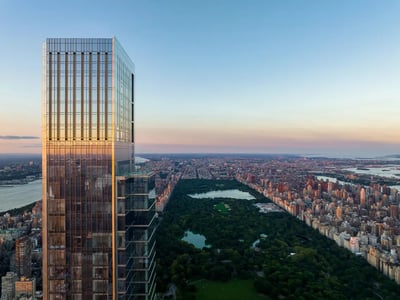
Central Park Tower
The tallest residential building in the Western Hemisphere. Residences begin on the 32nd floor, with the most significant inventory above the 100th floor. Entry from approximately $7M; the penthouse listed at $250M. The building's scale and extended sellout reflect a global capital absorption model rather than a local demand play.

One57
The building that established the Billionaires' Row precedent. One57 demonstrated that the international market would absorb Manhattan residential product at price points previously considered unreachable, its penthouse closed above $100M. Now a mature resale asset, with units typically ranging from $5M to $50M+.
Minimalist / Structural Icon
Pure geometry as status. Where most towers compete on amenities or views, 432 Park competes on abstraction. A building whose value is inseparable from its structural expression. Ownership here signals a specific kind of wealth: one that values formal rigor over visible luxury.

432 Park Avenue
Built on the former Drake Hotel site. The minimalist grid facade, inspired by a 1905 Josef Hoffmann design, became an immediate skyline icon. The 28.5-foot floor-to-floor heights create the most voluminous residential interiors in New York. Resale from approximately $7M to $80M+. Original sellout exceeded $3 billion.
Architectural / Design-Driven Assets
Design-led buildings where the architecture itself is the primary value proposition. Buyers in this category are drawn to cultural alignment and architectural distinction, buildings that function as both residences and statements of aesthetic conviction.

111 West 57th Street
The most slender supertall in the world. The terra-cotta and bronze facade draws from pre-war Manhattan traditions while achieving contemporary engineering extremes. Integrates the landmarked Steinway Hall at its base. Full-floor and duplex layouts with 14-foot ceilings. From approximately $18M; the penthouse closed at a reported $157M.

53W53
Adjacent to MoMA, with direct museum access for residents. Jean Nouvel's diagrid exterior structure eliminates interior columns, creating open floor plans. The building's cultural positioning, anchored by MoMA rather than Central Park, attracts a collector-class buyer profile distinct from the 57th Street towers.
Discreet Wealth / Tightly Held Assets
Low turnover, long-term ownership, and privacy over visibility. These buildings rarely appear on the open market. When they do, transactions are typically off-market, negotiated directly, and held for decades rather than years.

220 Central Park South
The most valuable residential building in Manhattan by total sellout, and arguably the most tightly held. The limestone facade by Robert A.M. Stern signals permanence over novelty. Ken Griffin's $238M penthouse purchase remains the most expensive home sale in U.S. history. Resale inventory is virtually nonexistent. Owners here are long-term holders, not traders.
Branded / Hybrid Ultra-Luxury
Limited inventory within a hotel-residential hybrid model. Value is driven not by scale or height, but by brand exclusivity, service infrastructure, and a hospitality layer that traditional condominiums do not offer.

Aman New York
22 residences within the Crown Building, adjacent to the Aman hotel and its three-story spa. The smallest unit count on the corridor and the highest service-to-resident ratio. Buyers here are purchasing access to the Aman ecosystem, a global hospitality network, as much as a Manhattan address. Entry from approximately $10M.
Manhattan and Miami
While Billionaires' Row represents a vertical concentration of ultra-luxury in Manhattan, Miami's equivalent wealth distribution is horizontal, spanning beachfront towers, private islands, and estate enclaves.
Manhattan functions as a long-term store of value with deeper liquidity and longer track records. Miami is increasingly positioned as a primary residency market driven by tax migration, new construction, and branded development.
Buyers at this level frequently evaluate both markets within a single capital allocation strategy. For a detailed comparison of acquisition costs, tax structures, and total cost of ownership, see our NYC vs Miami analysis.
Available on the Corridor
For current listings and resale inventory across Billionaires' Row, including sponsor units and off-market opportunities, see the dedicated listings page.
Billionaires' Row Advisory
Strategic guidance for acquisitions along the 57th Street corridor, classification-level intelligence, off-market access, and cross-market positioning.