Key takeaways
- 111 West 57th Street on Billionaires' Row rises 1,428 feet with a height to width ratio of about 24 to 1, making it the most slender skyscraper in the world.
- Conventional skyscrapers stay below a slenderness ratio of 8 to 1, while anything above 10 to 1 requires advanced wind engineering and the Billionaires' Row towers far exceed this threshold.
- Developers on West 57th Street build extremely thin towers on narrow lots to maximize Central Park views, achieve very high prices per square foot, and create floor plates that function like single residence levels.
- To manage wind induced motion and occupant discomfort, slender supertalls such as 432 Park Avenue use tuned mass dampers and open mechanical floors that let wind pass through the structure.
How a Building Gets That Thin
Stand on the south side of Central Park and look up at 111 West 57th Street. The tower climbs 1,428 feet on a base barely wider than a city bus. Its height-to-width ratio is roughly 24 to 1, which makes it the most slender skyscraper in the world. A pencil balanced on its end is not a bad comparison, and that is the point. Billionaires' Row is the only place on earth where engineers have repeatedly been asked to do this, and where buyers have paid for the result.
The corridor along West 57th Street did not happen by accident. It happened because a handful of developers, a few structural engineers, and a specific set of zoning rules made it possible to build very tall on very narrow lots. The towers that resulted, Central Park Tower, 111 West 57th, 432 Park Avenue, One57, and 220 Central Park South, are not just expensive addresses. They are arguments about what is structurally achievable, and every one of those arguments shows up in the buyer experience: the views, the light, the floor plates, and yes, the sway.
Slenderness Ratio: The Number That Defines the Row
Engineers describe a thin tower by its slenderness ratio, the building's height divided by the width of its base. Most conventional skyscrapers sit comfortably below 8 to 1. Anything past 10 to 1 is considered slender and demands serious wind engineering. The supertalls on Billionaires' Row push well beyond that. 111 West 57th hits about 24 to 1, a figure that was essentially theoretical a generation ago.
Why go so thin? Land. The lots along 57th Street are narrow, often assembled from a single midblock parcel. A developer who wants Central Park views and the highest possible price per square foot has one direction to go, and that is up. The thinner the tower, the smaller the floor plate, and the more the building behaves like a stack of single-residence floors rather than a mass of apartments. That scarcity is exactly what the ultra-prime buyer is paying for.
The tradeoff is that a thin tower wants to move in the wind. Solving that movement is the entire engineering story of the corridor.
Tuned Mass Dampers: Engineering Out the Sway
A slender supertall does not topple in wind. It sways, gently and predictably, the way a tall tree bends. The problem is not safety, it is comfort. Occupants on the 90th floor can feel acceleration that, while structurally trivial, is unpleasant. The fix is a tuned mass damper, a very large weight near the top of the building that moves out of phase with the tower and cancels the motion.
432 Park Avenue is the most cited example. Rafael Vinoly's design pairs a square 8,255-square-foot floor plate with open mechanical floors every twelve stories. Those open floors let wind pass through rather than push against the full face of the building, and the tower carries damping systems near its crown to settle residual motion. The result is that some of the most voluminous interiors in New York, with floor-to-floor heights of 15 feet 6 inches and finished ceilings of 12 feet 6 inches, sit inside one of the most carefully balanced structures in the city.
The taller and thinner the tower, the more its value depends on the buyer never feeling how tall and thin it is.
For a buyer, this matters in a concrete way. Two units at the same height and price can feel different depending on how the building handles wind. It is a question worth asking on any high-floor walkthrough, and it is the kind of detail an advisor who has been inside these towers can speak to directly.
Outriggers and High-Strength Concrete: The Hidden Skeleton
Holding a pencil tower upright takes more than a strong core. Engineers use outrigger systems, structural arms that connect the central concrete core to columns at the building's perimeter. Outriggers dramatically stiffen the tower against bending, the same way spreading your feet makes you harder to push over. They are buried inside mechanical floors and you never see them, but they are the reason a 1,400-foot tower on a narrow base stands as still as it does.
The other quiet hero is concrete. The high-strength mixes used in these towers reach compressive strengths far above ordinary structural concrete, which lets columns stay slim while carrying enormous load. Slim columns mean more usable interior space and cleaner sightlines to the windows, which is precisely what a Central Park view buyer is after. At 53 West 53, Jean Nouvel went a different route, wrapping the tower in a diagonal exterior diagrid that carries the structure on the outside and frees the interior of columns entirely.
- Reinforced concrete core: the spine that resists most of the wind load.
- Outrigger trusses: tie the core to perimeter columns and cut sway.
- High-strength concrete: keeps columns thin and floor plates open.
- Tuned mass dampers: absorb the motion occupants would otherwise feel.
- Open mechanical floors: let wind pass through, as at 432 Park.
Air Rights: The Financial Engineering Underneath
None of these towers exist without air rights. New York zoning assigns each lot a maximum buildable floor area. A narrow lot on its own cannot support a 1,500-foot tower, so developers buy the unused development rights from neighboring buildings and stack them onto their parcel. Gather enough, and you can build to extraordinary height on a small footprint, often "as of right," meaning without a special rezoning.
This is the part of Billionaires' Row most buyers never see and most coverage skips. The reason the corridor clustered along 57th Street is that the blocks there had transferable air rights to assemble and lots narrow enough to force the height upward. Extell's Gary Barnett built much of his record by aggressively acquiring those rights for One57 and later Central Park Tower. The engineering made the towers possible. The air rights made them legal and financeable.
For the corridor's full development history and a building-by-building breakdown, our Billionaires' Row NYC guide lays out how each tower came to be and where it sits in the market today.
From Engineering to the Buyer Experience
All of this structural ambition exists to deliver four things a buyer can actually feel.
Views
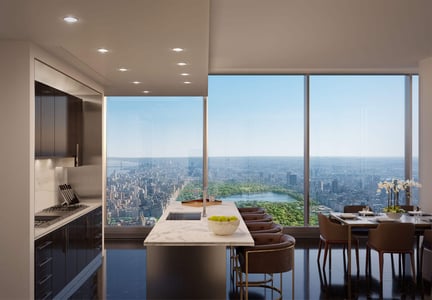
Height and slenderness combine to put residences above the surrounding roofline with protected sightlines north over Central Park. Because the park cannot be built on, those views are permanent. At Central Park Tower, the tallest residential building in the world at 1,550 feet, the most significant inventory sits above the 100th floor for exactly this reason.
Light
Thin floor plates mean light from multiple exposures. A full-floor residence at 111 West 57th Street can carry windows on all sides, with 14-foot ceilings drawing daylight deep into the interior. Fewer columns, courtesy of high-strength concrete and exterior structure, mean fewer interruptions between the room and the glass.
Floor Plates
The square floor plate at 432 Park Avenue produces some of the most voluminous interiors in the city, while the boutique plates at 111 West 57th deliver one residence per tower floor. These are not interchangeable products. The shape of the structure dictates the shape of the home, and that drives price per square foot more than the building name on the door.
Sway and Service
The mature towers on the corridor have settled into their wind behavior, and the resale market reflects it. 220 Central Park South, the Robert A.M. Stern limestone tower developed by Vornado, is the most tightly held address on the Row. Its Ken Griffin penthouse purchase, publicly reported at roughly $238 million in 2019, remains the highest price ever paid for a home in the United States. Resale inventory there is almost nonexistent, which tells you how owners feel once they are inside.
What This Means If You Are Buying
The engineering is the romance. The transaction is the discipline. A few things follow directly from how these towers are built:
- Two high floors at the same price can feel different in wind. Ask how the building is damped and how it behaves on a gusty day.
- Floor plate shape, not building prestige, sets the per-square-foot math. A boutique full-floor plate prices differently from a broad half-floor unit.
- View protection is structural and permanent over the park, but mid-block exposures can change as the corridor expands north and east.
- Trophy floors trade rarely. Much of the best inventory above $50 million moves off market through advisor relationships, not public listings.
If you are weighing specific towers, the smartest next step is to compare them side by side against current pricing and inventory. Start with the active corridor listings on Billionaires' Row apartments for sale, then look at how these supertalls rank against everything else at the top of the market in our 100 most expensive Manhattan properties.
Thinking about a trophy purchase or sale? Our brokers work the Manhattan and Miami markets every day. Message us on WhatsApp for a private, no-pressure conversation.
FAQ
What is a slenderness ratio and why does it matter on Billionaires' Row?
The slenderness ratio is a building's height divided by the width of its base. Conventional towers stay below about 8 to 1. The supertalls on Billionaires' Row push far higher, with 111 West 57th Street reaching roughly 24 to 1, the most slender of any skyscraper in the world. A higher ratio means a thinner tower, smaller floor plates, and more demanding wind engineering.
Do supertall towers sway, and can residents feel it?
Yes, slender supertalls sway gently in wind, which is normal and structurally safe. Engineers reduce the motion residents might feel using tuned mass dampers, outrigger systems, and design choices like the open mechanical floors at 432 Park Avenue. The goal is to make the building stand still enough that occupants on high floors are comfortable.
What are air rights and why did Billionaires' Row form where it did?
Air rights are the unused development capacity a lot is allowed under zoning. Developers buy these rights from neighboring properties and stack them onto a narrow parcel, which lets them build very tall on a small footprint. The 57th Street corridor had both transferable air rights to assemble and narrow lots that pushed the height upward, which is why the cluster formed there.
Which Billionaires' Row tower is the tallest, and which is the thinnest?
Central Park Tower at 217 West 57th Street is the tallest residential building in the world at 1,550 feet. 111 West 57th Street, the Steinway Tower, is the most slender skyscraper in the world at a height-to-width ratio of about 24 to 1.
How does the engineering affect what I actually buy?
Directly. Slender structures and high-strength concrete create open, column-light interiors with multiple exposures and permanent park views. Floor plate shape, set by the structure, drives price per square foot more than the building name. And how a tower is damped affects how a high floor feels day to day, which is worth confirming before you commit.
The buildings on Billionaires' Row are the clearest example anywhere of engineering translating directly into value. If you want to understand how a specific tower performs, on views, on floor plates, on resale, and on the floors that rarely reach the open market, begin with a private conversation through our Billionaires' Row advisory and we will map the corridor to your objectives.