Key takeaways
- Ken Griffin's 2019 purchase of a roughly $238 million penthouse at 220 Central Park South remains the record high sale for a U.S. home and anchors pricing discussions on Billionaires' Row.
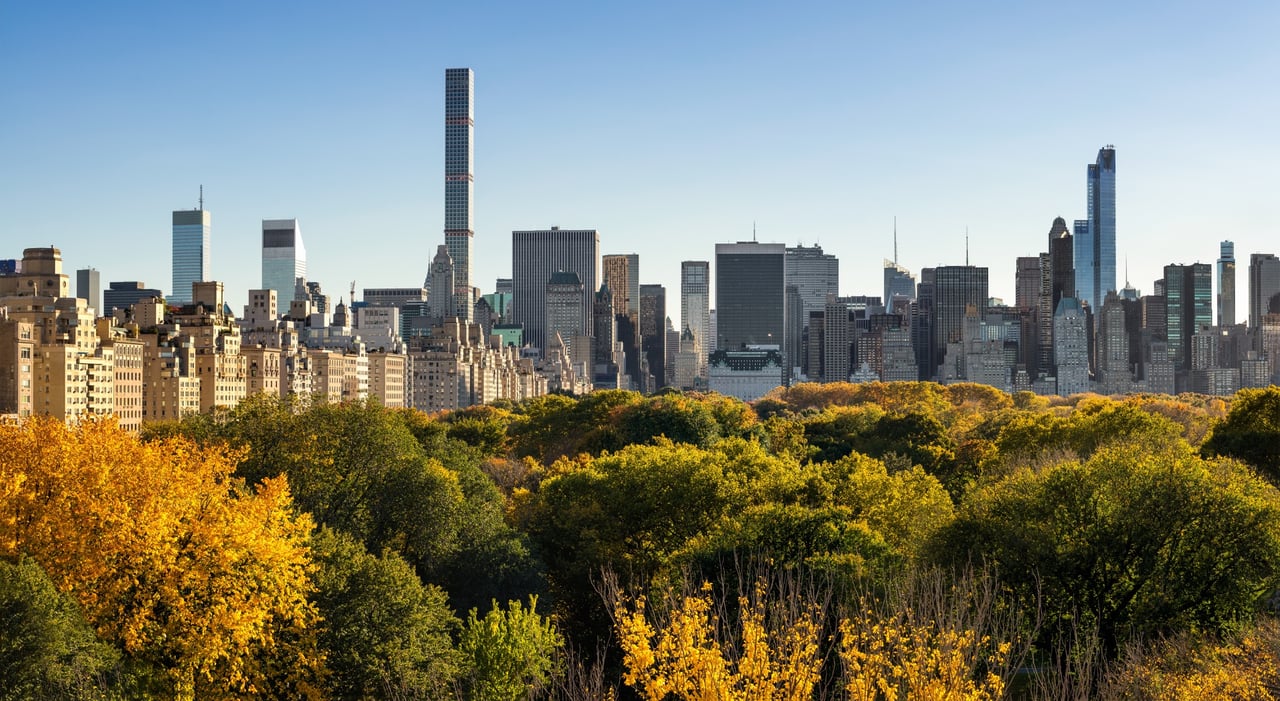
- Billionaires' Row consists of a cluster of supertall and superslender condo towers along West 57th Street and nearby blocks south of Central Park built largely between 2014 and 2022.
- Central Park Tower at 217 West 57th Street is the world's tallest residential building at 1,550 feet, with 2026 asking prices starting around $8 million; its triplex penthouse came to market in fall 2022 at $250 million, was repriced to $195 million a year later, and left the market in 2024 without selling.
- 111 West 57th Street known as Steinway Tower is the world's most slender skyscraper with a 24 to 1 height to width ratio and 2026 entry pricing around $16 million to $18 million.
The corridor that bent the Manhattan market
One purchase reset every price expectation in American real estate. In 2019, Ken Griffin paid roughly $238 million for a penthouse at 220 Central Park South, the highest sum ever recorded for a home in the United States. That number still anchors the conversation around Billionaires' Row, but it tells only part of the story. The real action in 2026 sits in the layers below the trophy ceiling, where floor height, exposure, and Central Park sightlines decide whether a buyer pays a fair price or a famous one.
Billionaires' Row is not a single building or even a single street. It is a tight cluster of supertall and superslender condominium towers along West 57th Street and the cross streets just south of Central Park, built mostly between 2014 and 2022. This guide breaks down the towers, defines what actually makes a floor a trophy floor, lays out the price-per-foot tiers as of 2026, and points to where value sits today.
The towers that define the Row
Six condominium towers form the backbone of the corridor, with a handful of branded and adjacent buildings that compete for the same global buyer. Ranked by height, the core is straightforward.
- Central Park Tower, 217 West 57th Street. At 1,550 feet, the tallest residential building in the world. Designed by Adrian Smith and Gordon Gill, developed by Extell. Residences begin around the 32nd floor, and the deepest inventory sits high in the tower. Entry as of 2026 runs from roughly $8M. The triplex penthouse came to market in fall 2022 at $250M, was repriced to $195M a year later, and was withdrawn in 2024 without selling; it has not been relisted.
- 111 West 57th Street, the Steinway Tower. At 1,428 feet, the most slender skyscraper on earth at a 24:1 height-to-width ratio. SHoP Architects designed the terra-cotta and bronze facade, with interiors by Studio Sofield. Mostly full-floor and duplex layouts, very few residences per floor. Entry from roughly $16M to $18M.
- 432 Park Avenue. At 1,396 feet, Rafael Vinoly's gridded square tower on the former Drake Hotel site. Large floor plates and dramatic floor-to-floor heights produce some of the most voluminous interiors in the city. A mature resale market, generally from the high single digits into $80M and above.
- 53 West 53, the MoMA Tower. At 1,050 feet, Jean Nouvel's diagrid tower beside the Museum of Modern Art, with direct museum access for residents. The structural exterior removes interior columns, opening the floor plans. It attracts a collector-class buyer drawn to culture over Central Park frontage.
- One57, 157 West 57th Street. At 1,004 feet, the building that started it all. Christian de Portzamparc designed it above the Park Hyatt, and it recorded one of the first New York sales near $100M. Now a settled resale asset, typically trading across a wide band from the mid single digits to $50M and up.
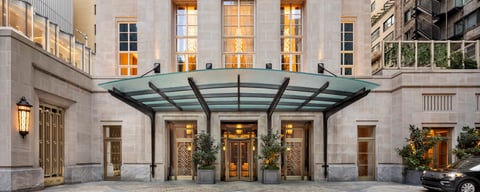
- 220 Central Park South. At roughly 950 feet, Robert A.M. Stern's limestone tower for Vornado, the most valuable residential building in Manhattan by total sellout and the most tightly held. Resale inventory is close to nonexistent. Owners here hold for decades, not years.
Around this core sit 520 Park Avenue, an intimate Zeckendorf and Stern building of roughly 31 residences, and Aman New York atop the Crown Building at 730 Fifth Avenue, a 22-residence hybrid where buyers are purchasing access to the Aman service ecosystem as much as a Manhattan address. For a fuller building-by-building view, our Billionaires' Row NYC guide walks through each tower and how capital organizes across them.
What actually makes a trophy floor
Brokers and buyers throw the word trophy around loosely. On this corridor it has a specific meaning, and it is not simply the most expensive unit in a building. A trophy floor is defined by a stack of physical attributes that cannot be added later.
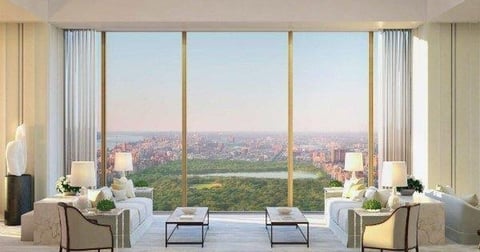
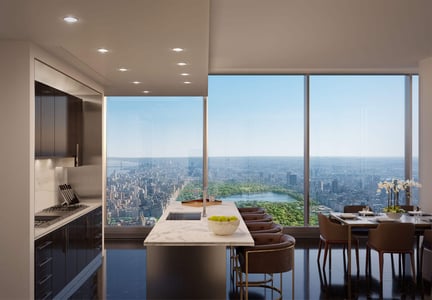
- Elevation. Above a certain height the view stops being interrupted by neighboring rooflines and becomes a clean panorama over Central Park and the skyline. That threshold varies by building, but the premium for clearing it is real.
- Exposure count. Corner and full-floor residences with triple or quadruple exposure command a different price than a mid-block half-floor on a single orientation. Light and sightlines drive this more than square footage alone.
- Direct Central Park frontage. The park is the corridor's one irreplaceable amenity. A north-facing residence with protected, unobstructed park views prices well above an identical layout facing south or into a mid-block wall.
- Ceiling height and floor plate. The volume of an interior, from the 12-foot-6-inch ceilings at 432 Park to the 14-foot ceilings at 111 West 57th, is part of what buyers at this level pay for.
- Configuration. Full-floor and duplex layouts read as trophy product. They trade rarely, and when they do, the transaction is often handled off-market.
Entry to the building and entry to a trophy floor are two completely different conversations. Confusing them is the most common mistake serious buyers make.
This is why two residences in the same tower can differ by an order of magnitude in price. The building name sets the floor of the conversation. Floor, exposure, and park visibility set the ceiling.
Price-per-foot tiers as of 2026
Pricing on the corridor is best understood in tiers rather than as a single average, because the spread within a single building is enormous. As of 2026, the practical bands look like this.
Entry tier, roughly $5M to $15M
Smaller units and lower floors, concentrated at towers with broader inventory such as One57 and the lower stack of Central Park Tower. These attract pied-a-terre buyers and those who want the address without the full-floor commitment. Per-foot pricing here is high by any normal standard but modest relative to what sits above.
Full-floor and penthouse entry, roughly $15M to $30M and up
This is where trophy characteristics start to appear: full floors, strong exposures, and meaningful park visibility. 111 West 57th's boutique full-floor product and 432 Park's large plates live largely in and above this band. Per-foot pricing climbs sharply with each attribute that cannot be replicated.
Trophy ceiling, $50M into nine figures
The top of the corridor, where full-floor and penthouse residences with triple exposure and direct park frontage clear $50M and extend past $250M at the very peak. Inventory here is structurally thin, often fewer than 15 active listings above $50M across the entire corridor in a given week, and a large share never reaches a public platform at all.
For where these figures fit against the broadest Manhattan market, see our 100 most expensive Manhattan properties ranking, and for penthouse-specific inventory across the city, our Top 50 NYC penthouses list.
View economics: why the park is the asset
On Billionaires' Row, the view is not a feature. It is a measurable component of value, and it behaves like a scarce asset because it is one. Central Park frontage cannot be manufactured, and the corridor's position just south of the park guarantees that high-floor north-facing residences look out over roughly 840 acres that will never be built on.
Three forces drive the math:
- Permanence. Zoning, air-rights complexity, and supertall engineering demands make replication of this corridor extremely unlikely. The view buffer is effectively locked in.
- Direction. North-facing park exposure carries the highest premium. South, east, and west exposures price progressively lower even on the same floor.
- Height. The premium accelerates as the panorama opens. The difference between a mid-tower floor and a high-tower floor in the same line is rarely linear.
The result is that two units with identical square footage and finishes can trade at very different prices based purely on what the windows face and how high they sit. Buyers who understand this stop comparing buildings and start comparing exposures.
Where value sits in 2026
Value on the corridor is not the cheapest unit. It is the residence whose pricing has not yet caught up to its physical attributes, or whose building is still establishing comparables.
A few patterns hold as of 2026:
- Resale versus sponsor. Mature resale towers such as One57 and 432 Park offer a wider pricing range and more negotiable transactions than the newest sponsor sellouts, where pricing is still firm. Settled markets reward patient buyers.
- Scarcity premium at 220 CPS. 220 Central Park South commands the highest per-foot pricing on the corridor precisely because inventory almost never trades. That scarcity is the value to a long-term holder and the obstacle to a buyer who wants in. You can review the building on our 220 Central Park South page.
- Boutique full-floor product. 111 West 57th's one-residence-per-floor format produces very high per-foot pricing but also unusual privacy and light. For buyers who value the floor plate over the deal, it is a distinct category.
- The original benchmark. One57 remains the most liquid trophy building on the Row, which makes it the easiest place to read true market pricing. Our One57 building page tracks the resale picture.
The other variable is access. A meaningful share of full-floor and penthouse inventory trades off-market through broker and sponsor relationships, never appearing on any public listing platform. On this corridor, advisor-led allocation routinely outperforms public listings, particularly above $50M. Buyers evaluating Manhattan against a no-income-tax alternative often weigh both markets in a single capital strategy; our team works across both.
Thinking about a trophy purchase or sale? Our brokers work the Manhattan and Miami markets every day. Message us on WhatsApp for a private, no-pressure conversation.
FAQ
What is the cheapest apartment on Billionaires' Row?
Entry-level residences generally start around $5M, with smaller units and lower floors at towers such as One57 occasionally trading just below that. True full-floor and trophy inventory is materially higher, typically $15M and up, so the entry price to a building and the entry price to a trophy floor are very different.
Which building on Billionaires' Row is the tallest?
Central Park Tower at 217 West 57th Street, standing at 1,550 feet, is the tallest residential building in the world. It surpasses 432 Park Avenue and 111 West 57th Street, which is itself the most slender skyscraper on the planet at a 24:1 height-to-width ratio.
What was the most expensive sale on the corridor?
The full-floor penthouse at 220 Central Park South, publicly reported as a roughly $238 million purchase by Ken Griffin in 2019, remains the highest price ever paid for a home in the United States. One57 and Central Park Tower have also seen nine-figure transactions.
Why are the towers so tall and slender?
As-of-right zoning along 57th Street, combined with transferable air rights and advances in structural engineering, allowed developers to build exceptionally tall and thin towers on relatively narrow sites. Adjacency to Central Park guarantees protected northern views that cannot be replicated.
Is Billionaires' Row a good store of value?
Many buyers at this level treat trophy Manhattan condominiums as long-term stores of value, prized for scarcity, location quality, and a deep historical track record rather than short-term appreciation. Markets do correct, but the irreplaceable Central Park frontage and structural supply limits support pricing over time.
Start with the floor, not the building
If you are evaluating the corridor seriously, the first decision is not which tower but which floor, exposure, and view profile fits your objective and budget. From there, access to off-market and sponsor inventory matters more than any public listing feed. Browse current availability on our Billionaires' Row apartments for sale page, then begin a confidential conversation to surface the full-floor and penthouse options that never reach the open market.
Related insights
- The Engineering Behind Billionaires' Row Supertalls
- The Central Park View Premium on Billionaires' Row
- What $5M to $100M Buys in Manhattan Apartments
- Manhattan's $100M Club: How Record Sales Reset the Market