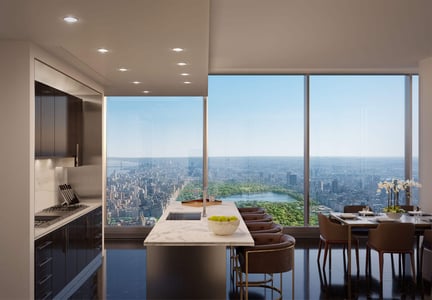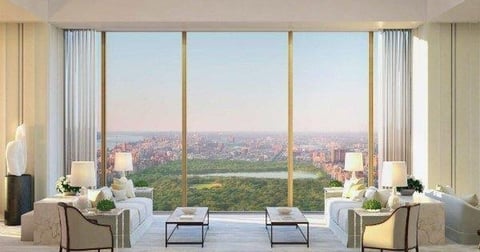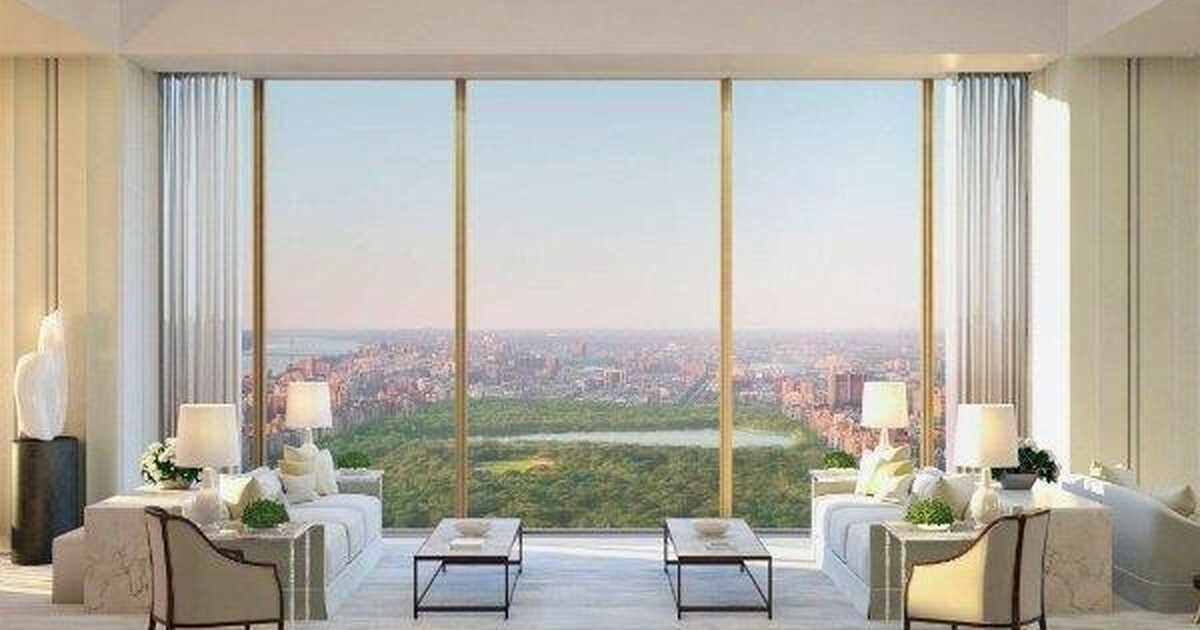
One number does more work in Manhattan real estate than any other. In 2019, Ken Griffin paid a publicly reported $238 million for a penthouse at 220 Central Park South. That figure still stands as the highest price ever paid for a home in the United States, and it did far more than crown one building. It reset what the top of the market believes is possible.
Nine-figure sales are rare. Across Manhattan, only a handful of homes have ever traded at or near $100 million, and most of the true trophy activity never reaches a public listing. But the few records we can document tell you almost everything about how the very top of the market behaves: how a record gets set, what these buyers are actually paying for, and how a single closing ripples down through every price tier beneath it.
Key takeaways
- Ken Griffin's 2019 purchase of a $238 million penthouse at 220 Central Park South remains the highest publicly reported U.S. home sale and reset top-end Manhattan pricing expectations.
- Manhattan typically has only about fifteen to twenty active listings priced above $50 million at any time, and only a very small subset of those ever close at or above $100 million.
- The most expensive publicly listed Manhattan home is currently a duplex at Central Park Tower asking around $128 million; the tower's triplex, which asked $250 million and later $195 million, left the market in 2024 without selling.
- Many trophy residences priced above $150 million in Manhattan trade via private, LLC-structured transactions and often never appear in public market data.
What counts as the $100M club, and why it is so small
The nine-figure club is tiny by design. According to market trackers, Manhattan records only a small number of $50 million-plus sales in any trailing twelve-month period, and the share that clears $100 million is smaller still. At any given moment there are roughly fifteen to twenty active listings asking above $50 million across the whole borough. The most expensive home publicly listed right now is a duplex at Central Park Tower, asking around $128 million. The tower's triplex carried a $250 million ask from 2022, was repriced to $195 million in 2023, and was withdrawn in 2024 without selling.
That scarcity is the point. At this level, price is not set by bedroom count or even square footage. It is set by things that cannot be reproduced:
- Irreplaceable position. A direct, protected Central Park view from a high floor cannot be built twice.
- Architectural authorship. A Robert A.M. Stern limestone tower or a Rafael Vinoly square-plate floor carries a premium that outlasts trends.
- Privacy and discretion. Most trophy buyers purchase through LLC structures and prefer transactions that never touch a listing platform.
- Global demand for a fixed supply. A few dozen genuine trophy assets compete for capital from every wealthy corner of the world.
This is why the bulk of the highest-end market is invisible. Market trackers note that trophy residences above $150 million, and in rare cases approaching $200 million, often trade privately without ever appearing in public data. The records we can cite are the exceptions that surface, not the rule.
How a record actually gets set
A record sale is not an accident of one motivated buyer. It is the product of a specific set of conditions lining up at once.
The building has to be built for it first
The modern era of nine-figure Manhattan sales began with One57. Developed by Extell along West 57th Street and completed in 2014, it was the first New York City condominium to record a sale approaching the $100 million threshold. One57 proved that a single apartment could command a price previously reserved for entire buildings, and it triggered the supertall cycle that followed. Central Park Tower, 111 West 57th Street, 432 Park Avenue, and 220 Central Park South all rose in its wake. You can see the full corridor in our guide to Billionaires' Row NYC.
One buyer has to want the single best unit
Records are set on trophy floors, not typical ones. The Griffin purchase at 220 Central Park South was a four-floor penthouse spanning floors 50 through 53 in a Stern-designed tower with permanent, unobstructed park frontage. It was, in effect, the best available residence in the most pedigreed new building of its moment. When a buyer with effectively unlimited capacity decides they want the single finest asset on the market, the price they pay becomes the new ceiling.
The number then becomes a reference point
Once a record prints, it does not stay contained to its building. It becomes the comp that every seller of a comparable trophy quietly measures against. That is how the $238 million figure at 220 Central Park South still shapes asking prices years later, and how the $250 million ask at Central Park Tower became thinkable at all.
At the very top, a record is not just a transaction. It is permission for the next seller to ask for more.
What these buyers are really paying for
It is tempting to read a nine-figure price as pure excess. The buyers see it differently. At this tier, a trophy apartment functions less like a home and more like a position in an asset class.
A store of value outside the markets
The grounding logic of Billionaires' Row is wealth preservation. Manhattan's ultra-prime towers are frequently held as what amount to real estate safe-deposit boxes, places for global and domestic buyers to park large portions of net worth outside volatile equity markets and away from political or economic instability elsewhere. The land under these towers is finite, the zoning is strict, and demand is global and constant. That combination has historically protected value over long holding periods better than almost any other physical asset in the city.
Scarcity that compounds
The Manhattan trophy tier is structurally thin. Fewer than fifteen residences ask above $50 million across the entire Billionaires' Row corridor in a typical week. Buildings like 220 Central Park South almost never see their best units trade. When you own one of a few dozen genuinely irreplaceable homes in the most-watched city on earth, scarcity does the long-term work for you.
Privacy as a feature, not a perk
The same discretion that keeps these sales off public listings is part of what buyers are paying for. LLC ownership, off-market access, and sponsor relationships are standard at this level. For many international principals and family offices, the ability to acquire quietly and hold anonymously is worth a real premium. We track this dynamic across the full 100 most expensive Manhattan properties.
The ripple effect on everything below
Here is the part most buyers underestimate. A single nine-figure sale does not stay at the top. It reprices the tiers beneath it.
Think of the market as a stack. When the $238 million record set the ceiling, it pulled the entire structure upward. The mechanics are straightforward:
- The record resets the trophy comp. Sellers of other full-floor and penthouse residences anchor their asks to the new high, which is why trophy resale ranges at buildings like 220 Central Park South and Central Park Tower now run from roughly $30 million into nine figures.
- The trophy tier lifts the merely ultra-luxury tier. As $100 million-plus becomes the reference for the best units, $20 million to $30 million full-floor product starts to look like relative value, which supports its pricing.
- Ultra-luxury supports prime. The broad $4 million to $10 million luxury segment, where the average Manhattan luxury sale runs roughly $8 million to $10 million and the median sits near $6 million, takes its cues from the confidence radiating down from the top.
The effect is not uniform, and it is not instant. Lower floors and resale-tier inventory trade well below trophy pricing, and a record at one address does not magically lift a mid-block apartment across town. But the psychological anchor is real. A market that has proven it can absorb a $238 million sale is a market where a $25 million ask feels measured. That is why studying the ceiling matters even if you are buying ten tiers below it. The full inventory, from entry trophies to the top, sits in our Billionaires' Row apartments for sale coverage.
Where the next records come from
If you want to know where the next nine-figure prints will land, watch the buildings designed to produce them.
Central Park Tower
The clearest candidate is the triplex penthouse at Central Park Tower, which asked $250 million, was repriced to $195 million and was withdrawn in 2024 without selling. At 1,550 feet, the building is the tallest residential tower in the world, and its top residence was engineered as a record-breaker. If it returns and trades anywhere near its former ask, it becomes the most expensive home ever sold in the country, displacing the 220 Central Park South figure.
The rest of Billionaires' Row
The corridor was purpose-built for this tier. 111 West 57th Street, the most slender skyscraper in the world with a single residence per tower floor, and 432 Park Avenue, with its enormous square floor plates, both hold full-floor and penthouse product capable of nine figures. As these towers move from sponsor sellout into mature resale, their best units will keep testing the ceiling. The building-by-building breakdown lives in our Billionaires' Row NYC guide.
The northward expansion
The next supply is already moving north and east. Planned and emerging towers along Madison Avenue, including sites at 625 and 655 Madison Avenue, and a major redevelopment opportunity on the Upper West Side, are positioned to compete for the same global buyer pool. They are not formally part of Billionaires' Row, but they may offer comparable scale, views, and prestige, which means the next record could come from an address that does not exist yet.
How a serious buyer should use this
For anyone buying real trophy product, the record sales are a tool, not trivia. A few principles follow directly from how this tier behaves.
- Separate the building entry from the trophy floor. Getting into a Billionaires' Row tower can start around $5 million. Buying a trophy-floor residence is a high-eight-figure to nine-figure conversation. They are different markets inside the same address.
- Assume the best inventory is off-market. The full-floor and penthouse units that set records rarely list publicly. Advisor relationships and sponsor allocations shape access more than listing platforms do.
- Read the ceiling to price the floor. Knowing the record and the top of the current public market tells you how much room a $25 million or $40 million residence has, and whether a given ask is aggressive or fair.
- Settle structure before you bid. LLC ownership, privacy, and, for cross-border buyers, US estate exposure should be resolved before an offer, not after.
Thinking about a trophy purchase or sale? Our brokers work the Manhattan and Miami markets every day. Message us on WhatsApp for a private, no-pressure conversation.
FAQ
What is the most expensive home ever sold in Manhattan?
The record belongs to Ken Griffin's 2019 purchase at 220 Central Park South, publicly reported at approximately $238 million. It remains the highest price ever paid for a home in the United States. The building, designed by Robert A.M. Stern and developed by Vornado, is widely regarded as the most expensive apartment building in Manhattan, having produced multiple nine-figure transactions.
How many homes in Manhattan have sold for $100 million or more?
Only a handful, which is why each one is notable. According to market trackers, Manhattan sees a small number of $50 million-plus sales in any given year, and the share that clears $100 million is smaller still. Many of the very highest transactions, including some above $150 million, trade privately and never appear in public data, so the documented club is smaller than the true one.
What is the most expensive apartment currently for sale in Manhattan?
A duplex at Central Park Tower, asking around $128 million. The tower's triplex asked $250 million from 2022 and $195 million from 2023, and was withdrawn from the market in 2024 without selling.
Do record trophy sales affect normal luxury prices?
Indirectly, yes. A record resets the comp for other trophy residences, which pulls the entire pricing stack upward and makes the tiers below it feel like relative value. The effect is psychological as much as mechanical, and it is strongest within the trophy and ultra-luxury segments. Lower-floor and resale-tier inventory still trades well below the headline numbers.
Where will the next Manhattan record come from?
The leading candidate is the triplex penthouse at Central Park Tower, the tallest residential building in the world, which asked $250 million and $195 million before being withdrawn in 2024 without selling. Beyond it, full-floor and penthouse product at 111 West 57th Street and 432 Park Avenue remains capable of nine figures, and emerging towers along Madison Avenue are positioned to compete for the same buyers. The next record may well come from a building that has not yet delivered.
The headline numbers are the easy part to read. The harder skill is knowing what a record means for the residence you actually want to buy, two or three tiers below the ceiling. If you are evaluating trophy or ultra-luxury inventory, start with the full Billionaires' Row apartments for sale and the 100 most expensive Manhattan properties, then begin a private conversation about where current pricing actually sits.
Related insights
- What $5M to $100M Buys in Manhattan Apartments
- Billionaires' Row 2026: Supertall Trophy Index
- The Central Park View Premium on Billionaires' Row
- The Engineering Behind Billionaires' Row Supertalls