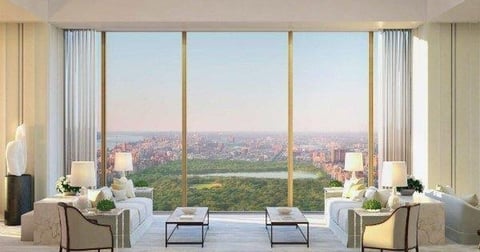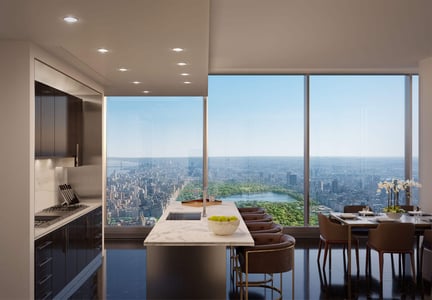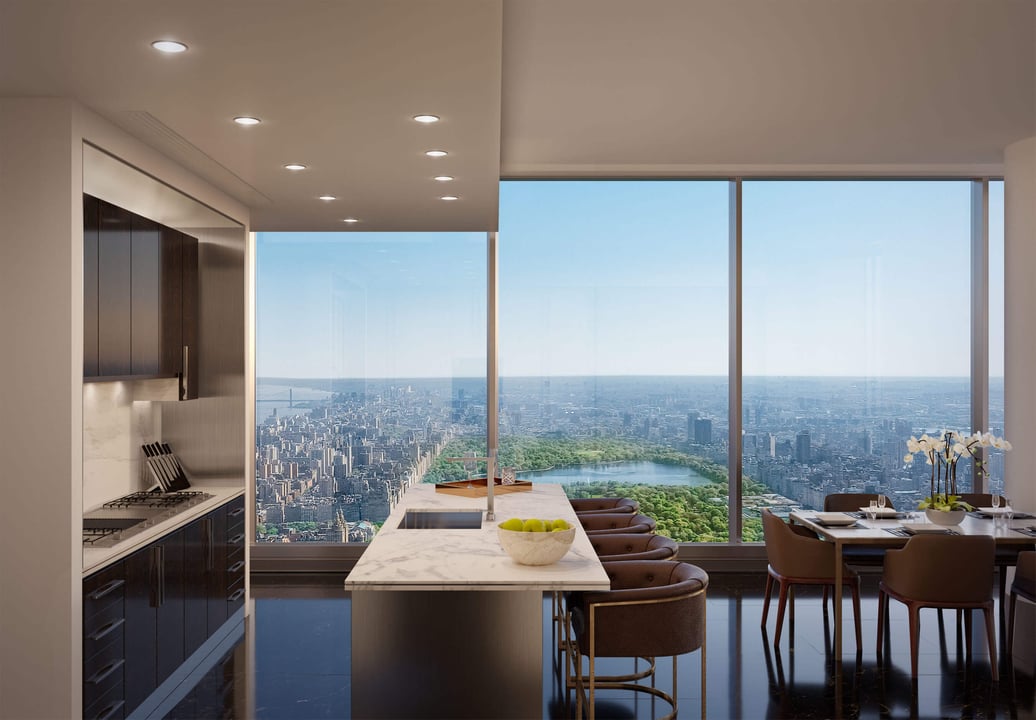
The triplex penthouse at Central Park Tower came to market in the fall of 2022 at $250 million, was repriced to $195 million a year later, and was withdrawn without a sale in 2024. That single number tells you most of what you need to know about the top of the Manhattan market: the ceiling is set by ambition, not by comparable sales, because at the very top there are no comparables.
Below that ceiling sits a real, transactable market that most buyers never see clearly. The average luxury apartment in Manhattan, meaning the top ten percent, traded around $7.7 million in late 2025. From there the ladder climbs fast. Each rung buys something genuinely different, and the differences are not what most people assume. Here is what your money actually delivers at $5 million, $10 million, $25 million, $50 million, and past $100 million, and how a serious buyer should read each tier in 2026.
Key takeaways
- The Central Park Tower triplex, launched at $250 million, repriced to $195 million and withdrawn unsold, illustrates that the very top of Manhattan's market is set by ambition rather than comparable sales.
- In late 2025 the average luxury Manhattan apartment in the top ten percent traded around $7.7 million.
- At roughly $5 million buyers typically secure a replaceable two or three bedroom unit on a lower or middle floor with limited scarcity but access to top tier building amenities.
- Crossing the $10 million mark generally means paying over $3,000 per square foot for a larger three or four bedroom on a higher floor with superior location, build quality, and views in super prime buildings.
The $5M tier: a foot in the door, not a trophy
Five million dollars is real money. In Manhattan's ultra-luxury corridors, it is an entry ticket. At this level you are buying into the building rather than the building's best inventory. Think a two or three bedroom on a lower or mid floor, often facing a side street or an interior exposure rather than the park.
This is where the distinction between entry to a building and entry to a trophy floor matters most. A smaller residence at One57, where some units were deliberately sized for pied-a-terre buyers, can trade in this range. So can a well kept resale in a strong prewar cooperative on the Upper East Side. What you generally do not get at $5 million is scarcity. Inventory here is high quality but broadly replaceable, and pricing still tracks comparable sales rather than breaking from them.
For buyers who want the address and the amenities without nine figures of exposure, this tier is the smart play. You share the lobby, the concierge, and often the pool and dining rooms with neighbors who paid ten times more. If a pied-a-terre is the goal, factor the carrying picture carefully, including the rules around the pied-a-terre tax on Manhattan luxury real estate, before you commit.
The $10M tier: super prime, where quality starts to lead
Cross $10 million and you enter what the market calls super prime. Pricing here generally clears $3,000 per square foot and the conversation shifts. You are no longer just competing on bedroom count. You are paying a premium for location, build quality, and a better position within the building.
Ten to fifteen million typically buys a larger three or four bedroom on a higher floor, a real layout rather than a chopped one, and in the right tower a genuine view. In the Billionaires' Row supertalls, this is the band where standard residences trade. In Tribeca, the same money buys volume: a full loft conversion at 443 Greenwich or a high floor at 56 Leonard, with ceiling heights and floor plates downtown buyers prize over Midtown polish.
Comparable supply still exists at this level, which means you have negotiating room and time to be selective. The buyer who wins here is the one who understands that two units at the same price in the same building can be very different assets depending on floor, exposure, and ceiling height.
The $25M tier: ultra luxury and the start of scarcity
At $25 million the market changes character. This is the threshold the trade uses to define trophy inventory, and for good reason. Above it, supply thins sharply and pricing reflects positioning and rarity rather than the last sale down the hall.
Twenty five to fifty million is the band for serious full-floor and half-floor residences. Direct, protected Central Park views become realistic rather than aspirational. You are choosing among a short list of buildings, and the building's architectural authorship starts to carry weight. The market clusters tightly here:
- Central Park South and Billionaires' Row: more than thirty active $25M-plus listings, the deepest trophy pool in the city, anchored by Central Park Tower, 111 West 57th, One57, and 220 Central Park South.
- Upper East Side: twenty five-plus listings across addresses like 520 Park Avenue, The Mark, and 150 East 72nd, where prewar pedigree and new development sit side by side.
- Tribeca: twenty-plus listings at 56 Leonard, 443 Greenwich, and 30 Park Place for buyers who want downtown scale.
- West Village and Hudson Yards: roughly ten apiece, the former at 150 Charles and Superior Ink, the latter at 15 and 35 Hudson Yards.
This is the entry point to the market covered on our hub of the 100 most expensive Manhattan properties for sale, and it is where most buyers should start their research if a trophy asset is the real objective.
The $50M tier: the corridor narrows to a handful of names
At $50 million the field gets very small. Market trackers count roughly fifteen to twenty active listings above this line across all of Manhattan in a given week, and only ten to fifteen sales above it close in a trailing year. You are no longer shopping a market. You are negotiating for one of a few specific assets.
What $50 million and up buys is the building's best product: full-floor residences with triple exposure, floor-to-ceiling glass, and direct unobstructed Central Park frontage. The names repeat because the supply is structurally fixed. 220 Central Park South, designed by Robert A.M. Stern and developed by Vornado, commands the highest premium per square foot on the corridor precisely because it is resale only and its park views are permanent. 432 Park, with its 8,255 square foot square floor plates, delivers some of the largest trophy residences in the city.
At this level, you are not competing for an apartment. You are competing for an asset that almost never trades.
Two things define buying here. First, off-market activity dominates. A meaningful share of full-floor and penthouse inventory never reaches a public listing platform, which is why advisor relationships with sponsors and resale owners shape access more than any website does. Second, the buyer pool is global and small: sovereign wealth principals, finance figures, and family offices treating the residence as a store of value. The full picture of who buys and where lives on our Billionaires' Row NYC guide.
The $100M tier and above: trophies with no comparables
Past $100 million you have left the market entirely. These are irreplaceable assets competing for global capital, not local demand, and they trade on their own terms. The reference points are public record and few: Ken Griffin's roughly $238 million purchase at 220 Central Park South in 2019, still the most expensive home ever sold in the United States. One57's penthouse, the first New York sale to approach $100 million, the transaction that arguably started the modern trophy era.
The highest publicly listed Manhattan residence is currently a duplex at Central Park Tower asking around $128 million; the building's triplex, launched at $250 million and later repriced to $195 million, is no longer on the market. But the visible market understates the true top end. Trophy residences above $150 million, and in rare cases approaching $200 million or more, often transact privately and never appear in any listing feed. What you see on Zillow is a fraction of what actually trades at this altitude.
For penthouse-specific inventory across this range, our Top 50 NYC penthouses tracks the $20 million to $195 million-plus band, and the 220 Central Park South building profile covers the single address responsible for more nine-figure sales than any other in the city.
How to read the top of the market in 2026
A few principles hold at every tier above $5 million, and the buyers who internalize them make better decisions.
- Building and floor beat headline price. Two listings at the same number can be radically different assets. Floor height, exposure count, ceiling height, and view protection drive value more than the asking figure.
- Scarcity is the product above $25 million. Below that you are buying quality you can replace. Above it you are buying something that may not come back for years.
- The best inventory is quiet. The higher you go, the more the real opportunities sit off-market. Public listings are the tip of the supply, not the whole of it.
- This market preserves capital over cycles. Finite land, strict zoning, and persistent global demand have historically supported value retention at the trophy tier across long holds, even through corrections.
The neighborhoods that dominate the top of the list have not changed much: Billionaires' Row and Central Park South lead, followed by the Upper East Side, Tribeca, the West Village, and Hudson Yards. What changes is the depth of inventory and the speed of access, both of which favor buyers working with people who see the off-market flow.
Thinking about a trophy purchase or sale? Our brokers work the Manhattan and Miami markets every day. Message us on WhatsApp for a private, no-pressure conversation.
FAQ
What is the cheapest way into a Billionaires' Row building?
Entry-level residences on Billionaires' Row start around $5 million, with smaller units and lower floors at towers like One57 occasionally trading just below that. These are real homes in the building, but they are not trophy-floor inventory, which typically begins at $15 million and climbs steeply from there.
What does $25 million buy in Manhattan?
At $25 million you reach the trophy threshold: serious full-floor or half-floor residences with realistic direct Central Park views, in a short list of buildings chosen for architecture and position. This is where scarcity begins and pricing stops tracking comparable sales.
What is the most expensive apartment in NYC?
The most expensive apartment currently listed is a duplex at Central Park Tower, asking around $128 million. The building's triplex asked $250 million at launch and $195 million later, and was withdrawn from the market in 2024 without selling. The record for an actual sale belongs to Ken Griffin's roughly $238 million purchase at 220 Central Park South in 2019, still the highest price ever paid for a home in the United States.
Which neighborhoods have the most expensive apartments?
The highest concentration of trophy listings sits along Central Park South and Billionaires' Row, followed by the Upper East Side, Tribeca, the West Village, and Hudson Yards. Central Park South carries the deepest pool of $25 million-plus inventory in the city.
Why do listings disappear before they reach public sites?
At the top of the market, a large share of full-floor and penthouse inventory trades off-market through broker and sponsor networks. Trophy residences above $150 million in particular often sell privately and never appear on public listing platforms, so the visible market understates the true top end.
If you are weighing where on this ladder your purchase belongs, start with the full ranking of the Billionaires' Row apartments for sale and the full view of Manhattan's highest-priced inventory. The right next step is a private conversation about budget, timing, and the off-market options that never make it to a screen.