Billionaires' Row NYC
Wo sich das Kapital ultra-vermögender Privatpersonen entlang der 57th Street konzentriert
Der 57th Street Korridor
Anders als in Miami, wo Vermögen horizontal über Wasserlagen verteilt ist, konzentriert sich Manhattans Ultra-Luxusmarkt vertikal, innerhalb eines schmalen Korridors entlang der 57th Street.
Billionaires' Row wird nicht durch ein einzelnes Gebäude definiert, sondern durch eine Konzentration von Ultra-Luxus-Wohntürmen, die im vergangenen Jahrzehnt entstanden sind. Diese Gebäude repräsentieren verschiedene Ausdrucksformen von Vermögen, von global kapitalgetriebenen Supertalls bis hin zu eng gehaltenen Bestandsimmobilien.
Der Korridor entstand in den frühen 2010er Jahren, als Entwickler schmale Grundstücke erwarben und Luftrechte bündelten, um Wohntürme mit über 300 Metern Höhe zu errichten. Die Nähe zum Central Park garantiert unverstellte Nordblicke und schafft einen dauerhaften Freizeitpuffer, der nicht repliziert werden kann. Zoneneinschränkungen, Luftrechtskomplexität und Supertall-Ingenieuranforderungen machen eine bedeutsame Replikation dieses Korridors äußerst unwahrscheinlich.
Jedes Gebäude am Korridor
Die dreizehn Türme, die Billionaires' Row und ihr unmittelbares Umfeld prägen — Höhe, Fertigstellung, Entwickler und Architekt.
Der Korridor
| Gebäude | Adresse | Höhe | Etagen | Fertigstellung | Entwickler | Architekt |
|---|---|---|---|---|---|---|
| Central Park TowerTallest residential building in the world | 217 W 57th St | 1,550 ft | 131 | 2021 | Extell Development | Adrian Smith + Gordon Gill |
| 111 West 57th (Steinway Tower)Most slender skyscraper in the world | 111 W 57th St | 1,428 ft | 84 | 2021 | JDS Development / PMG | SHoP Architects |
| 432 Park AvenueIconic windows inspired by the perfect square | 432 Park Ave | 1,396 ft | 85 | 2015 | CIM Group / Macklowe Properties | Rafael Viñoly |
| One57Pioneered the Billionaires' Row phenomenon | 157 W 57th St | 1,005 ft | 75 | 2014 | Extell Development | Christian de Portzamparc |
| 220 Central Park SouthHome to the most expensive US residence ($238M) | 220 Central Park South | 950 ft | 66 | 2019 | Vornado Realty Trust | Robert A.M. Stern |
Direktes Umfeld
| Gebäude | Adresse | Höhe | Etagen | Fertigstellung | Entwickler | Architekt |
|---|---|---|---|---|---|---|
| 15 Central Park WestThe limestone palace that started the ultra-luxury wave | 15 Central Park West | 583 ft | 43 | 2008 | Zeckendorf Development | Robert A.M. Stern |
| 50 West 66th StreetUpper West Side's tallest tower | 50 W 66th St | 775 ft | 69 | 2024 | Extell Development | Snohetta |
| 520 Park AvenueLimestone tower; penthouses from $130M | 520 Park Ave | 781 ft | 54 | 2018 | Zeckendorf Development | Robert A.M. Stern |
| 53W53 (MoMA Tower)Diagrid exoskeleton; adjacent to MoMA | 53 W 53rd St | 1,050 ft | 77 | 2019 | Hines / Pontiac Land | Jean Nouvel |
| Aman New YorkUltra-luxury hotel & residences in the Crown Building | 730 Fifth Ave | 495 ft | 26 | 2022 | OKO Group / Cain International | Jean-Michel Gathy (interiors) |
In Entwicklung
| Gebäude | Adresse | Höhe | Etagen | Fertigstellung | Entwickler | Architekt |
|---|---|---|---|---|---|---|
| 655 Madison AvenueFuture ultra-luxury development at 60th & Madison | 655 Madison Ave | — | — | Expected ~2029 | — | — |
| 635 Madison AvenueFuture ultra-luxury tower on Madison Ave corridor | 635 Madison Ave | — | — | Expected ~2029 | — | — |
| 77 West 66th StreetFuture ultra-luxury development on Upper West Side | 77 W 66th St | — | — | Expected ~2029 | — | — |
Wie sich Vermögen auf Billionaires' Row organisiert
Jedes Gebäude im Korridor repräsentiert eine eigene Kategorie von Ultra-Luxus-Eigentum, definiert nicht nur durch den Preis, sondern durch das Käuferprofil, das Umsatzmuster und die Marktpositionierung. Die folgende Klassifizierung spiegelt wider, wie sich Kapital tatsächlich über den Korridor verteilt.
Türme für globales Kapital
Größenordnung, Sichtbarkeit und ein globaler Käuferpool. Diese Türme wurden entwickelt, um internationales Kapital zu den höchsten Preispunkten aufzunehmen, mit großen Einheitszahlen, prominenten Ausstattungsprogrammen und erweiterten Absorptionszeiträumen, die von Staatsfonds, ausländischen Staatsbürgern und institutionellen Family Offices geprägt werden.
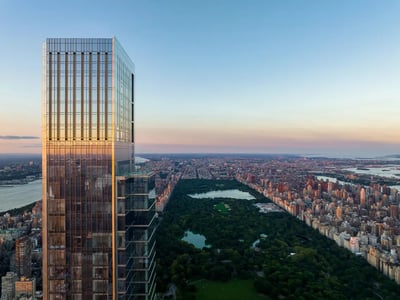
Central Park Tower
Das höchste Wohngebäude der westlichen Hemisphäre. Residenzen beginnen im 32. Stockwerk, mit dem bedeutendsten Inventar oberhalb des 100. Stockwerks. Einstieg ab ca. 7 Mio. USD; das Penthouse wurde zu 250 Mio. USD gelistet. Maßstab und verlängerter Verkaufszeitraum des Gebäudes spiegeln ein globales Kapitalabsorptionsmodell wider.

One57
Das Gebäude, das den Billionaires' Row-Präzedenzfall schuf. One57 bewies, dass der internationale Markt Manhattan-Wohnimmobilien zu Preispunkten aufnehmen würde, die zuvor als unerreichbar galten, das Penthouse wurde für über 100 Mio. USD verkauft. Heute ein gereiftes Wiederverkaufsobjekt, mit Einheiten typischerweise von 5 Mio. bis 50 Mio. USD+.
Minimalistische / strukturelle Ikone
Reine Geometrie als Status. Wo die meisten Türme über Ausstattung oder Aussicht konkurrieren, behauptet sich 432 Park durch Abstraktion. Ein Gebäude, dessen Wert von seinem strukturellen Ausdruck untrennbar ist. Eigentum signalisiert hier eine bestimmte Art von Wohlstand: einen, der formale Strenge über sichtbaren Luxus stellt.

432 Park Avenue
Auf dem ehemaligen Drake-Hotel-Grundstück errichtet. Die minimalistische Rasterfassade, inspiriert von einem Josef-Hoffmann-Entwurf aus 1905, wurde sofort zu einer Skyline-Ikone. Die 8,7-Meter-Geschosshöhen schaffen die volumenstärksten Wohnräume New Yorks. Wiederverkauf ab ca. 7 Mio. bis 80 Mio. USD+. Der ursprüngliche Verkaufserlös überstieg 3 Milliarden USD.
Architektonisch / designgeprägte Objekte
Designgeprägte Gebäude, bei denen die Architektur selbst der zentrale Wert ist. Käufer dieser Kategorie suchen kulturelle Zugehörigkeit und architektonische Distinktion, Gebäude, die zugleich Residenz und ästhetisches Bekenntnis sind.

111 West 57th Street
The most slender supertall in the world. The terra-cotta and bronze facade draws from pre-war Manhattan traditions while achieving contemporary engineering extremes. Integrates the landmarked Steinway Hall at its base. Full-floor and duplex layouts with 14-foot ceilings. From approximately $18M; the penthouse closed at a reported $157M.

53W53
Adjacent to MoMA, with direct museum access for residents. Jean Nouvel's diagrid exterior structure eliminates interior columns, creating open floor plans. The building's cultural positioning, anchored by MoMA rather than Central Park, attracts a collector-class buyer profile distinct from the 57th Street towers.
Diskreter Wohlstand / eng gehaltene Objekte
Geringe Fluktuation, langfristiges Eigentum und Privatsphäre vor Sichtbarkeit. Diese Gebäude erscheinen selten am offenen Markt. Wenn doch, verlaufen Transaktionen meist außerhalb des Marktes, direkt verhandelt und über Jahrzehnte statt Jahre gehalten.

220 Central Park South
The most valuable residential building in Manhattan by total sellout, and arguably the most tightly held. The limestone facade by Robert A.M. Stern signals permanence over novelty. Ken Griffin's $238M penthouse purchase remains the most expensive home sale in U.S. history. Resale inventory is virtually nonexistent. Owners here are long-term holders, not traders.
Branded / hybride Ultra-Luxusresidenzen
Begrenzter Bestand innerhalb eines Hotel-Residenz-Hybridmodells. Der Wert entsteht nicht durch Größe oder Höhe, sondern durch Markenexklusivität, Serviceinfrastruktur und eine Hospitality-Ebene, die klassische Eigentumswohnungen nicht bieten.

Aman New York
22 residences within the Crown Building, adjacent to the Aman hotel and its three-story spa. The smallest unit count on the corridor and the highest service-to-resident ratio. Buyers here are purchasing access to the Aman ecosystem, a global hospitality network, as much as a Manhattan address. Entry from approximately $10M.
Manhattan und Miami
Während Billionaires' Row eine vertikale Konzentration von Ultra-Luxus in Manhattan darstellt, ist Miamis äquivalente Vermögensverteilung horizontal, sie erstreckt sich über Strandtürme, private Inseln und Anwesenenklaven.
Manhattan fungiert als langfristiger Wertspeicher mit tieferer Liquidität und längeren Erfolgsnachweisen. Miami positioniert sich zunehmend als primärer Wohnsitzmarkt, getrieben durch Steuermigration, Neubau und Markenentwicklungen.
Käufer auf diesem Niveau bewerten häufig beide Märkte im Rahmen einer einzigen Kapitalallokationsstrategie. Für einen detaillierten Vergleich von Erwerbskosten, Steuerstrukturen und Gesamtbetriebskosten, siehe unsere NYC vs. Miami Analyse.
Was ist im Korridor verfügbar?
Für aktuelle Angebote und Wiederverkaufsinventar entlang Billionaires' Row, einschließlich Sponsoreinheiten und Off-Market-Möglichkeiten, besuchen Sie die dedizierte Angebotseite.
Beratung Billionaires' Row
Strategische Beratung für Akquisitionen entlang des 57th Street Korridors, Intelligenz auf Klassifizierungsebene, Off-Market-Zugang und marktübergreifende Positionierung.