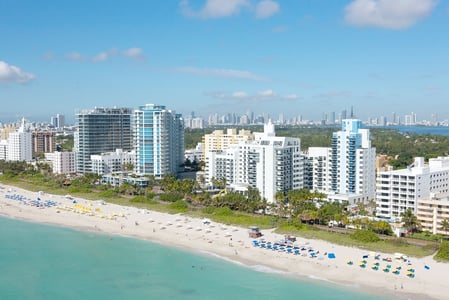

Miami has become one of the most active global destinations for cross-border real estate investment. International capital from Latin America, Europe, and Asia flows into South Florida at a scale that no other US market matches. But foreign buyers face a distinct set of tax, legal, and financing considerations that differ meaningfully from domestic transactions, including FIRPTA withholding, entity structuring decisions, and limited mortgage availability. This guide covers what you need to know before committing capital.
Ask a Florida attorney to check the buyer's status and the property's location before contracting.
For the broader US framework, ownership structures, financing, and closing, read our pillar guide: How International Buyers Purchase US Luxury Real Estate →
Our experience with international buyers
We have sold property to buyers of over 40 nationalities. Over the years, we have worked with many clients from Asia, Europe, Mexico and South America.
We started meeting clients in Europe when the euro was very strong. That worked. When the euro dropped, we focused more on Asia. For many years, we regularly traveled to mainland China, Hong Kong, Singapore, Taiwan, Seoul and Japan.
Anthony Guerriero is a former CPA and is very aware of the tax issues foreign buyers and investors need to consider. We offer a one-stop shop, coordinating with attorneys, bankers and accountants focused on foreign buyers.
IMPORTANT: Florida SB 264 Restrictions
Florida Statutes 692.201–692.204 restrict certain buyers and entities linked to the seven countries defined in the law. For individuals, domicile and US citizenship or lawful permanent residence matter; nationality alone does not decide eligibility. Separate provisions cover agricultural land, property on or within 10 miles of military installations or critical infrastructure, and broader PRC-related ownership restrictions. Exceptions, affidavits and registration requirements need individual review. Before contracting, have a Florida attorney check the buyer, ownership chain, parcel and any applicable court orders. US sanctions also require a separate review. Florida Statutes 692.201–692.204 OFAC
Why Miami Works for Foreign Buyers
Choose the property and review the building
Condo ownership and rental rules vary by building. Check association approval, entity ownership, minimum lease terms, rental frequency and local rental rules before committing. Available funds alone do not establish eligibility to buy or rent out a unit.
Florida has no individual state income tax
Florida has no individual state income tax. Federal income tax, property taxes and filing obligations can still apply. An entity's Florida corporate income-tax treatment needs separate review.
Homestead protection.
Homestead creditor protection and the property-tax exemption are different benefits with separate eligibility rules. Neither follows automatically from foreign ownership. Creditor protection has acreage limits and exceptions, including certain mortgages, taxes and assessments. Ask a Florida attorney about your ownership and use; the property appraiser determines eligibility for the property-tax exemption. Florida DOR Florida Constitution, Art. X §4
International infrastructure.
Miami is a gateway city. Banks here routinely work with foreign nationals. Attorneys specialize in cross-border transactions. Real estate agents (including us) conduct business in Spanish, Portuguese, French, and other languages. The entire ecosystem is set up to serve international buyers.
Where Foreign Buyers Are Purchasing
Brickell
Miami's financial district attracts Latin American buyers who want urban convenience and proximity to international banks and businesses. High-rise condos, walkable streets, strong rental demand. Entry points around $500K for one-bedrooms, $1M+ for larger units in top buildings.
Miami Beach
Iconic oceanfront living. South of Fifth (SoFi) is the ultra-luxury enclave. Mid-Beach and North Beach offer more space and a quieter feel. European and South American buyers dominate here. Oceanfront units start around $1M and climb to $20M+ for penthouses.
Sunny Isles Beach
Strong Russian and Latin American buyer presence. Modern high-rise towers, many with branded residences (Porsche Design Tower, Residences by Armani Casa, upcoming Bentley Residences). Direct ocean views at prices below Miami Beach.
Coconut Grove
More residential, family-oriented. Appeals to buyers seeking a neighborhood feel rather than a high-rise lifestyle. Mix of condos and single-family homes.
Coral Gables
Mediterranean architecture, tree-lined streets, excellent schools. More single-family homes than condos. Appeals to families establishing permanent residency.
Post-Surfside Due Diligence
Following the Champlain Towers collapse in 2021, Florida passed significant condo reform legislation. As a foreign buyer, you need to understand what this means:
Milestone inspections: Buildings over three stories and 30+ years old (25 years if near the coast) must undergo structural inspections. Some older buildings have failed or face expensive remediation.
Reserve requirements: Associations can no longer waive reserves for structural components. Many buildings are now collecting special assessments to fund reserves they previously ignored.
What to ask before buying:
- Has the building completed its Milestone Inspection? What were the results?
- What is the current reserve funding level?
- Are there pending or recent special assessments?
- What is the building's plan for compliance?
Your buyer's agent should verify all of this before you make an offer. Poorly maintained buildings with deferred maintenance are risky purchases right now.
Financing for Foreign Nationals
Specialist lenders may consider borrowers without US credit history, but approval depends on the borrower, documentation, intended use, ownership entity and building. Obtain lender-specific terms for down payment, reserves, rate, fees and project review before committing to a financed purchase.
Prepare passport and address evidence; income or business records; tax returns if requested; bank and investment statements; the source and transfer trail for purchase funds; and entity documents if applicable. Ask which records need translation. A pre-approval is not a final loan commitment.
Tax Considerations
Depreciation and allowable expenses, including mortgage interest, can offset rental income. Unused passive rental losses generally carry forward until usable, subject to passive-activity, at-risk and other limits; there is no general seven-year expiry. This can leave positive cash flow with little or no current federal income tax, but no 15-year tax-free period is guaranteed. The result depends on rent, expenses, financing, tax basis and ownership. A nonresident individual may need an IRC 871(d) election and Form 1040-NR to claim net-basis deductions. Property taxes and tax on sale may still apply. IRS Publication 527 IRS Publication 925
How depreciation and carryforwards can shelter rental income
Hypothetical example, in US dollars: a nonresident individual buys a $1,100,000 rental property for cash. Assume $825,000 of depreciable building basis and $275,000 of land. At an eligible 27.5-year GDS recovery period, full-year depreciation is $30,000. The model starts after the initial partial tax year, with no opening losses, and covers 15 full tax years.
Years 1–7: annual rent of $60,000 less $42,000 of deductible cash expenses leaves $18,000 of positive cash flow. Deduct $30,000 of depreciation and the tax result is a $12,000 loss each year. Assuming no other passive income absorbs it, suspended passive losses accumulate to $84,000.
Years 8–15: assume annual rent rises to $90,000 and deductible cash expenses to $50,000. Cash flow is $40,000; after $30,000 of depreciation, rental profit for tax purposes is $10,000. Apply $10,000 of carried-forward losses each year. Over eight years, $80,000 is used and $4,000 remains. Under these assumptions, this rental generates no current federal income tax during the 15 modeled years, despite positive cash flow.
Year 16: if the same figures continue, the remaining $4,000 offsets part of the $10,000 tax profit, leaving $6,000 of taxable rental income.
| Model year | Annual cash flow before income tax | Annual taxable rental income after carryforwards |
|---|---|---|
| 1–7 | 18,000 | 0 |
| 8–15 | 40,000 | 0 |
| 16 | 40,000 | 6,000 |
These are assumed figures, not a property forecast or guaranteed exemption. The example assumes rental-only use, a valid net-income election and timely filings, sufficient basis and amount at risk, and losses available under the passive-activity rules. Cash expenses are assumed fully deductible. Property taxes are included in expenses; home-country taxes and tax on sale are separate. Depreciation reduces tax basis and can affect tax on sale.
A nonresident individual's US rental income that is not effectively connected with a US business is generally taxed at 30% of gross income, or a lower treaty rate, without expense deductions. An eligible IRC 871(d) election can allow net-basis treatment at graduated rates. IRS §871(d)
Have the accountant confirm eligibility, the election statement, tax-ID requirements, returns and deadlines. Do not assume that buying through an LLC or making a loss removes filing duties.
FIRPTA generally requires the buyer to withhold 15% of the amount realized when a foreign seller disposes of U.S. real property. Exceptions and IRS withholding certificates can reduce or eliminate withholding. It is credited against the seller's tax; only an overpayment is refundable. Submitting Form 8288-B does not itself authorize reduced withholding. IRS approval and the applicable withholding and remittance rules must be handled by the closing and tax advisors. IRS FIRPTA IRS Form 8288-B
U.S. estate-tax treatment depends on domicile, ownership and treaty eligibility. For a non-U.S.-citizen who is not U.S.-domiciled, an estate return is generally required when U.S.-situated assets exceed $60,000, subject to the applicable rules. An LLC alone does not automatically remove estate-tax exposure. IRS Form 706-NA
Florida has no individual state income tax. Federal income tax, property taxes and filing obligations can still apply. An entity's Florida corporate income-tax treatment needs separate review. Florida DOR
Closing taxes and costs depend on location, price, financing and the contract. One percentage cannot describe both Manhattan and Miami. Request an itemized estimate, including any buyer-broker fee. Miami-Dade: $0.60 per $100, plus a $0.45 surtax unless the single-family dwelling exception applies. Florida DOR
The Buying Process
- Engage a buyer's agent: someone who knows Miami, works with international buyers, and will represent your interests (not the seller's)
- Get pre-approved: if financing, secure a pre-approval letter from a lender who works with foreign nationals
- Define your criteria: neighborhood, building type, budget, investment vs. personal use, rental potential
- Search and tour. We can conduct virtual tours if you're overseas
- Make an offer. In Florida, offers are made in writing with a deposit
- Due diligence: inspection period (typically 10-15 days) to review condo documents, financials, inspection reports
- Remote closing is often possible, but the attorney, lender and title or settlement company must approve the signing method in advance. Ask whether a power of attorney, consular notarization or another accepted method is appropriate. Allow time for appointments, authentication and original documents.
The entire process typically takes 30-45 days for cash purchases, 45-60 days with financing.
FIRPTA and Tax Considerations for Exit Strategy
FIRPTA generally requires the buyer to withhold 15% of the amount realized when a foreign seller disposes of U.S. real property. Exceptions and IRS withholding certificates can reduce or eliminate withholding. It is credited against the seller's tax; only an overpayment is refundable. Submitting Form 8288-B does not itself authorize reduced withholding. IRS approval and the applicable withholding and remittance rules must be handled by the closing and tax advisors. IRS FIRPTA IRS Form 8288-B
FIRPTA can matter at your purchase as well as your eventual sale. If you buy from a foreign seller, ask the closing attorney or settlement agent to establish the seller's status and any withholding obligation. Plan sale proceeds after withholding, rather than treating the gross selling price as immediately available cash.
Tax on sale depends on gain, holding period and ownership. Depreciation reduces tax basis and may affect the tax due on sale. State taxes may also apply; there is no universal 28% federal maximum for a foreign property seller.
A qualifying Section 1031 exchange may defer gain on business or investment real property. Buying another property alone is insufficient; personal-use homes generally do not qualify and strict timing and other rules apply.
Buying Through an LLC: What Foreign Buyers Should Know
An LLC can be the named buyer and owner on the deed in a residential transaction, adding a layer of opacity between the individual and the property. It can also help protect personal assets from the LLC's liabilities: Florida generally does not make members or managers personally liable for company debts solely because of that role. The extent of privacy and protection depends on the structure and facts. Personal guarantees or a person's own conduct can create personal liability. This privacy benefit does not eliminate required owner identification or tax reporting. Florida Statutes 605.0304
Resolve ownership before signing. Ask US and home-country advisors to compare liability, estate treatment, reporting, financing and eventual sale. Confirm that the lender and building accept the proposed owner. An entity should not be presented as a guarantee of anonymity or tax exemption.
U.S. estate-tax treatment depends on domicile, ownership and treaty eligibility. For a non-U.S.-citizen who is not U.S.-domiciled, an estate return is generally required when U.S.-situated assets exceed $60,000, subject to the applicable rules. An LLC alone does not automatically remove estate-tax exposure. IRS LLC IRS Form 706-NA
Treaty benefits depend on the particular treaty and the person's eligibility. An income-tax treaty does not necessarily provide estate-tax relief, and no estate treaty does not mean 0% estate tax. Have US and home-country advisors review the applicable text rather than relying on a passport-based tax table. IRS
Common Questions from International Buyers
Do I need to visit Miami to buy?
Remote closing is often possible, but the attorney, lender and title or settlement company must approve the signing method in advance. Ask whether a power of attorney, consular notarization or another accepted method is appropriate. Allow time for appointments, authentication and original documents.
Can I rent out my unit?
Condo ownership and rental rules vary by building. Check association approval, entity ownership, minimum lease terms, rental frequency and local rental rules before committing. Available funds alone do not establish eligibility to buy or rent out a unit.
Do I need a US bank account?
Helpful but not required. You'll need to wire funds for closing. Some buyers open US accounts; others wire directly from overseas banks.
What about property management?
We offer property management services for overseas owners: tenant placement, lease management, maintenance coordination. Many of our clients never visit their properties; we handle everything.
Why Work With Us
We've helped international buyers from Brazil, Argentina, Colombia, Mexico, Spain, France, the UK, Hong Kong, China and dozens of other countries purchase Miami real estate. We understand the unique considerations, from entity structuring to tax planning to managing properties across time zones.
We'll connect you with lenders, attorneys, and tax professionals who specialize in foreign buyer transactions. And we'll guide you through a market that rewards informed buyers and punishes those who don't do their homework.
Miami Office 1688 Meridian Avenue, Suite 700 Miami Beach, FL 33139 +1-646-376-8752
Related Resources:
- Complete Foreign Buyer's Guide to US Real Estate →
- Miami Home Buying Guide →
- Miami's Most Iconic Residential Buildings →
- Search Miami Luxury Condos →
- Miami Pre-Construction Condos →
- Miami Closing Costs Guide →
- Investing in US Real Estate: The International Buyer’s Framework →
NYC ↔ Miami International Buyers Guide
The full advisory framework: financing, tax, structure, exit.
Compare MarketsManhattan vs Miami
Tax structure, pricing, market dynamics, buyer profiles.
InventoryMiami Pre-Construction
Branded residences and friends-and-family pricing.
Frequently Asked Questions: Foreign Buyers in Miami
Can foreigners buy real estate in Miami?
Do foreigners pay higher taxes when buying or selling Miami real estate?
Should foreign buyers purchase Miami property in their own name or through an LLC?
Can a foreign buyer get a mortgage in Miami?
What is FIRPTA and how does it affect foreign sellers in Miami?
Are there any countries whose citizens cannot buy property in Miami?
Do I need to be in Miami to close on a property?
How long can a foreign owner stay in their Miami property?
When you're ready
Begin with a conversation, not a listing.
Manhattan Miami advises buyers and sellers across both markets. We start by understanding your goals, then we curate the right buildings, neighborhoods, and timing.
Start the ConversationReview estate-tax exposure and treaty eligibility
Treaty benefits depend on the particular treaty and the person's eligibility. An income-tax treaty does not necessarily provide estate-tax relief, and no estate treaty does not mean 0% estate tax. Have US and home-country advisors review the applicable text rather than relying on a passport-based tax table. IRS
Reviewed October 19, 2026
Active inventory: NYC new developments, Miami new developments, Billionaires' Beach Miami.
Related Resources
- Investing in Miami Real Estate: tax advantages, FIRPTA rules, and wealth-preservation strategy
- Miami Condo Market Report 2026: market data, pricing, and investment analysis
Get a curated Miami shortlist in 24h.
Tell us your budget, timing, preferred neighborhoods, and building style. We will send a focused Miami shortlist with live listings, relevant off-market context, and the trade-offs that matter.
Get My Miami ShortlistForeign-buyer cost calculators
International buyers can use the mortgage calculator, affordability calculator, Miami closing-cost guide, and real estate calculator hub to prepare financing, cash reserve, and cash-to-close assumptions before making an offer.