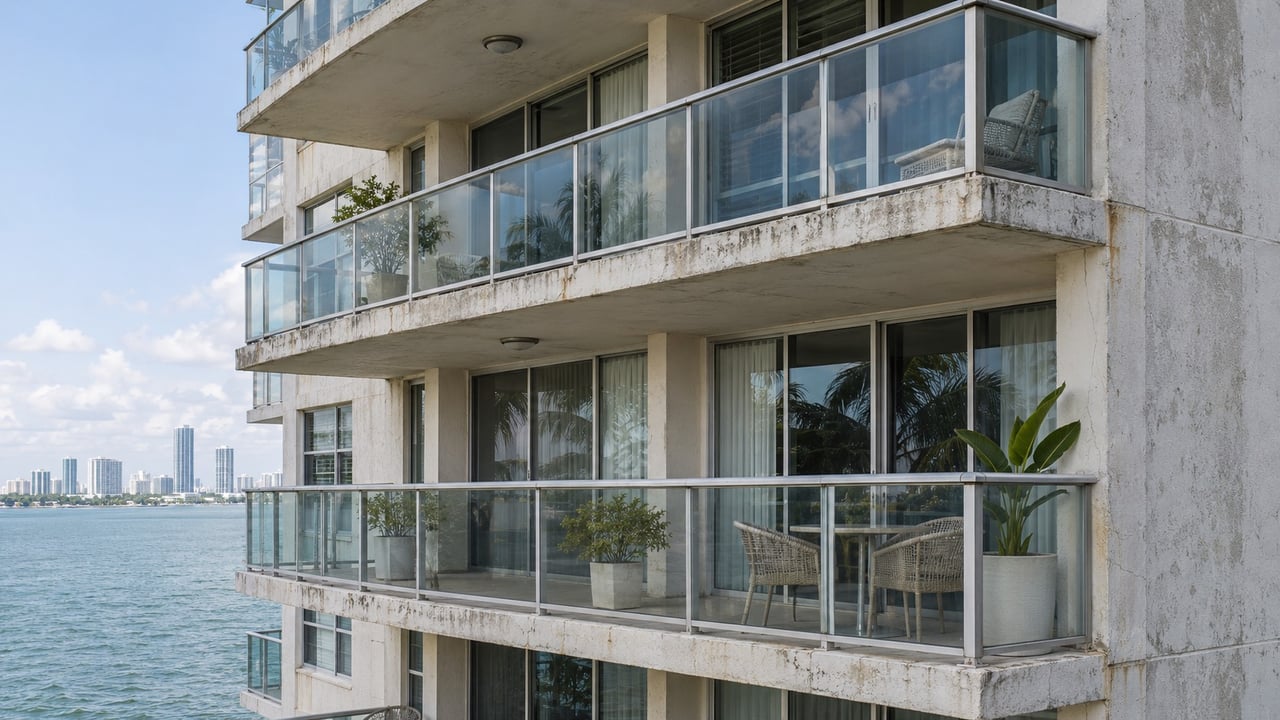
Before you buy a Miami condo, check three things: where the building stands on its milestone inspection or county recertification, what its structural integrity reserve study (SIRS) recommends for reserves, and how the cancellation clause in your resale contract works. Associations must send unit owners the inspector-prepared milestone summary within 45 days of receiving the report, and DBPR says owners can review and copy a completed SIRS. A buyer is not yet an owner, so ask for both before you make an offer.
This guide draws on the Florida Senate's statute pages, guidance from the Florida Department of Business and Professional Regulation (DBPR) and the Miami-Dade County recertification page, all read on November 7, 2026. The Sources list names the statute edition behind each link. It is a buyer's checklist, not legal advice.
The short version
- A milestone inspection is a structural inspection of an aging building. A SIRS is a reserve study of listed building components, with a recommended annual funding schedule.
- The milestone inspection threshold is three or more habitable stories for condominium and cooperative buildings. The SIRS threshold is condominium buildings that are three stories or higher in height.
- Miami-Dade runs its own recertification program. Its page puts condominium and cooperative buildings of three stories or taller, built in 1998 or later and within three miles of the coastline, on a 25-year first inspection.
- Florida requires residential condominium resale contracts to carry one of two statutory clauses. The second gives the buyer 7 days, excluding Saturdays, Sundays and legal holidays, to cancel by delivering written notice. Check which clause your contract uses before you count on that window.
- Check the report dates, the funding schedule and the repair status.
What is the difference between a milestone inspection and a SIRS?
| Milestone inspection | Structural integrity reserve study (SIRS) | |
|---|---|---|
| Question it answers | Is there substantial structural deterioration? | Which covered components need reserves, and what annual funding does the study recommend? |
| Source | Fla. Stat. 553.899 | Fla. Stat. 718.112(2)(g) and DBPR guidance |
| Trigger | By December 31 of the year the building reaches 30 years from its certificate of occupancy, then every 10 years. A local agency can set 25 years where conditions such as salt water proximity justify it. | At least every 10 years after the condominium's creation, for each building that is three stories or higher in height. |
| Who performs it | A licensed architect or engineer, who may lead a team of professionals. | Performed or verified by a licensed engineer or architect, a certified reserve specialist, or a professional reserve analyst. |
| What you receive | Unit owners get the inspector-prepared summary of findings. The full report is published on the association's website if it is required to have one. | Each inspected item with its estimated remaining useful life and replacement cost or deferred maintenance expense, plus a reserve funding schedule. |
| Red flag | A Phase 2 report with repairs not commenced within the required deadline. | No SIRS when one is due, or a budget whose reserve line does not follow the study. |
What does a milestone inspection involve?
Phase 1 is a visual examination of habitable and nonhabitable areas, including the major structural components, with a qualitative assessment of structural conditions. If the architect or engineer finds no signs of substantial structural deterioration, Phase 2 is not required. If substantial structural deterioration is identified, Phase 2 must be performed. It can involve destructive or nondestructive testing and must recommend a program for assessing and repairing the distressed areas.
The statute excludes surface cracks, sagging, misalignment, signs of leakage and peeling finishes from "substantial structural deterioration" unless the inspecting professional decides they are a sign of it. A reference to cracking alone therefore does not establish substantial structural deterioration under that definition. Read the professional's determination and recommendations.
At the state level the clock runs from the certificate of occupancy. Under the state formulas, a 1998 certificate produces a December 31, 2028 date at age 30, or December 31, 2023 if the local 25-year requirement applies. Those calculations alone do not establish a particular building's deadline, because the county schedule and building-specific notices come into play.
How does Miami-Dade County change the timeline?
Miami-Dade's recertification program began in 1975 and was amended on June 1, 2022. The county page lists these categories for existing buildings:
- Built on or before 1982: buildings that already had an initial recertification continue on the established schedule.
- Condominium and cooperative buildings of three stories or taller, within three miles of the coastline, built 1983 to 1997: recertification by December 31, 2024, then every 10 years.
- All other buildings built 1983 to 1992: recertification by December 31, 2024, then every 10 years.
- Condominium and cooperative buildings of three stories or taller, within three miles of the coastline, built on or after 1998: recertification when the building age reaches 25 years, then every 10 years.
- All other buildings built on or after 1993: recertification when the building age reaches 30 years, then every 10 years.
Take two condominium towers of three or more stories, each within three miles of the coastline, and assume the county's construction year matches the certificate-of-occupancy year. A 2008 tower reaches the county's 25-year age in 2033. A 2016 tower reaches it in 2041. As of November 7, 2026, neither has reached that age-based threshold, which does not mean nothing else is due. A covered condominium association also follows the separate SIRS schedule, which is measured from the condominium's creation. The county says it identifies the 1983 to 1997 coastal buildings through a GIS mapping project, so ask the building official how a specific property is classified.
When a building comes due, the owner receives a Notice of Required Recertification, and the reports must be submitted within 90 days from the date of that notice. The county also sends advance courtesy notices two years and one year ahead of the cycle. If a building fails to recertify in time, the county issues a citation with an initial $510 penalty, and accumulated penalties can reach $10,000 per violation.
The county report is prepared by a Florida-registered professional engineer or architect, who certifies that the building is structurally and electrically safe for continued occupancy. The county's guidelines include infrared thermography on electrical systems operating at 400 amperes or greater.
The county page also describes a separate rule for threshold buildings containing an exterior façade of structural sealant glazing. Under Section 2415.7.4 of the Florida Building Code, the owner must have the façade inspected every five years after installation and submit a written recertification report to the Building Official, prepared by a Florida-licensed professional engineer or architect. If the building you are considering has a glass curtain wall, first confirm whether this requirement applies to it.
Miami-Dade has 35 municipalities, and each municipality's building official has jurisdiction over building permitting, inspections and recertifications. The county's online recertification portal covers unincorporated Miami-Dade, where the folio number begins with 30. For a building inside a city, ask that city's building department for the status.
What must a SIRS cover?
DBPR lists eight elements: roof, structural systems, fireproofing and fire protection systems, plumbing, electrical systems, waterproofing and exterior painting, windows and exterior doors, and other elements over $25,000 or the inflation-adjusted amount, whichever is greater, that affect the building's structural integrity, as determined by the visual portion of the SIRS. DBPR says the Division must update that dollar amount annually based on the Consumer Price Index.
The statute requires the study to state each inspected item's estimated remaining useful life and its estimated replacement cost or deferred maintenance expense, and to provide a reserve funding plan or schedule with a recommended annual reserve amount. It may recommend that replacement reserves are not needed for an item with more than 25 years of remaining useful life, though it may recommend a deferred maintenance amount for that item. DBPR describes the baseline funding plan as one designed so the reserve account never drops to zero. Read the funding plan against the budget, because the budget must base the reserve amount on the most recent study.
For budgets adopted on or before December 31, 2024, owners could waive or provide less than the required SIRS reserves by a majority vote of the total voting interest. For budgets adopted on or after January 1, 2025, DBPR says associations may not waive them. An older budget history therefore deserves a close look.
The statute also lets a board take a limited step. For a budget adopted on or before December 31, 2028, if the association completed a milestone inspection within the previous two calendar years, the board, upon approval of a majority of the total voting interests, may temporarily pause reserve contributions or reduce reserve funding, for no more than two consecutive annual budgets, to fund repairs the milestone inspection recommended. This does not apply to an association controlled by a developer. A pause alone does not establish noncompliance, but it raises three questions: what is being repaired, what it costs, and who pays for it.
DBPR adds that an association whose reserves fall short of the SIRS funding schedule may need to levy assessments or secure a loan or line of credit to meet it.
Which documents should you request before making an offer?
Ask your broker to request these before an offer, not after. The first four come from the statutes above. The rest are suggested diligence requests, and a seller or association is not necessarily required to hand every one over before you sign.
- The most recent SIRS and any update. Check the completion date, the inspected items with their remaining useful life, and whether the funding schedule matches the current budget. The association must obtain an updated SIRS before adopting a budget whose reserve funding does not align with the most recent funding plan.
- The milestone inspection summary or county recertification report, if the building has reached its date. Ask whether Phase 2 was required and whether repairs have commenced. The statute requires repairs for substantial structural deterioration to be commenced within 365 days after the local agency receives a Phase 2 inspection report, and the local ordinance can set an earlier timeframe.
- The current annual budget and year-end financial statement. Compare the reserve line to the SIRS schedule.
- An estoppel certificate. Under 718.116(8), an association must issue one within 10 business days after a written or electronic request from a unit owner or the owner's designee, or a unit mortgagee or its designee, so the seller or an authorized designee of the seller can request it. It must itemize assessments, special assessments and other moneys owed, and those scheduled to become due, and it discloses transfer fees and open rule violations. An association waives the right to collect more than the certificate states from a person who relies on it in good faith.
- Board minutes for the last 12 to 24 months. Look for assessment discussions, litigation, engineer reports and insurance renewals.
- Special assessment history and anything proposed. Ask for the amount per unit, the purpose and the payment schedule.
- An insurance summary. The estoppel certificate includes contact information for the association's insurance, which is a starting point for asking about coverage, deductible and renewal date.
You can also check whether a building has reported its SIRS. DBPR publishes a SIRS Reporting Database of associations that submitted a completed reporting form. Only complete submissions are displayed, so a missing entry may mean an incomplete form. Ask the association.
Can you cancel a Miami condo resale contract?
Florida Statute 718.503(2)(d) requires a resale contract for a residential condominium unit to contain one of two clauses in conspicuous type. The first has the buyer acknowledge receiving the declaration of condominium, articles of incorporation, bylaws and rules, the most recent annual financial statement and budget, and the frequently asked questions document more than 7 days, excluding Saturdays, Sundays and legal holidays, before signing. The second makes the agreement voidable by the buyer, by delivering written notice of the intention to cancel within 7 days, excluding Saturdays, Sundays and legal holidays, after the buyer signs and receives those documents (the frequently asked questions document if requested in writing).
Under the statute, any purported waiver of these voidability rights has no effect, the buyer may extend the time for closing by up to 7 days, with the same exclusions, after receiving the documents, and the buyer's right to void ends at closing. A contract that does not conform to the paragraph is voidable at the purchaser's option before closing. Read which clause your contract carries. The first clause acknowledges receipt more than 7 days before signing, excluding Saturdays, Sundays and legal holidays, so check that the acknowledgment matches the actual delivery dates.
The SIRS and the milestone summary are not named in that list, so request them separately and do not wait for the clock to start. For purchases from a developer, the statute's legend gives the buyer 15 days after signing and receiving the items the developer must deliver. Confirm the terms of any contract with a Florida real estate attorney before you sign.
Which red flags justify a second opinion?
- Repairs for substantial structural deterioration that have not commenced within the applicable deadline.
- A SIRS that is overdue, or a budget whose reserve line does not follow the funding schedule.
- Reserve contributions paused with no clear repair plan behind the pause.
- A special assessment discussed in minutes but not yet levied.
- An inspection firm that also bid on the repair work without written disclosure. Florida makes the repair services contract voidable by the association when the required disclosure is missing.
Unresolved structural findings warrant review by an independent structural engineer. Reserve and contract questions may need financial or legal review. Arrange that review before any applicable contractual or statutory deadline.
What this means for price and negotiation
Investigate the estimated cost, funding source and allocation of any unresolved repair or assessment before you negotiate. Ask whether the money comes from reserves, a levied assessment or a loan, how much falls on each unit, and when it is due. The sources we reviewed do not quantify an effect on price, and none establishes a right to a credit, price adjustment or escrow. Ask your attorney what can be negotiated and how to document it.
Frequently asked questions
Does every Miami condo need a milestone inspection?
No. State law applies to residential condominium and cooperative buildings of three or more habitable stories once they reach 30 years from the certificate of occupancy (25 where the local agency requires it), then every 10 years. In Miami-Dade, covered coastal condominium and cooperative buildings built in 1998 or later reach their first recertification at 25 years. A building that has not reached its date has no age-based inspection due yet.
What is building recertification in Miami-Dade?
It is the county's structural and electrical inspection program, which began in 1975 and was amended on June 1, 2022. A Florida-registered engineer or architect certifies that the building is structurally and electrically safe for continued occupancy, and reports are due within 90 days from the date of the county's notice. Buildings inside one of the 35 municipalities answer to that city's building official.
Does a newer building avoid these rules?
Not entirely. Covered associations must complete a SIRS at least every 10 years after the condominium's creation, while the milestone and recertification schedules follow building age.
Can a buyer cancel a resale contract?
Where the second statutory clause applies and its cancellation period is still open, the quoted language permits cancellation by delivering written notice and does not state a reason requirement. That right ends at closing. Other rights depend on the contract and applicable law, so ask an attorney.
Where do I check whether an association filed its SIRS?
Use DBPR's SIRS Reporting Database. It lists associations that submitted a complete SIRS reporting form.
What does an estoppel certificate show a buyer?
It states the unit's regular assessment and paid-through date, itemizes assessments, special assessments and other moneys owed, lists amounts scheduled to come due, and discloses transfer or capital contribution fees and open rule violations. The reasonable base fee may not exceed $250 when no delinquent amounts are owed, and an additional $100 may apply for delivery within three business days.
Related reading
- Miami closing-cost guide
- Miami luxury condo buying guide
- Foreign buyers guide to Miami
- Best condos in Brickell
- Miami Beach condos for sale
- Miami condo market analysis
Sources
- Florida Statutes 553.899, Mandatory structural inspections for condominium and cooperative buildings (2026 edition; sections (2), (7) also read in the 2025 edition)
- Florida Statutes 718.112, Bylaws, including the structural integrity reserve study (2025 and 2026 editions)
- Florida Statutes 718.116, Assessments, including estoppel certificates (2026 edition)
- Florida Statutes 718.503, Developer disclosure and nondeveloper disclosure (resale clauses read in the 2025 edition; developer legend in the 2026 edition)
- Miami-Dade County, Building recertification
- DBPR, Milestone inspections and structural integrity reserve studies
This guide summarizes Florida law for general information and is not legal advice. The statute excerpts are from the editions named above, read on November 7, 2026, and they do not establish whether later legislation or local ordinances changed these rules. Local enforcement agencies may require the 25-year milestone schedule in the circumstances described above. Confirm the applicable inspection and repair deadlines for the specific building, and consult a Florida real estate attorney about a specific purchase.